Emanuel de Witte (1617–1692)
In earlier chapters we considered a number of dialogical issues arising out of the dual allegiance owed to civil and religious institutions, with the disparate traditions and ethical demands that those allegiances entailed, but only in passing did we take note of the existence of the family, the third member of the institutional triad that was, for centuries on end, responsible for the maintenance of social cohesion and of ethical standards in the West. In order to round out our inquiry into the relation of perspective to content, let us look brietly at a few images in which that aboriginal social group is reckoned with—for it goes without saying that the family antedates both Church and State and has served in various ways as the archetypal model for each. ..all the evidence available to us seems to indicate that in the long period of breakdown that followed the fall of Rome and the headlong decline of urban life the primary family relationship was to the clan rather than the intimate domestic circle of parents and children that the word famiIy brings to mind today.
By "family", Smith is referring to that social unit that is often called the "nuclear family", and according to a text quoted by Wikipedia, "Historical records indicate that it was not until the 17th and 18th centuries that the nuclear family became prevalent in Western Europe." So, one might ask whether the emerging images of the Madonna and Child in the 10th C. were really evidence to the contrary.

Codex Egberti (c. 980)

Benedictional of St. Aethelwold (c. 970's)
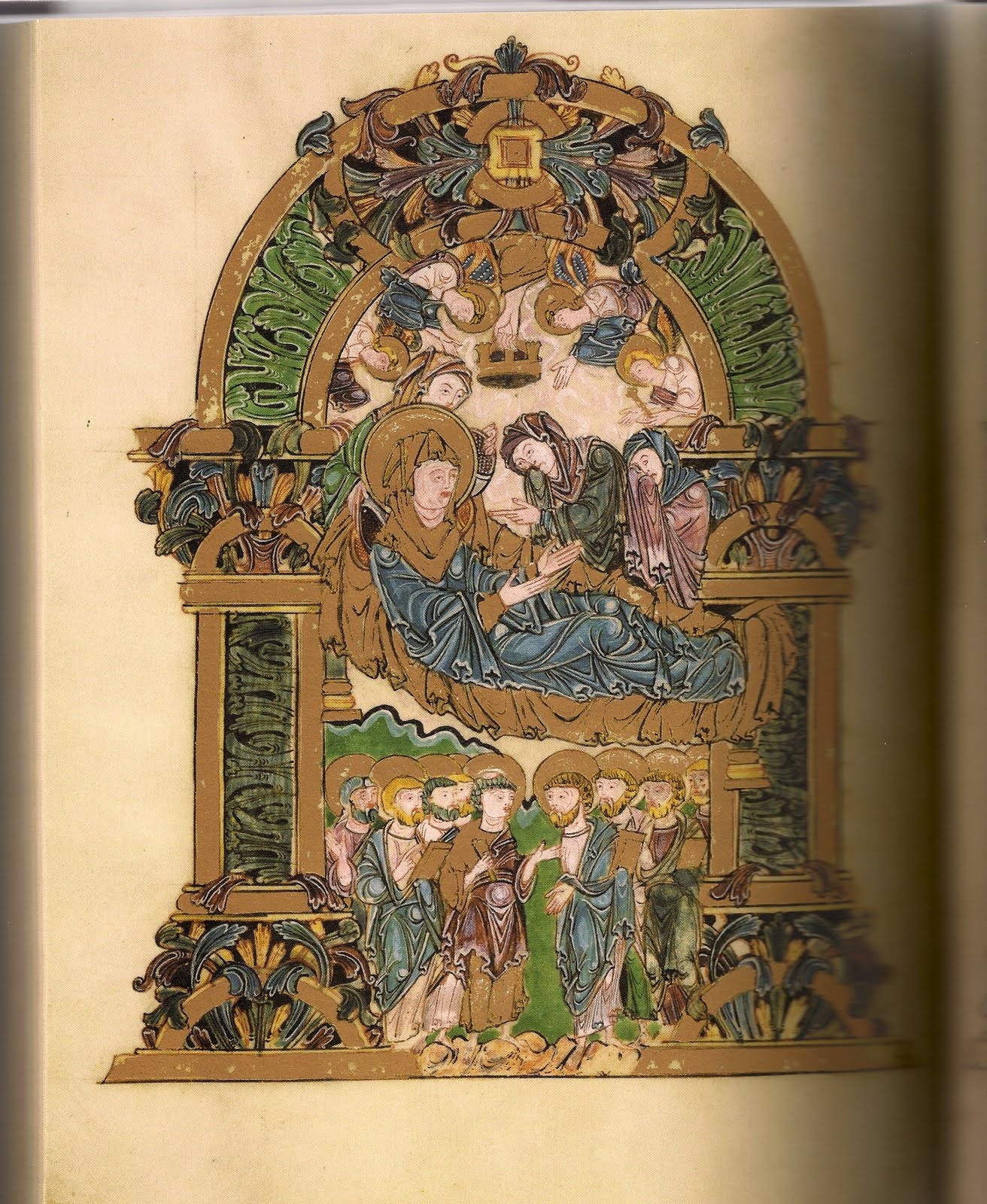
Benedictional of St. Aethelwold

Benedictional of St. Aethelwold
One of the most striking evidences of the renascence that began shortly before the year 1000 is to he found in the treatment of the Annunciation, a subject that had been as completely ignored during the Dark Ages as had been the Last Judgment. In works such as the Benedictional of St. Aethelwold and the Codex Egberti, scenes of the Nativity are celebrated with exuberant excitement, scenes that are in their very nature forward-looking and optimistic as nothing at all in the art of the immediately preceding centuries can be said to be.. Another indication of the fundamental change of outlook that occurred reveals itself in the rapid growth of what is sometimes referred to as “the cult of the Virgin,” ..... As early as the eleventh century there began to appear, in the East, mosaic and manuscript illustrations of the apocryphal life of the Virgin, in which special prominence was accorded her birth.

Rabbula Gospels, Ascencion, 6th Century
And yet, here we have a much earlier painting, that seems quite exhuberant to me, and has the Madonna front and center.

Santa Maria In Dominica, Rome, 8th C.
Here's another earlier image with Madonna and Child front and center. But, I've yet to find earlier examples of a nativity scene or an Annunciation. (or a lamentation, for that matter - and crucifixion is a rarity before the 10th C.) Another difference seems to be that sacred characters enter the 7th C. church to confront the parishioners, while in the 12C. church they confront each other, with the parishioners looking on as through a window or a proscenium in front of a stage.

Birth of the Virgin mosaic from Daphni
Between the eleventh and the fourteenth century the rendering of the subject was enriched and elaborated upon, as we can see when we put side by side the twelfth-century mosaic at Daphni and the frescoed version c. 1315 in the King’s Chapel at Studenica in Yugoslavia . 

The latter involves a much larger number of figures and “props,” by means of which (he painter conveys his sense of the expansive significance of a birth’s occurring within a diversified context. It would be a mistake, however, to interpret these changes as indicating any advance toward a perspectival art in the Brunelleschian sense, for though the fourteenth-century image is richer in anecdotal detail, it does not in the least suggest to us that we should “take our stand” with regard to a definable set of issues.
Studenica

The Nativity scene is part of a continuous frieze that includes other scenes to the right and to the left, all shown against the same background of discontinuous architectural fragments. The work lacks integrity even more obviously than does the Bigallo View of Florence and the Limbourg Temptation.

Although Giotto’s rendering of the subject is not one of his most compelling inventions, it possesses the formal, spatial, temporal, and psychological unity of a full-fledged Renaissance painting, even though it is earlier in date than the Studenica fresco.
At Studenica, we have the exact moment of the Virgin's birth, as two attendants are still holding the Anna's arms while a third is receiving the child. At Giotto's Arena Chapel, we have two moments of time since the child appears twice.

Giotto
Perhaps Smith was referring to a different nativity, Giotto's version of the birth of Jesus. But even there, the primary difference from Studenica is that the scene has been framed off within its own window rather than spilling into the space of the church.

Pietro Lorenzetti Birth of the Virgin, 1342
In the very fact that artists from the eleventh century onward increasingly painted Nativity images, it is plain to see that altitudes toward matrimony and parenthood were becoming steadily more affirmative. Yet all the while the Church continued to assert that chastity was the highest virtue, the celebate monk, nun, or priest the truest of Christians. The first artist who fully understood the ethical conflict in all this was Pietro Lorenzetti. In The Birth of the Virgin , his fixed triptych of 1342, he confronted the fact that it was necessary that the ecclesiastical frame of reference and the domestic or familial frame of reference be reconsiled with one another and with the lives and ethical committments of the Siennese Christians who were his fellow citizens.

How does Smith think this reconciliation is brought about?
First, by contrasting the roles of men (inactive, in a corridor that opens out to something like a palace courtyard) and women (active, within the contained space of the bedroom)
Second, "The three-dimensional colonnettes of the frame are directly related to the many slender shafts of which the church is composed --- Or may be regarded as a miniature version of the pinnacled, threc-doored entryway of the building itself, thereby associating entry into the church with entry into ihe life of the family"
Third, "Lorenzctti’s painting differs from the Studenica fresco in its use of perspective. Although there is some sense of central onvergence, only the lines in the floor come close to meeting in a single point, as is not at all the case with the haphazard, nonenclosing architecture of the fresco. Nevertheless, it is by means of perspective—by organizing his whole scene so as to create the appearance (though hardly the “illusion”) of there being a direct continuity between Anna’s bedroom and the space we occupy in the cathedral—that Pietro in effect compels us to recognize that something of urgent importance is happening here. We cannot simply “enjoy” the painting as an attractive formal composition on a flat surface, for if we comprehend anything at all of the picture’s message, we know that we are being urged to think seriously about the life of the family as it is led within the context of home, church, and city.
Would Smith seriously suggest, in contrast, that the Studenica fresco was intended to only be "an attractive formal composition of a flat surface"? Without a frame to separate itself from the space of the church, doesn't the Studenica fresco compell the viewer to feel like a member of the family up on the wall? The Greek church seems like a building where the public can share community with divinities, while the Italian church is becoming more of a place for personal experiences, like a movie theatre is today.
 Ghirlandaio Birth of the Virgin 1486-90
Alberti’s refinements would make no real difference, for the vanishing point is simply not a factor that matters. Lorenzetti’s image, for all its “inaccuracies.” is a far more stimulating and thought-provoking invention than Ghirlandaio’s large fresco of the same subject in Sta. Maria Novella, which I find to be a handsome but rather boring work of art

I also prefer the Lorenzetti version, but why? Accuracy, or inaccuracy, of Albertian perspective or figurative drawing, seems irrelevant.

It just seems to be that same kind of differnce (i.e. formal) that distinguishes an exciting tea cup from a boring one, which would not be cured by introducing some kind of narrative anomaly into the picture, or making it more like a sacred event and less like a secular procession. His portraits are so much more delightful
****** PART II ********
The dialogue concerning the relation of Church to family was not exclusively a preoccupation of the laity -- it should not surprise us to find that clerics, too, had to wrestle with the ethical and emotional concerns that arise out of familial relatedness. Surely the subtlest and most penetrating address to these matters was made by that subtlest of artists, Jan van Eyck, in his Madonna in the Church.

 Jan Van Eyck, Madonna in a church
Clearly it was van Eycks purpose to engage us in the subtlest meditation Of scale that is to be found in all Western art. The figure on our left is at once a virgin mother—a very young mother with an unusually small baby— and a regal queen wearing an enormous crown and appearing, because of the small size of her head in relation to her body, to be extraordinarily tall. As a stately queen, her stature dwarfs that of an average person in the same way that a thirteenth-century Gothic cathedral dwarfs all the other buildings around it and also the worshiper on its floor. Yet this tenderest of young mothers occupies the church as a housewife might occupy her living room or as the abbot occupies his bedroom. That largest of public gathering places has become the locus of an intimately personal encounter. In the richest and most provocative of all metaphors, the Virgin is shown to be queen, priestess, mother, and maiden all in one.
A similar painting of an out-sized Madonna visted Chicago in the past decade, and the effect certainly is charming. But doesn't feel especially subtle.
 The Master of 1499, portrait of Christiaan de Hondt
Since the Master of 1499 copied Van Eyck's "Madonna in a Church", Smith follows others who speculate that the above is a copy of what was originally the right wing that accompanied it in a diptych. Then, he notes that when viewed together, the similar sizes of the Madonna and the abbot would suggest that, rather than being a giant woman in a normal church, the Madonna is a normal sized woman in a tiny church
For his part, the clerical donor is shown to play the contrapuntal role of “virgin father —un père spirituel, a father-confessor who is himself engaged in an act of confession, perhaps, in the privacy of a domestic interior. Yet his jeweled miter and gilded crozier remind us of the role he normally played within, and only within, a stately church. Herzog suggests that the bedchamher is not merely that, but should also he seen as a thalamus, the mystical bridal chamber that symbolizes the relation of the sacrament of ordination to the sacrament of marriage. The bedroom contains many objects that can be interpreted as Marian symbols. I think it likely that van Eyck meant to aver that the fatherhood of a priest is as charged with familial implications as is the motherhood of Mary with ecclesiastical meaning. Like the Arnolfini bedchamber, this one, too, invites us to ponder the sacral significance of conjugal matrimony as well as the abbot’s mystical marriage to the Church—to consider the relation of all motherhood to that of Mary the Mother of God, to reflect upon the relation of all fatherhood, parental and priestly alike, to that of God the Father
"likely" or just "possible"?
The links to "conjugal matrimony" seem a bit thin.
BTW, Smith also makes a point of demeaning the quality of the work of the "Master" of 1499 when he was copying - and modifying - the original Madonna by Van Eyck.
The Master of 1499 probably captured no more of van Eyck’s magic in the right panel than he did in the left.
Which makes even weaker any speculations concerning whatever Van Eyck may have intended.
Like the Arnolfini bed- chamber, this one, too, invites us to ponder the sacral significance of conjugal matrimony as well as the abbot’s mystical marriage to the Church—to consider the relation of all motherhood to that of Mary the Mother of Cod, to retlect upon the relation of all fatherhood, parental and priestly alike, to that of God the Father, who is visibly present here as the smallest figure of all, the tiny baby, "For he that hath seen me hath seen the father.. I and the father are one" (John 14:9)
This is where Smith seems closer to being a thoughtful Christian than an art historian.

Finally, Smith shows us yet another variation of the Van Eyck piece, this one by Jan Gossaert.
The Madonna wing of the diptych is nearly the same

while other wing has been changed to fit a different donor, Antonio Siciliano

As you can see when they are placed side-by-side, Gossaert has added a south wall to the nave.
As Smith explains it, this shows, by contrast, how Van Eyck wanted the space of the two wings to be contiguous - as if the Madonna and the Abbot were in the same room, while clearly, Antonio Siciliano is completely outside a building as he kneels in the wilderness with his patron saint, Anthony.
Smith goes on to speculate how deftly Van Eyck would have coordinated the lighting in the Abbot's study if only he had painted it (instead of the clumsy "Master" of 1499 whose copy is all that is left)
But I'm more interested in noticing how different the Gossaert Madonna feels, with only a few changes in the architecture as well as the figure that make her feel more earthy and less etherial.
******PART III************

Altdorfer "Birth of the Virgin", 1525
Now Smith asks us to consider the sense of space in the above painting
"In the painting there are simply not enough orthogonals to enable us to locate a vanishing point, nor can we make even a wild surmise as to the floor-plan and elevation of this imaginary church. Composed of Romanesque, Gothic, and classical elements, they cannot possibly be fitted together into an intelligible whole, for they lie in ill-assorted planes and appear to be seen from a variety of unrelated vantage points. Baldass observes, without comment, that the building could not possibly have been built. Benesch remarks, in comparing the drawing with the painting, that in making the latter the artist “threw to the winds” his architectonic schema in favor of a “magical chiaroscuro.” Winzinger speaks of its being “pure poetry.”
Since Altdorfer was a practicing architect,how can we account for the impossible archtecture in this painting?
In one word, Smith's answer is "Luther"
Sensitive artist that he was, and practicing architect, Altdorfer was no doubt fully aware of the relation between the regularities of architectural design and the regulatory functions of the institutions that had traditionally erected great stone edifices in cities—aware, too, of the regulated and regulatory architectonics of Albertian perspective.

Roger Van Der Weyden, "Seven Sacraments", 1445
By way of contrast, Smith asks us to consider the above image, painted 80 years earlier
Van der Weyden’s painting constitutes a splendid defense of just what it was that Luther and the reformers were later to sweep aside: a pattern of ritual and sacramental observances, of beliefs, traditions, and practices, that shaped and affected the daily lives of the vast majority of fifteenth-century Christians. That pattern provided what has been called the “sacred canopy” of medieval life, providing it with meaning and security. Van der Weyden’s altarpiece was made for the Bishop of Tournai, Jean Chevrot, and explicitly affirms the all-encompassing role of the Church in measuring out, by means of sacramental observances at crucial points, the course of the Christian’s life from birth to death. The regularities of this Gothic church perfectly symbolize the regulatory authority of the Church as it dispenses the “means of grace” for the salvation of men’s souls.


Smith also notes the large figure of the family's father in the Altdorfer painting, as he is carrying bread and wine into the church, not to perform the transubstantiation that Luther found so repulsive, but to feed his family.
It is in the very nature of Protestant thought that none of the various denominations should have been able to bring forth a “doctrine of the Church,” a theoretical statement of the nature of the Church’s being. For the Platonic realists of the Middle Ages the issue posed no problem at all: for them, the idea of the Church was timeless and unchanging, a real entity, created and established by God himself, a house built upon the rock. The relation of that idea to a large and well-ordered stone building was so generally self-evident as to afford the medieval architect a splendid opportunity for the invention of formal metaphors that had the widest popular appeal. For the Protestants, however, with their strongly nominalistic cast of mind, their inclination toward identifying the Church with congregations of living members, and their rejection of both a personified “Ecclesia” and an association of the Church with the supernal personhood of the Virgin Mary, the realist bases of architectural symbolism were all but obliterated, as Altdorfer seems to have perceived.
...what emerged inevitably was the art of landscape painting—of which Albrecht Altdorfer was perhaps the very first practitioner, as well as being the chief inspiration of the school of South-German landscape painters that followed in his wake.
Wow... these two paintings do seem to summarize the last thousand years of European history. Though not a Christian, I am definately a Protestant in my attitude towards authoritative social institutions - even if I strongly prefer the Van Der Weyden painting to that of Altdorfer.

Altdorfer landscapes


And to make a good discussion even better, Smith then ties it into the history of music:
Though the Protestant church has not created a great architecture (with the exception of the Church of England), it has from the beginning placed an emphasis upon participatory music that has distinguished its forms of worship from those of the medieval church. One could argue that the Reformation itself was closely related to changes that were taking place in the art of music during Luther’s lifetime. The basic symbolism of polyphony (that is, of two or more voices pursuing their separate melodic lines within an agreed-upon rhythmic and modal framework, resolving their transient dissonances in tentative harmonies but pressing on always toward an ultimately harmonious and all-resolving conclusion) increasingly appealed to cultivated Europeans from the fourteenth century onward. But it entered an altogether new stage in its development with the inventions of josquin des Près and his followers—inventions that pertained to the driving dynamics of personal consciousness and to the articulation of nuances of personal feeling as earlier music had rarely done. Whereas only a devoted musicologist can take real pleasure in the music of Dufay and Binchois, that of des Prés, or of the court of Henry VIII, is plainly on our side of a watershed that lies in the vicinity of the year 1500. It was to just that new sense of dynamic musicality that Altdorfer alludes by introducing his great circle of fluttering angels who set the church to ringing and reverberating with their song, and by transforming the architecture of his church into a flickering, nontectonic array of varied shapes and chiaroscuro patterns. It was said in his own day that Luther had conquered Germany with singing.
********PART IV**************

Pieter Jansz Saenredam (1597-1665
During the century and a half that followed Altdorfer’s death, a new genre in the art of painting developed in the Low Countries—the interior architectural vista. The earlier examples, by artists such as the Steenwycks, are generally imaginary; the later examples, by Saenredam, de Witte, and Houckgeest, are mostly depictions of identifiable buildings. The genre has been studied at length by art historians (from Hans Jantzen and Dagobert Frey through Friedrich Heckmanns and Rob Ruurs) who, not surprisingly, have been mainly been preoccupied with problems of Raumdarstellung (space representation) and of surface composition. Their modus cogitandi has been much the same as John White’s: they have not asked why anyone should have wanted such pictures or what they may have meant to the artists who painted them and to the people who bought them. Harmen Van Steenwyck (1612-1656)

It is easy to regard these works as being hardly more than large picture postcards, souvenirs made for people no longer seriously concerned with religious matters. Witness the dogs, children, beggars, and miscellaneous bystanders one so commonly sees in such images. But if we understand church buildings to be primary symbols of the enduring reality of the Church, and if we concede to the artists a seriousness of concern that is commensurate with the intensity of their acts of looking, composing, and rendering, then we may see those paintings as religious affirmations.
Must "seriousness of concern" imply "religious affirmations"? Not to modern academics in science or the humanities. But in 17th C. Holland, yes, that does seem likely.
In addition to the "intensity of their acts of looking, composing, and rendering", do the resulting images feel any more related to religion than contemporary paintings of secular buildings?

Houckgeest,"View through an arcade", 1638
The above certainly has a quiet, airy, peaceful feeling - though it does feel a bit colder/harsher than the churches.

Gerrit Houckgeest (1600-1661)
The most engaging and provocative of the works of both Saenredam and de Witte are those in which the artist has chosen a perspectival vantage point from which he can win for himself a harmonious but asymmetrical composition created out of the regularly disposed elements of a great basilica, a composition that had little or nothing in common with the tectonic schema that the architect himself had invented as an appropriate symbol of the Church.

Gerritt De Witte
By such means the artists did not seek to deny or diminish the significance of the Church but only to establish a relationship of reciprocity between the mobile, self-conscious, self-centered individual and a collective ordering of things that could be represented by an enduring immensity (the painters had no interest in little parish churches), even though the nature of that encompassing immensity could not be grasped in its entirety. What mainly matters is the relation of the Church to praxis—to moral action, to the on-going demands of “life as drama”—wherefore there are some fifty pictures by de Witte in which a preacher is shown to be addressing his congregation, expounding the relevance of a particular biblical passage to daily decision making and to the modes of self-understanding with which his flock had to wrestle. 
If we compare any or all the church paintings with Brunelleschi’s tavolette, we see at once that the qualities of formality and of transcendency that Filippo associated with the Baptistry are virtually absent, while the openness, irregularity, and mobility he linked with the Piazza della Signoria have become central to the artist's religous concern
Just as with the missing original right wing of the Van Eyck diptych, Smith has an unfortunate habit of building an argument upon paintings that do not exist. (the above is his reconstruction of what the Brunelleschi lost tavolette might have looked like.) And though De Witte often depicts a preacher preaching, the other examples shown above do not.
But still - I do join him in suspecting that the genre of 17th C. Dutch church paintings was intended to be more profound than picture post cards are today, even if it's only because they feel that way to me today.

Emanuel de Witte
and now we come to this unusual painting which I believe inspired Smith to write this chapter.

It's unsual because it contains a painting within a painting, which actually exists as the piece shown above.

And that painting-within-a-painting includes the same family members who are depicted in the larger portrait.

As he compares the full-size church interior with the miniature included in the portrait, Smith notes that:
miniature: all three face the preacher
2.fullsize: lower left has standing man and woman seated and reading
miniature: lower left has standing couple and dog
3.fullsize: family at the lower right is in light
miniature: family at lower right is in shadow
So the miniature emphasizes the lower left, with the descending pattern of man-woman-dog, that is echoed in the family portrait as father-daughter-dog.
And, Smith notes that "Each of the figures occupies a position that is closely related to architectural patterns":
The church column behind that trio in the miniature is echoed by the column behind the daughter, seen through the door leading out to the garden. And beside that column is an arch in the garden that echoes the arches in the church, and that enframes the daughter's head, just as other arches in the portrait enframe the female portrait bust over the door and the mother's head. while:
The father is seated in a high chair somewhat as the preacher is elevated in his pulpit directly above. It is entirely appropriate that the father’s position should be the one that is least restricted by the domestic architecture and that is most clearly related to the larger order of things symbolized by the gathering of the community in the great church.
But isn't the father's head framed by the arches in church depicted above him, just as the daughter is framed by the doorway into the garden of love and the mother is framed by the hearth? We can also note that the mother and daughter are between the father and the church in the miniature, while that order is reversed in the fullsize painting. And in neither painting are they facing towards the pulpit. What might that mean?
Through the doorway at the left we see, between the column and the door jamb, a marble statue of a nude female figure that faces in the same direction as the daughter and that is drawn to just the same scale as are the men and women in the foreground of the church scene on the wall. The statue alludes, in all probability, to the popular notion of a “love garden,” introducing still another ethical and emotional factor into the dialogical argument of the painting. Although in most of de Witte’s church pictures both men and women are present, men generally predominate in the congregation and a man always occupies the pulpit. But in the Family Portrait there is no mistaking the fact that the women are in their own domain, their dominance being reinforced by the statue in the garden and the bust over the door. The interplay between the masculinc and the feminine, the dialogue between the public and the private, the institutional and the personal, is as striking as in van Eyck’s Madonna of the Chancellor Rolin, but the balance or thrust of the argument is altogether different.
To which, I might add that the preacher in the church painting cannot be seen. Has he already left or not yet arrived?
This does seem to be a female-centric world, despite the size and position of the father, and his self-indulgent grape-picking gesture, which Smith relates to a contempory book of self-improvement that recommends:

"how to manage matters not by intellect but with sensitivity, not grasping too tightly or pinching too sharply but recognizing that in all things there are certain rules and laws that must be obeyed by anyone who would be a deft or clever man -- one should seize the pot by the handles, beautiful fruit by the stem, dirty scoundrels by the neck; etc"
And nobody in the portrait seems to be enjoying themselves except for the frisky little dog. They seem weighed down by their expensive clothing, and father seems to be bursting out of his (i.e. he doesn't need to be eating any more grapes!) The two females seem tense and the father seems tipsy.
I'm not surprised that not a single other portrait by De Witte can be found on the internet.
In his church interiors no less than in his one family portrait and in his one domestic genre scene, de Witte declares that, on the one hand, buildings should remind us that “There is in every matter certain rules and certain laws”, but, on the other hand, those rules and laws should not be regarded as constituting a rigid code but rather a flexible and infinitely variable framework within which each of us must exercise wise judgment, good taste, and the "hardigheid" that becomes the canny man"
Which Smith asks us to contrast with the following:

Antonio or Piero Pollaiuolo , Annunciation, 1470
and then draw the following concusion to the chapter:
Such a relationship could hardly have existed in Brunelleschi’s mind between Sto. Spirito and the Pitti Palace. The institutional order to which those buildings refer, and which they sustain, is symbolized, insofar as domesticity is concerned, by Piero (?) Pollaiuolo’s Annuriciation. The painting involves a dialological relationship between male and female, active and passive, openness and containment, that is reminiscent of Pietro Lorenzett,’s Birth of the Virgin. Behind the mobile and gesticulatory figure of the angel a busily articulated corridor pulls us urgently toward the open sky and a far horizon, while the windowless bedcharnber behind the Virgin seems spaciously tranquil by comparison. The elaborate perspective does not define an interior the figures occupy, for they constitute a frieze in the immediate foreground in a truly trecento manner. As in so many other perspectival paintings, the grids serve to establish a lawful frame of reference, an almost legalistic context, a costruziofle legittima, within which we are invited to understand the meaning of Gabriel's message. Through the window over his head we can see an adjoining balcony from which the owner of the palazzo (surely not the carpenter Joseph) could have had a commanding view of the Tuscan countryside and of the walled city of Florence—its shape and skyline clearly dominated by the Duomo and the Palazzo Vecchio.
And yet... De Witte's family portrait does indeed provide a grid on the floor and follow single point perspective just a rigorously as Pollaiuolo's Annunciation, so if it does suggest a "flexibility" towards law and order, that suggestion has to be deduced from something else.
For me, it's suggested by the awkwardness of the figures and the room. It feels like the storage room of an antique dealer, inhabited by an unhappy family who were rich, have fallen on hard times, and are still trying to keep up appearances. But that's probably just because De Witte was not very good at doing family portraits. (so he never got another such commission in his very long life)
I wish Smith had chosen a better painting, but how many examples can there be that combine interior views of a church and a home? Which is why this entire chapter is problematic, while it's too bad he didn't offer more discussion of domestic interior views that are more prolific in Dutch painting.
The Pollaiuolo Annunciation feels awkward for me as well -- as if he had finished painting the two figures in the foreground, and then tried to frame them in an architectural setting. I wish I could find a better image of it on the internet, but it does not seem to have a very large fan base.