Art practice is now understood primarily as a vehicle for the reflection of modes of reception and theory rather than as a mode of making…Paul Crowther
It is improbable that more nonsense has been written about aesthetics than about anything else: the literature of the subject is not large enough for that (Clive Bell)

Index

*********************
*********************
The Index is found here
*********************
*********************

Wednesday, December 23, 2020

NORMAN BRYSON : Word and Image, Chapter Three


This is Chapter Three of  NORMAN BRYSON's  : Word and Image,  French Painting of the Ancien Regime. (1983). Text in Yellow are quotes from the author, Text in Orange are  quotes from others.


***************************************************************************


Watteau; The Embarkation for Cythera (detail), 1717

WATTEAU and REVERIE


Poussin, Ecstasy of St. Paul, 1649-50


LeBrun's committment to the discursive image always tended towards extremism. In his Discourse on Poussin 's Saint Paul in Ecstasy, we find him converting into allegory a painting that does not seem allegorical at all. Of the three angels who appear with the Saint, the first, LeBrun claims, is to be read as effective or total grace, the second as aiding or intervening grace, and the third as elective grace; the sinking leg of the saint represents his sin, while the green robe he wears signifies his hope of raising himself above sin through works, and his red mantle signifies his ardent charity.


This painting may not seem allegorical, but it does feel literary.  This is not Paul of Taurus, the Jewish tentmaker who traveled throughout the eastern Mediterranean preaching the gospel.  This is the St. Paul who wrote books of scripture and lives on within their pages -- and this painting might serve as an illumination for one of  them.  Regretfully, (or more like shamefully) the Louvre has decided not to offer high resolution images on its website - so not much can be said about this work.


  Such adventurous exegesis was not without its critics. Already within the Academie, the Conference sur L''Expression met with some resistance: LeBrun was accused of having plagiarised his ideas from medicine - 'on a pretendu qu'il avait tire les idees de l'illustre M. de la Chambre'; at the Discourse on Saint Paul , there were 'des personnes . .. qui parlerent de cet ouvrage diversement'; and even Felibien, the spokesman for the earliest ideals of the Academie, rejecting LeBrun's complex systematisations, wrote that 'for the movements of the body engendered by the passions of the Soul, the painter can learn of them in no better way than by consulting nature'. Actual assault on the discursive image comes from dangerous opponents: from Pierre Mignard, LeBrun's lifelong rival, who rather than take second place to LeBrun refused to join the Academie at all, and who became its Director in 1693 once LeBrun had fallen from political favour; and from Roger de Piles, leader of the ascendant rubeniste party, and spokesman for a new and rapidly developing anti-academic tas te. J Mignard's first objection was that pursuit of the discursive image had led LeBrun into impersonality: since LeBrun's work was literary and not painterly, it was natural that he should wish to delegate the execution of his paintings to assistants; but then they were no longer by LeBrun (the contrast here was with Mignard 's own enormous but never delegated project of decoration in the cupola at Saint-Cloud). Mignard next objected that LeBrun's allegories were both tedious and obscure: 'Having carefully read your pamphlets,' Mignard writes, 'one finds nothing in your work corresponding to what is written. ' 


Pierre Mignard, "Christ and the Woman of Samaria" , 1681


Mignard, cupola of Val-de-Grace, 1663


It's interesting that one academician of that time would accuse another of  "work that was literary and not painterly".  I wish that Bryson had shared the exact quote. It's an especially fascinating critique since Mignard's work appears no less literary than LeBrun's .  He creates stages with actors, not paintings with a  painterly life of their own. -- even if he was less concerned with allegorical figures.                               

The charge of obscurity is repeated by Roger de Piles: in his account of LeBrun he complains that 'his pictures were like so many enigmas, which the spectator would not give himself the trouble to unriddle'. Roger de Piles adds to this the charge of dogmatism- there are several ways, he maintains, and not just one way, of representing a particular passion; and the charge of artificiality - '[LeBrun] studied the passions with extraordinary application, as appears by the curious treatise he composed on them, which he adorned with demonstrative figures; nevertheless, even in this, he seems to have but one idea, and to be always the same, degenerating into habitude, or what we call manner. '


These quite reasonable objections from that time lead me to wonder whether LeBrun's system of expressions was used only by him - and whether his approach was marginal to the academy even if politics had placed him at the top.


The most effective theoretical attack on LeBrun's project arrives, however, obliquely, through the quarrel between rubenistes and poussinistes (which the rubenistes were eventually to win).  The quarrel itself is too vast a subject to examine in detail here, and there is an important sense in which the quarrel is in any case irrelevant to the issue of the discursivity or figurality of the image. Even in his most vigorously rubeniste polemics, de Piles insists on the importance to painting of the parameter of expression. Evaluating the 'expressivity-level' of the Masters, he awarded LeBrun a score (he was a great believer in scores) that is just below Rubens and Raphael, and rather higher than Poussin.  It is vital to his argument that Rubens be seen to succeed in expressions as in every other aspect of painting, and there is no question that expression is to be downgraded as a parameter, only that colour is to be upgraded. With respect to colour, Poussin's score is shockingly low.  Yet obviously, if Rubens is to be elevated to equality with Raphael, success in colour must count for at least as much as success in expression, and this entails a reorganisation of priorities in which expression is effectively downgraded. The priorities of the Academie in 1667 can be tabulated, from the Discourses delivered by LeBrun, Bourdon and Philippe de Champaigne, as follows:


LeBrun
1 Disposition
2 Design and proportion
3 Expression of the passions
4 Perspective

Bourdon
1 Light
2 Composition
3 Proportion
4 Expressions
5 Colour
6 Harmony

Philippe de Champaigne
1 Composition
2 Grouping
3 Expression
4 color and chiaroscuro

Noting that none them  list drawing, anatomy, or anything like innovation.

Also noting that none of these criteria could be called spiritual - and don't seem to relate to either Classical or Christian  ideals.  This was apparently the kind of art school that focused on a harmonious composition and figurative expression. Surprisingly,  only one  includes perspective.

For LeBrun, colour is not a consideration at all; but for those who do admit its importance, colour and expression are adjacent priorities, so that if rubeniste taste gains a following, expression will be demoted. The triumph of the rubenistes entails an immediate adjustment within the figural and discursoive components of the painterly sign, with the discursive in full retreat.


Yet the attack is wider than this, for it threatens the whole metaphysical foundation of the painterly sign as LeBrun had conceived it. 'Reason tells us that the figure is in the objects; only a vague sentiment tells us that it is coloured.'  That is Descartes' position on colour, and LeBrun gives it the usual support he grants to Cartesian thinking. He sees colour as a parasitic quality: 'if the merit of something is the greater, the less it depends on another thing foreign to it; it follows that the merit of design (dessin) is infinitely above that of colour'. LeBrun's argument is that design must be a logically superior category, since there can be design without colour, but there cannot be colour without design. Whether this is true is of course, debatable; certainly de Piles disagreed, insisting that in nature colour and light are inseparable. LeBrun's determined philosophical tone is significant. It tells us that the issue of colour directly concerns his policy of Cartesian painting. Colour is not a quality of mind or reason, and is in fact unnecessary to reason's perception of the world, which operates quite efficiently in monochrome. Even loftier is this:

It must be considered that colour in painting cannot produce any hue or tint that does not derive from the actual material which supports the colour, for one would not know how to make green with a red pigment, nor blue with a yellow. For this reason it must be said that colour depends entirely on matter, and, as a result, is less noble than design, which comes directly from the spirit. '


Yes - specific mineral or biological pigments are necessary for color - but aren't the properties of paint, brush, and canvas necessary for design ?  (evidentially not  for LeBrun who, like the conceptual artists of today,  hired others to execute his paintings)


Colour is degrading to the image because of its materiality, and painting ought to transcend its material base - its ignobly non-spiritual signifier. The rubeniste challenge threatens the whole Cartesian conception of the painterly sign. LeBrun's dependence on Descartes has naturally been the subject of much discussion .. , It is rare to find so close a connection between painting and philosophy, and for once the connections the art historian can make between the two do not have to be mysterious or 'epistemic'. LeBrun could hardly be more obvious in his reliance on Descartes' work: whole sections of the Traite sur les passions de l 'a me are transcribed almost verbatim into the Conference sur ['expression, and it is to Descartes that we owe not only LeBrun's classification of the passions, but in some instances the actual signs by which the passions are to be recognised. Yet the whole idea of a Cartesian painting is strange, because strictly speaking it cannot exist. In dualism, the self is no longer resident in the physical universe; yet all that painting can represent is the world of extension where the self precisely no longer resides. The ego, like the deity, cannot be represented; only at the pineal does the ego penetrate the physical world, and LeBrun's fascination with dissections of the brain proves that he was well aware of this reduction of the painter's scope .


The rationalization of spirituality is an ongoing project in the modern secular world - to be either dutifully joined or passionately rejected.  It's not especially rational or spiritual -- and  Descartes' pineal gland was an especially kooky notion.


But in another sense Cartesian dualism very obligingly serves LeBrun's idea of the mission of the Academie to reform painting in France. One of the axioms of the reform is that in the grand style, the physical surface presented by the universe must be transcended: to copy that surface is servility, the province of the little masters, mere metier. LeBrun and Felibien took from Poussin the vision of a French painting that would discard the outward encumbrance of matter, and rise beyond it into a province exclusively de l'esprit. In perfect form, this painting would not be physical at all, but the communication of ideas from one consciousness to another across an image that is altogether transparent; the image as a channel of transmission with minimal redundancy or 'noise', much like the  Word as understood by the Grammar of Port Royal.  In the absence of such a utopian possibility, the channel must descend to physical signs, but in so far as these directly correspond to ideas, pure transmission is still maintained. 


LeBrun's dream to "discard the outward encumbrance of matter" would eventually be realized in the proliferation of conceptual art by the art academies of today.


LeBrun's insistence on the image that fully yields up its discursive content entails a certain theology of the sign: as mind is to extension, so signified is to signifier. And for this reason Roger de Piles could not have chosen a more precise target-point through which to attack LeBrun's project than colour; for colour is the aspect of painting least susceptible to confiscation by the signified. As LeBrun's pronouncements show, colour is precisely the parameter where the image ceases to be discursive, spiritual, transcendent, and falls into a degraded materiality which it had been the ambition of LeBrun to overcome. Moreover, de Piles fully understood the rhetoric of the Academie, which, despite its theoretical and intellectual flavour, was then, and long remained, committed to a way of speaking about painting that relied heavily on the use of exemplary figures as the principal counters in debate.


We've been shown whose color  Roger de Piles preferred, but we've not been given any of his explanations regarding specific paintings.

Renoir, Two Sisters (detail), 1881

Here's a painting in our local museum, and the first  thing that I will ever say about it is "Wow - the color!"  And it seems to have been painted to draw just that kind of reaction.   I didn't really notice that it depicts 'two sisters'  until  today. Is that  attention-grabbing effect what de Piles had in mind ?


Ingres, Apotheosis of Homer, 1827


 It is hard for us to reconstruct this rhetoric, though the task is quite essential, if only because without reconstructing the Acadernie's mode of discourse we shall never discover why the Apotheosis of Homer is so central in the work of Ingres, or what is meant by its very precise and very enigmatic placement of Raphael, Pindar, Racine, Shakespeare, Moliere, Longinus, Poussin, and the rest (Rubens is the great absentee). The nearest contemporary analogy would be a coded diplomatic or political language, like that of Pravda (or Pravda in a certain Western myth), where abstract issues are not directly addressed, but by working out the implications of a hierarchy of figures, and by following who has been elevated and who denounced, one can reconstruct an ideology which it is the exact purpose of such a language to obscure. In Rubens, de Piles found precisely the counter through which to issue the challenge of the subversive signifier. And without Rubens, it is possible that the signifier might have long continued as the vital but unmentionable component of the painterly sign. Certainly the early colour-debates, which lacked this central counter, were quickly recuperated: in 1671, during - significantly - a three-month absence from the Academie of LeBrun, Blanchard delivered a defence of colour which, despite its revolutionary potential, soon sank without trace; the official historian of the Academie writes of 'discourteous visitors to the public debates' who spread 'Lombardic maxims' (pro-colourist ideas); they were soon silenced. But with 'Rubens' in the balance against 'Poussin', the assault of the signifter on the signified could proceed apace, and the main issues - recomposition of the sign, redefinition of the relation of the image to the world and to the text - could be conveniently concealed beneath the acceptable disguise of a work of canonisation. After the theory of the subversive signifier, the practice: Watteau.


"Subversive signifiers" can be found before, during, and after the career of Charles LeBrun.


School of Fontainebleau, "Diana the Huntress", 1550

The origins of Watteau might better be sought 
in empathy for the School of Fontainebleau
rather than opposition  to the academy of Charles LeBrun.


Watteau; The Embarkation for Cythera (detail), 1717


Watteau 's painting has always, from the beginning, enjoyed a special relationship to text. Already in 1719, the first biography, in Italian, had appeared. Watteau's friends during his lifetime tended to become devotees, and after his death, biographers. Antoine de la Roque, the influential editor of the Mercure de France, wrote his detailed obituary notice in 1721, Jean de Jullienne his personal memoir in 1726; Edme Gersaint added another memoir in 1744, e and in 1748 the Comte de Caylus, another personal friend, delivered a lengthy discourse on Watteau to the Academie. These documents between them compose a remarkably detailed record, and in them is visible a tendency with a promising future- people who have not written on art before may write on Watteau: Watteau catalyses writing. The beginnings of what is almost a minor literary genre, with its own specialised rules, are to be found in two lyrical and hyperbolic poems of 1736 by the Abbe de la Marre, 'L'Art et la Nature Reunis par Watteau' and 'La Mort de W atteau, ou la Mort de la Peinture'. For a century the genre is fairly dormant, during a rapid decline in Watteau's reputation; but in three articles by Paul Hedouin in the 1830's a new flowering begins. The articles have very little to do with Watteau and nothing at all to do with painting, but they unveil what is to become the characteristic form of Watteau writing, in which the paintings are used as the pretexts for verbal extravaganza. Baudelaire is a major contributor to the genre; and Watteau is taken up by Banville, Gautier, Nerval and the other members of the rue de Doyenne group, who turn him into a cult.


No ! -- those articles have everything to do with Watteau and painting.  It was Watteau's paintings, and possibly only Watteau's paintings,  that provoked the enthusiasm to write  them. (eventually Bryson will say something to the same effect).  


I looked for a long time through the gate. It was a park in Watteau's taste; Slender elms, black yews, green bower, Paths combed and drawn with a line, I went away with a sad and delighted soul; Looking at it I understood that; That I was close to the dream of my life. That my happiness was locked away... Theophile Gautier, 1838


A poetry as unique as it is delightful, the poetry of sumptuous ease, of the colloquies and songs of youth, of pastoral recreations and leisurely pastimes, a poetry of peace and tranquility amid which the movements even of a garden swing die faintly away, the ropes dragging in the sand ... it is a smiling Arcady, a tender Decameron, a sentimental meditation, a dreamily distracted courtship; words that soothe the spirit, a Platonic gallantry, a leisure given over to things of the heart, a youthful indolence; a court of amorous pre-occupations, the tender teasing courtesy of newly-weds, leaning towards each other over their linked arms; eyes without hunger, embraces without impatience; desire without lust, pleasure without desire; a boldness of gesture orchestrated like a ballet for the occasion; feminine ripostes, of the same nature, tranquil and disdainful of haste in their assurance . .. Goncourt  brothers: French 18th Century Painting (1859-1879)


Visible, fictional, there they are before us. In the mirror of their false presence, those symmetrical faces, of 'never' and 'always', recognise each other and reconcile themselves to each other. Doubtless they have always been like this; doubtless they have never existed. Are they alive? In the streams, seemingly immobile, one sees the imperceptible current flow, which carries everything away ... Already they are leaving us; they [Watteau's figures] abandon us; tender and distant, unaware of our presence, they gently pivot and, step by step, depart. ... Rene Huyghe, 1950


Note that both Gautier and Huyghe express the sadness of loss.  They must return to their daily lives - they cannot live in Watteau's imaginary world forever.  BTW - I'm not sure that Gautier was writing about a Watteau painting except as a reference to an actual gated park that he had been walking past.  There were no Watteaus in the art museums where I  grew up, but I had a similar feeling for the paintings by Corot.  He really milked a dreamy longing for Arcadia that is especially attractive to a young life  filled with anxiety, uncertainty, and confusion.  They feel so deep, profound, ancient, timeless.


Corot, "Festival of Pan",1855-60, Taft Museum, Cincinnati
Even now my heart longs for this painting.


        Claude de Lorrain, "Apollo and the Muses", 1652
Here's a similar piece contemporary with LeBrun.


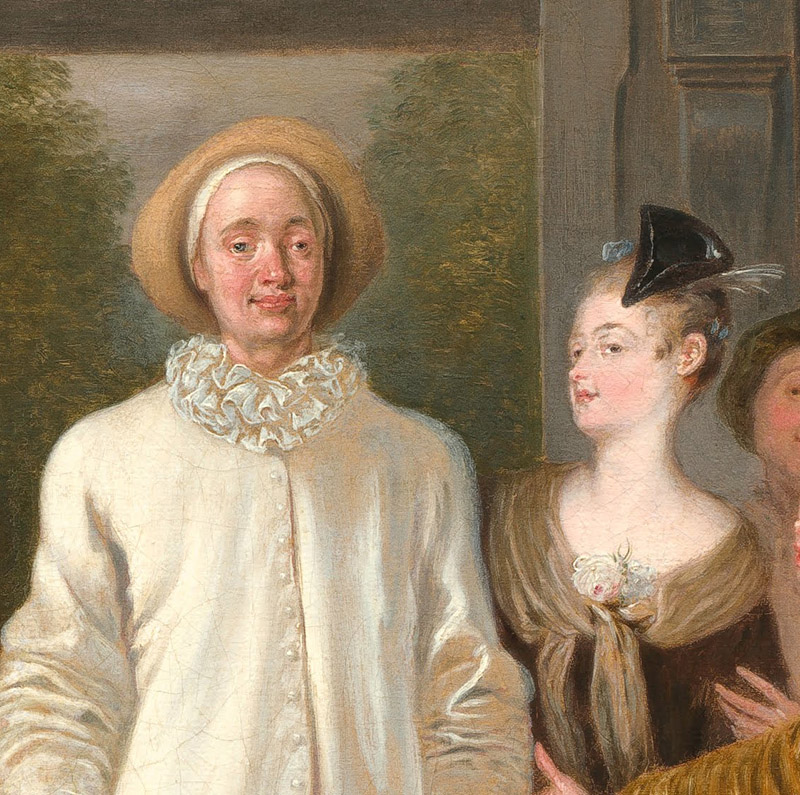
Watteau, Pierrot ( or Gilles ), 1718-19

Bryson then compiles what he calls  the 'myths' about Watteau, drawing from many more written responses like the three quoted above. In a melancholy variation, "Watteau, permanently dying,  tries to draw vitality from his figures by osmosis.  He is the fool, whose comedy barely conceals a sadness that is profound, though not bitter.  He is Pierrot, he is Pagliacci, above all he is the portrait of Gilles"

I would like to read some more original commentaries along with whatever analysis Bryson would append to them.  But I have no interest in Bryson's compilations  put into his own words - primarily to demean them: "Painful though it always is to dissect the habitual discourses that serve to stabilize our view of  the art of the past, in this case the pain is greater because genuine insight is entangled in the general confusion.....observations of value are mingled promiscuously with the banality of stereotypes"


********


By way of a very long digression, 
here is what Elie Faure (1873-1937) 
had to say in his History of Art.


Note: all of the Watteau paintings embedded in this  section were included in Faure’s book.  The works by other artists like Goujon and Poussin were chosen by me.

Jean Goujon, Fountain of the Nymphs, 1550

The Rationalist Passion


The sun which rose from the depth of Lorrain’s canvas, amid their severe architecture, was Watteau. An autumn sun lighting up russet foliage.  A profound sigh of nature, delivered from a corset of iron, and at the same time dying from having been so long compressed, and giving herself up to the desires of the poet with the concentrated and fiery heat of a flame which is burning out. In reality they are still there, the severe architectures ; the fate of the regency installs itself in the great palaces. Saint Simon and Montesquieu, iconoclasts, both belong by birth and by activity to the castes which guarded and cared for the icons; and the teaching of the school, until the end of the century, and beyond it, will reign officially. Its aspects are controlled by the mind.

For better or worse, Faure casts a wider net into the French civilization of that time.  Bryson has yet to mention Claude Lorrain at all - but Faure puts his name right into the first sentence of his essay about  Watteau.  And it does seem to belong there.  Whether Watteau had ever seen his paintings or not, the  arcadian world depicted by Lorrain is brought to life by Watteau, and it distinguishes him from his teacher, Gillot.


Poussin, Echo and Narcissus, 1627


When Poussin gave order to his ideas and his images, he could not purge his flesh of the memory of the forms and the nymphs whom Jean Goujon and Ronsard encountered in the woods. When Watteau came forth from the alleys to explore these woods, full of forms and of shadow, the will of Poussin and the harmony of Racine penetrated there with him. He arrived, with the freedom of the senses and with a thirst for mystery, in a world which had swept mystery from all its avenues and had forbidden the senses to go beyond the limits of reason. He accepted the exterior of this world, so as to keep intact his whole strength and his melancholy, and overturn their spiritual intimacy in order to send blood coursing through the marble of the statues, bathe the trees of the gardens with mist and light, and wring ardor and tears from the costumed personages who, for fifty years, had been crossing the stage, refusing to lend to it their spiritual intimacy in order to send blood coursing through the marble of the statues, bathe the trees of the gardens with mist and light, and wring ardor and tears from the dissimulated passion, and to borrow its well-schooled tremors. He still wears the wig, but he will have no more to do with pensions and offices. · Instead, his lot is wretched poverty, a life of wandering, consumption, and the tenacious presentiment of death. That was enough to make him seek the shelter of the leaves, listen to music as it circled round, and surprise, in words overheard by chance and fleeting forms, the illusion of love and the flight of the hours. What a mystery is a great artist! Whether Watteau wished it or not, his sentimental comedy in the eternity of nature is the image of existence of us all, seen by an ardent nature across his bitter destiny. Here is the confronting, without respite and with admirable love, of life, too short, and of the infinite desired. Trembling soul, adoring soul, the burned out pinks and the pale blues quiver like his poor soul. he feels that he is going to die.  Between two flutters of an eyelid which mark the awakening of consciousness and the repose which comes too soon, he expresses the happy appearances and the poignant realities of the adventure to which he is condemned. 


This is indeed myth making with rather florid prose - though that is how Faure  writes about other artists as well.  I agree that it is annoying to have a writer pretend to tell you something about the artist when he is only telling you about his reaction to that artist’s work.


The Italian Comedy, 1716

The resigned pessimism of the Italian farce, the cruel reality which prowls through the masquerade and masks it self with black velvet, came at their destined hour to afford distraction to a dying aristocracy and to the profound man who hides this death struggle under flowers. The whole century will feel it, Tiepolo, Cimarosa, Guadi, and Longhi will reply, later on , to Watteau, from the center of the the fete; and from Spain herself, somber, ruined, and seeming almost dead, comes the bantering laugh of Goya. But with Watteau, it is the prelude, intimate, delicate, drunk with tenderness, wildly desirous of making the illusion endure. He listens to the wind. He  wanders and chats with the comedians. Like them he embroiders upon any canvas. Never did subject have less importance in itself. It is always the same, like the relationship of man and woman with love and with death. Since that is so, how monotonous! The ·groups posed on the moss, like leaves torn dying from the trees, or like ephemeral butterflies, will be carried away by the breeze which hurries them on to the abyss, with the forgetfulness and the phantoms, the plaint of the violoncellos, the sigh of the flutes, the perfumes, and the sound from the jets of water. When one isolates from its frame the talk of all these charming creatures, dressed in satin, powdered, rouged, having nothing in life to do but make love and music, everything expresses the joy of the instant seized on the wing. Here is nothing but prattle, rockets, and cascades of laughter, and an intricate cross-fire of gallantries and confessions. The round dance turns, the innocent games are organized and, when the concert begins, the flute and the mandolin scarcely cause voices to be lowered. Why does the ensemble give that sensation so near to sadness? The spirit of the poet is present. Slow steps and swayings, scattered words, necks that turn aside to seize a phrase of gallantry, throats bending to escape or to offer themselves, inclined and laughing faces resembling flowers only half open, all will pass, all will pass! How quickly a society appears and disappears under the trees a hundred years old, which, themselves, will die one day! Nothing is eternal but the sky, from which the clouds will disappear.


I would have preferred a discussion of how this street theatre differed from the Roman poets whose mythology inspired earlier generations of secular art.


Watteau, Fete Champetre


Several other paintings have the same title
but none of them are consistently as sharply drawn as the "Embarkation"
I fear that this theme was so popular back then
that Watteau and his imitators quickly turned out quite a few
to cash in on the opportunity.
The Art Institute of Chicago has one,
and genuine or not,
I have never cared for it


 The costumed comedy reveals a terrible ennui with life; it is only the song of the sonorous instruments which can cradle the despair of those who have nothing to do but amuse themselves. Not one of us will arrest the impalpable instant when love transfixed him, and he who comes to tell of it with tones which penetrate one another and lines which continue one another, still burns with a desire that he will never satisfy. 

This seems more like a modern disparagement of the French aristocracy than a discussion of either paintings or theatre.


To tell all this, he had therefore placed that which is most fugitive amid that which is most durable among the things seen by our eyes-space and the great woods. He died at Nogent, under the fog and the trees, quite near the water. He had brought back from his Flemish country, and from a visit· he had made to England, the love of moist landscapes where the colors, in the multiplied prism of the tiny suspended drops, take on their real depth and their splendor. Music and trees, the whole of him is in them. The sonorous wave, rising from tense strings, itself belongs to the life of the air, with the light vapor which sets its azure haze around the scattered branches, the slender trunks which space themselves or assemble in clusters near the edge of the deep forests, and the luminous glades away toward the distance and the sky. The sound does not interrupt the silence, but rather increases it. Barely, if at all, a whispered echo reaches us from it. We do indeed see the fingers wandering upon the strings; the laughter and the phrases exchanged are to be guessed from busts leaning over or thrown back, and from fans that tap on hands- the actors in the charming drama are at a distance from their painter, and scattered to the depth of the clearings which flee toward the horizon, whose blue grows deeper, little by little. And the genius of painting resolves into visual harmonies the sound of the instruments which hovers above the murmurs of the voices. The green, the red, or the orange of the costumes of comedy or of parade, and the dark and silky spots made by the groups of people conversing, are mingled with the diffused silver which trembles and unites the tips of the near-by leaves with the sunny spaces which stretch away among the dark trunks.

I would have preferred a discussion of the effects of a specific painting - the qualities are so uneven amongst them.


Watteau, Woman with right arm raised, Louvre, 1717-8

Watteau's great life drawing suggests that his mind worked very quickly, incorporating observed detail into building a pictorial space with flair and power.

This effect plays quite  well, for me,
against the sentimentality
that Faure and others have noted so well.


 One suspects that he remained chaste, among these assemblies of lover·s whom he sees only from afar. One guesses it from his statues of nude women, from his nude women themselves, from his groups of actresses and prattling ladies of high birth who have no other concern than love and talk of love. His ardent adoration of them always keeps him at a distance. He fears to hurt them, to penetrate their mystery, to know them from too near by, to tear the aerial veil which trembles between them and him. He caresses them only with his wandering harmonies, stolen here and there -as would some been from the north, living in the damp forests, or under the lights of the fete-with the powdered gold of the hair, with the rose of the bodices, with blued and milky haze, with the flowered moss on which rest skirts and mantles of satin, with the nocturnal phosphorescence given to jewels and velvets by the gleam of the moon and of waving torches. It is the irised air which models the marble, which quivers when it touches breasts or necks, and which carries the same poignant agitation to the sprightly faces, to the fingers picking at the guitars, and to the delicate, pure legs under the stockings of transparent silk. But he never approaches; he is steeped in the breath of nature, and its ardor consume:·s him, but the vision of nature which issues from him is as distant as an old dream. Observe it in its detail. The vast structure of the forms, solid, turning, and substantial, makes them appear to be·on the plane of man; he builds his little personages as great as his desire; he paints with the breadth, the fire, and the freedom of Veronese, of Rubens, of Velasquez, or of Rembrandt. Move away from the picture. The harmony moves away also; man and the woods are no more than a passionate memory for this being who dies of phthisis, alone in his room, embittered, in pain, hating every one who approaches him, but loving from afar everything he has seen along his path, forgiving all for the pettiness of their minds because of the power of their instincts, and because of the splendor of the earth, peopled with leaves and waters. 


Again - I wish he didn’t make up details of the artist’s personal life.  It’s demeaning to all concerned.


This man who had sent forth over the world swarms of Amors to scatter roses through the· azured mist that is touched with gold, who had seized in flight, from perfumes and from smiles, all that is subtlest and most secret in the confessions of low voices, and stolen all the transparent stones of rings and necklaces, to mingle them with the blood of the skin and the light of the eyes, had remained immersed through all his senses in the earthiest of existences. One divines in him the wandering poet of the street who spends an hour watching boxes nailed up, amuses himself at shop entrances with the coming and going of buyers, or, covered with mud, goes on to the near-by storehouse, to see a nag unharnessed there, soup being prepared, and straw being unloaded from carts, or a troop of soldiers, dripping with mud and water.· The nature he paints is by no means "opera scenery." From the roots of the tree to the clouds in the sky, it trembles with the life which runs through it. 


It does indeed feel like opera scenery to me,
even if it has been elegantly painted.


Watteau, Collation
Hopefully the actual painting is much better than this reproduction
which resembles a decorative plate.
Not much sadness, longing, or intoxication
that I can feel.


No one had ever breathed with such intoxication the strong odor of the damp woods, listened with so much surprise to the murmur of words in the silence of the great trees, (how about Ruysdael ?) or discovered with so much enchantment the gay spots formed by lovers, and people chatting among the dark trunks, and under the green shadow of the leaves. 


There is something quite sculptural about these volumes in space. Watteau draws heads, not faces.


The " opera scenery " is only a pretext calculated to bring about the acceptance of the man who comes to break it down. In reality, he reacts against everything which, at the time when he came into the world, brought about the success of the preachers,  the style of the artists, and the fortune of the shopmen.


But aren't these the people whom he is entertaining ?


The titles of these scenes are inter-changeable, and apparently at the discretion of whoever hangs it.  This appears to be one of the better ones in both figurative detail and overall design. Note the two long steps that serve as a proscenium in front of  the arboreal background that is something like a stage curtain.  This is indeed an opera theatre. 


 The muzzled aristocracy which, in the preceding century, had consented to discipline its original roughness, in order to give to the state that facade, straight and bare, behind which politics and thought expressed their desire to imprison the soul of France, had matured rapidly in luxury, intrigue, and the exercises of the mind. Feeling itself about to die, it unchained its instincts. And immediately, at the instant when it was about to reach the height of an expansion of grace and of intelligence on the other slope of which its decline was forecast, it found, to represent it, a great artist who preferred to die in a charity hospital rather than live with it, but who found it adorable from afar. The clear vision of La Rochefoucauld, the pain of Pascal, and the bitterness of Moliere excused in it two centuries of hypocrisy and of baseness for the sake of that second when a man of their race breathed its purest fragrance. And Montaigne recognized the aptitude of France to unite, in the same artistic expression, the most intimate despair and the loftiest elegance of the mind.


That conflation of "intimate despair" with "loftiest elegance of the mind" does seem to be more French than German, English, Italian, or Spanish. And it does seem to especially apply to the carefree love in Watteau's outdoor scenes.

Bryson was addressing his profession, and he may have underestimated their ability to make aesthetic distinctions - like that between the 12th century and the 19th century windows at Canterbury.

Faure was addressing his fellow art lovers, and he may have underestimated our interest in distinguishing historical fact from sentimental fiction.  I  am too curious about the actual circumstances of Watteau's life to accept a romantic fantasy about it.


********


Eventually, Bryson gets around to offering his own interpretation of Watteau's body of work:


"Although from a purist viewpoint the Watteau myth is an accidental misfortune visited upon innocent work, its underlying format is apt - an accurate reflection of the Watteau sign. Where LeBrun produces images consumed by discourse the figural and the discursive exactly fitting each other- Watteau 's strategy is to release enough discourse for the viewer to begin to verbalise the image, but not enough in quantity or in specificity for the image to be exhausted. Instead of setting up in competition against the image, text seeks an identity with the image. LeBrun's discursive form is the catechistic question and answer, 'Why are the eyes raised towards the forehead?: Because that signifies ecstasy'; Watteau's form is the koan - the question without closure. With LeBrun discourse stands to the image in a relation of power: it tells the eye where to look, what to find, and not to linger. With Watteau, discourse provides a way of triggering a powerful subjective reaction in the viewer - he hears unplayed music, imagines a consumptive body at the moment of seeing only healthy ones, describes the absence of explicit meaning as 'melancholy' and 'depth', and tries to fill the semantic vacuum set up by the painting with an inrush of verbal reverie. If there is a mistake in the Watteau literature, it lies in not suspecting that the heightened verbal reaction has in fact been required . When we examine Watteau's discursive strategy, we find this wayward and seemingly  irrelevant genre of writing is exactly apposite.


Don’t you feel that same tinge of sadness when viewing Botticelli’s Primavera ?  As beautiful, hopeful, and amazing as it is - that blossoming of the Renaissance in Florence only lasted a moment - and the feeling needed to create it will never return.  I feel a semantic vacuum in all rapturous paintings- and so I like to read and write about them.


In Watteau's master, Gillot, we find a late variant on the LeBrun pattern: the Scene of the Two Carriages exactly corresponds to a text, in this case a pantomime first _performed by the Italian players in 1695. The image claims to be nothing more than illustration and can be fully explained by consulting the theatrical script: it lacks the resonance of excess

Wrong.  

The above image claims that this show is wacky and fun - a kind of claim that LeBrun  would never try to make.  It does so by being wacky and fun itself.


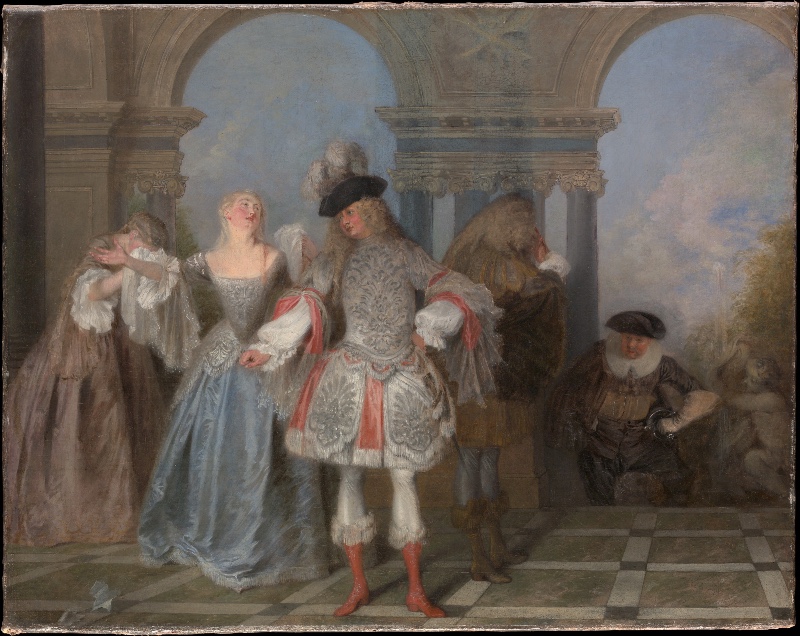
Watteau:  Les Comediens Francais,  1720


Placed beside it, Watteau 's painting ofLes Comediens Fran[ais is sheer enigma .When we consult the script of the play the scene supposedly illustrates - Moliere's Le Depit Amoureux - little correspondence is discovered; the painting blurs and elides together dramatically separate and indeed incompatible moments of the play. The meaning of the scene, even when we are familiar with the Moliere, remains uncertain: the painting both demands and disappoints our reading. And if we do not know the Moliere, we cannot even decide whether the scene is from tragedy or comedy. The woman weeping at the left seems tragic enough - but the Weeping Woman is also a stock character from period comedy. The 'heroine' who raises her right arm in extravagant gesture may be acting a tragedy, but equally well she may be an actress parodying tragedy; nor can we be sure, if parody is involved, whether it comes from the actress's own performance, or from Watteau's caricature of a performance meant as straight tragedy. The cavalier seems, in his oversumptuous costume, to be part of an obscure satire; but the costume is also, in certain details, beautiful, and its beauty partly justifies the painting. To record so faithfully, and with such delicacy,_ the exact folds of material and its transitions of colour is not easily compatible with the intention to make the costume seem funny (for instance, so as to send up French stage conventions and to promote Italian ones). The gentleman behind the cavalier turns away from us and his hand-gesture is unclear; such rotation from the viewer is a favourite de-stabilising device with Watteau, and in this case it serves to obscure from us whether he is comically quizzing the figure who enters from the stairs - and how is this compatible with the woman who weeps? - or whether he is concealing a state of extreme emotion. The entering figure raises unanswerable dramatic questions: will he bring a solution to the problem resulting from the letter (bottom left)? It seems quite possible: his left arm signals assurance and executive competence. Or is he responsible for the problem? His hat, both comic and sinister, signals 'intriguer'.


  Watteau's piece seems to either promise or  recall the pleasure of viewing a show. It
 invites us to share some light-hearted drama in the lives of  handsome, elegant, well-furnished young aristocrats.  It's a bit more sumptuous and mysterious than the frontispiece to the show’s printed text shown above.  That doesn't really appeal to me - but then I was not the target audience for this production.  As a fan of Mr. Bean and the Three Stooges, I would prefer the slapstick that Gillot was promoting.
(BTW - the Met website declares that this painting does not represent any specific play- though the frontispiece above would suggest otherwise)


Gillot: Le Tombeau de Maitre Andre


In this early work, Watteau is already insisting that we read: hence the theatrical space, where bodies at once become signalling systems; and in this he is close to Gillot, whose scenes from drama and in particular from the Italian Comedy always refer us to the reading conventions of the stage.  But whereas Gillot remains close to the original spectacle, Watteau insists on departure, partly through the scrambling of the original text, and partly through the uneasy relation he introduces between the theatrical frame and the frame of the 'picture. For this there is no counterpart in his master. A theatre frame makes everything inside it semantic, from gesture to coiffure to spatial disposition; the picture-frame does not normally do this, but when the two are so closely interrelated as here - the stage backdrop, with its fountain, trees, and sky, explicitly puns on the background of a painting- we cannot be sure which frame-system to follow: the always semantic theatre-frame, or the semantically neutral picture-frame. If the pun means 'painting is like theatre', it encourages us to find within the picture-frame all the meaningfulness we find on stage - only to disappoint us; if the pun means 'painting is unlike theatre, despite the superficial resemblance', it asks us to suspend our expectation of meaningfulness from the image but with so much enigma around, such suspension is almost impossible to achieve.


detail

This detail is a bit too visually compelling to be called strictly semantic.  I wonder whether Gillot inspired Giorgio de Chirico.


Watteau :  Italian Comedians, 1720


The customary companion-piece to Les Comediens Francais is Les Comediens Italiens  and one can see why the Italian theatre is so central to Watteau's work. Unlike the French drama, it does not accord pride of place to the script. Its characters are fixed - Pantalone the merchant; his friend the Doctor; Isabella and Orazio, the noble lovers; Arlecchino the servant, Scapino or Mezzetino the musician, Pedrolino the comic butt. But the situations and dialogue are fluid and unpredictable, with much stress on improvisation.  French drama in Watteau's eyes is word-bound, like the art of LeBrun (it is possible that Les Comediens Francais also satirises the art of Versailles). In the acting codes of the French classical theatre, bodily movement is always the servant of speech: 'In the theatre, before breaking the silence, one should prepare one's speech by some gesture, and the beginning of this gesture must always precede the speech by a longer or a shorter time, according to the circumstances';  'the gesture on stage must always precede the word'.  Gesture functions only as herald of the recit, announcing its arrival, accompanying it with movements of only supportive function, and marking its closure with a flourish.


 I must have seen this painting many times in Washington, but can’t recall ever doing so.  It does seem that, as Bryson says, Watteau preferred Italian comedy to French.  It also seems, however, that each figure presents the standard body and facial expression expected of its character.  Contrary to Bryson’s later suggestion, they have not stepped out of character.  In this conventional curtain call, there is no improvisation, only what Bryson calls discursive gesture.  Yet the painting itself has a lively, vibrant quality - with deft resolution of detail in all the figures. Those qualities are absent in so many of the pieces attributed to Watteau.


Watteau, "The Concert"


 Watteau hugely exploits the space around the curtain. ........... In the Concert at Berlin, the landscape is both the non-semantic, unframed space of a park; and a backdrop, the very substance of the theatrical frame, which turns the sub-legible bodies of persons into the hyperlegible bodies of players. The foreground shows a group that is at the same time fully theatrical (in costume, and their instruments are those of professional performance) and non-theatrical (no performance is taking place) . Watteau's transitions are meticulous: the distant group on the right is clearly within a painting, though the handling is close enough to that of the main group on the left to make us uncertain; the sylvan bust similarly belongs to both worlds; the floor is ambiguously flagstone and stage-boarding; while in the most daring area of the canvas, where a girl is seen against a cello, Watteau risks the astonishing effect of painting the instrument in a high-finish, 'Dutch' manner, with invisible brushwork and emphasised texture and reflection, while the figure of the girl is painted in broad, dry strokes that by contrast with the instrument seem elliptical, as though a painting of the girl stood next to a real cello (some of this effect is unfortunately lost in reproduction).

This is one strange painting! The drawing of the figures is  much weaker than the "Italian Comedians" or the "Embarkation"  - yet the overall composition is just as lively.  There is another variation, and I've compared the cello girls below:


The cello girl from the painting shown by Bryson is on the right.  The shoulders are more awkward. Overall, however, it does not appear to be any worse a painting.  I'm guessing that both of these are copies of an original now lost. Or, shudder the thought, perhaps this sweet, sensitive poet farmed out his designs to be completed by others. He was running a business.

Bryson's comments about "the space around the curtain" might just as well apply to the theatre's scenic designers as to Watteau.  Wasn't it their job to make the transition from stage to background curtain feel seamless?


And here is yet another variation.


BTW -  it does indeed feel like the painting presents a  theorbo performance-- it's just that we viewers are the intended audience, not the other characters on stage.


The result of this stage/life ambiguity is both to coax and to disappoint the interpretative glance, a double movement further developed in the magnificent Meeting in a Park. Whereas in LeBrun's battle scenes, the figures tended to turn towards the spectator and to display with exaggerated visibility their legible surfaces, here more than half the total number of figures emphatically turn their backs - perhaps Watteau's strongest 'illegibilising' device.


Doesn't  subject matter better account for that difference ? 
 Martial prowess versus recreational leisure.
This is not an art that that might accompany imperial ambition.


 The situation is still presented as a narrative one, and the couple on the right are signalling to us and to each other with extreme explicitness; which not only sets in motion our voyeuristic curiosity, but establishes that explicit and legible gestures are attainable in this world. When legibility is elsewhere unforthcoming, we know that we are being refused information.


It is amusing how the elegant lady staring into the distance on the left appears completely unconcerned with the mock date rape being attempted, and thwarted, to her right.

Bryson suggests that turning this lady and her beau away from the viewer is a "discursive strategy" to "refuse information" -  "Watteau's strongest 'illegibilising' device."   But that is to ignore the information that is being offered. More than just information - it’s Watteau's way of inviting the viewer into the park in the wake of their entrance. 


The characteristic Watteau long-shot itself works against facial emphasis - the faces are simply too small for us to follow their expressions - and probably this is the reason the longshot is so often used. But from another point of view, Watteau is a master of the repertoire of gestures of attention. We may not be able to read the faces, but we see very clearly the exact inclination and mutual tilt of the heads: in this respect Watteau's only rival is Degas. Interest in recording with absolute precision the angle of the head is responsible for many of the simplifications and exaggerations he introduces into physiognomy, for 'tilting' can only be clearly established by emphasizing certain details, notably the lines of the eyebrows and eyelids, the ears, and the hairline; it is also aided by defining the nose as a line ending in a point- all the 'triangulations' Watteau typically stresses 


Rembrandt


Tiepolo


Degas


Degas


Sargent


Anders Zorn


Bernardo Strozzi

As it turned out,
it was not easy finding 
good drawings of tilted heads.
Most of the above are seen from above and the side
Only a few are tilted to left or right.


Watteau, "Mezzatin"


 In Watteau, the eyes behave as though in this theatrical representation of 'high passion' - an extreme case is the three- sided gaze of the Mezzetin, the Turk ,and the female dancer in the Fetes venitiennes. But the body does not support this 'passion' - on the contrary, a stately dance is in progress, and the Mezzetin seems preoccupied with his music-making. What emerges is a disparity between the non-signalling bodies, engaged in their physical activity, and the eyes which, within the theatrical convention, signify intense feeling through their attentive inter-crossing. The two sets of signals are contradictory, and to reconcile their opposition the viewer creates an array of meanings which are not themselves directly represented - restraint, extreme depth of emotion, tact, respect for the privacy of the other, introversion.

Bryson reads the signals from the face and body language but not from the design of the painting.  Could that be called 'design-blindness'?   It's been evident in his response to almost every work he has mentioned so far.  As with the Medieval windows in Chapter One,  once he has read the  discourse, "the image has no further purpose to serve"


Watteau, "Les Champs Elysees"


 The allusions to theatre force us to read, and whether the figures are actors who have been transported from the stage into the park, or whether they are non-actors masquerading in the costumes of the theatre, we cannot avoid interpreting gesture, posture, and expression as we would if we were watching a play. But the unreadable bodies, turning their backs on us or huddling so close together that we cannot quite see their expressions, refuse to yield the meanings that a stage performance would supply. Hence the repeated ploy of so linking two figures that they seem a single compositional unit- and it is almost Watteau 's only unit: the compositional management of more than two or at the most three figures can cause him endless difficulty*


*Watteau's difficulties with the compositional management  of groups emerges clearly in the Wallace Collection's "Les Champs Elysees", where the uncertainty of ground plan, uneven massing, and reliance on filling intervening spaces with a crude grass notation recall the rudimentary solutions of naive painting.


Or perhaps these clumsy "grass notations" resemble naïve painting because they were executed by one of the naïve artisans hired, perhaps by Watteau, to execute this piece.  The overall design feels magnificent, but all of the faces and figures feel small and clumsy. At best, they belong on collector plates.


Meeting in a Park


It is almost impossible to resist Watteau 's call to interpret. In the Meeting in a Park , there is a clear parallelism between the two women who turn their backs, one accompanied and able if she chose to turn towards the group, the other alone and facing a void. As with Eisenstein's 'third sense', the  juxtaposition alone - and not any visible mark- starts to generate meaning and to involve the viewer in elaborate textual commentary. An attempt is being conducted, by a small group of highly civilized people, to take the greedy, raw material of eros and transform it into a principle of social harmony; the attempt may succeed- the primitive advance and recoil of the couple on the right are eventually fulfilled in the fruitful intimacy of the couple on the left; but the attempt may also fail, and if it does the individual is thrown back into a deep solitude, as with the distant female near the lake


Or -- once again -- it might be the chosen subject which has set the tone for these paintings.  Apparently Watteau was more familiar with theatre people than Bryson. They are more inclined than us solid citizens to believe that "All the world's a stage" - so they take things, especially romance,  less seriously and are more fun to hang out with.  In this painting, as well as many others, Watteau  invites you to join them .  Their gestures are not serious enough to demand interpretation.


Poussin, The Israelites Gathering Manna from the Desert, 1637


 The ability to provoke an intricate reaction such as this is not the only way the Meeting in a Park behaves like a text. By juxtaposing those three areas of the painting- the flirting couple, just beginning to separate from the gregarious society into the unit of the couple; the intimate couple; and the distant solitary woman- Watteau hints that his three subjects may be three stages in the development of a single relationship, a successive progress of love viewed in the simultaneous time of the image, like a strip- cartoon (at a sublime level). An interesting precedent here is Poussin: the Israelites Gathering Manna in the Desert similarly juxtaposes within the same image scenes of misery from the time before the manna was found, with scenes of youthful enthusiasm and elderly hesitation from the time after its discovery by the Israelites. This temporal dislocation was in fact a source of criticism at the 1667 debate on the painting at the Academie, and LeBrun produced a characteristically pro-discursive defense:


The historian communicates by an arrangement of words, by a succession of discourse which builds up the image of what he has to say, and he is free to represent events in any order he likes. The painter, having only an instant for his communication .... sometimes finds it necessary also to unite several moments from different times, to render his scene intelligible.


The Poussin is as crackling with  tension as the Watteau is carefree. Poussin offers religious instruction - Watteau offers diversion. Poussin presents  Divine intervention - Watteau invites you into a place that no longer needs it. Poussin carries his refined disturbance into every  figurative detail - but Watteau loses elegance when he goes small.
  And I have no idea why the politically correct, officious commentary of LeBrun needs to be revisited yet again. If Watteau was invited to join the Academy , obviously LeBrun was no longer taken seriously, if he ever was.  (Below, Bryson will counter that Watteau was accepted due to his "invocation of high discursive principle" -  but I think he was referring to the academy of the late 20th century rather than the early 18th. )


Denied the information available to the figures, but still asked by the image to go on interpreting, the viewer pursues the only option left open to him - reverie. The image sets in motion a boundless semantic expansion, a kind of centrifugal rippling of meaning that knows no boundary. The Watteau image, unlike the image in LeBrun, is entirely open - no scenario or exegesis could ever satisfy our discursive hunger and reverie is a form of thought, and of language, which respects this infinity of possible implications; a machine for the infinite expansion of the signified.


I'm  guessing that Bryson takes pleasure in pursuing an "infinity of possible implications".  That is his rather intellectual kind of "reverie".  As I have suggested, however, we do have "information available to the figures"  and Bryson has shared it:  they are theatre people enjoying a sunny afternoon in an elegant park - complete with well-groomed lawns, statuary, and tall, elegant trees.  A  more likely reverie could come from imagining that you have joined them.


Rubens, "Garden of Love",  1630-35


The Meeting in a Park, where the distant woman and the woman in the intimate couple seem to resolve, like the pageboys in LeBrun's equestrian portrait of Chancellor Seguiet, into a single figure, is a fairly extreme example, but the principle is also present in the Pilgrimage to Cythera, which collapses a 'before' into an 'after' - the beginning of the day of love, as the pilgrims make their way to the island, and the end of the day of love, as they prepare to leave. Although Watteau is unlikely to have taken the principle either from Poussin or from LeBrun's Discourses, the miraculous ease with which the Pilgrimage was accepted by the Academie may to some extent be due to its invocation of high discursive principle, a loyalty to text over image, which harmonised with the doctrines of the ancient Academie; it would have appealed to the old guard, routed by the rubenistes, but still not without influence. But a more congenial precedent is Rubens himself, who in the Garden of Love shows a couple entering the painting from the left, pushed into it by a forceful cupid, and seemingly at the beginning of their courtship; and a second couple descending the steps on the right, who are at a later stage of love. The detail which is especially close to Watteau is that in each case, the cavalier is wearing the same kind of hat. But in the juxtaposition of the two female backs in the Meeting in a Park, Watteau goes much further than Rubens towards stating that his different groups represent phases in the progress of love-relationships; and the implications- that love decays before its time, that desire produces melancholy are of course quite alien to Rubens' 'robust' optimism. If the cavaliers in Rubens' garden are interchangeable, it is because love is not as individuated there as Watteau believes it can be and for Watteau, interchangeability marks a failure of the personalization of love, and of the project of its conversion from crude biological drive into social harmony.

I do wish that Bryson had used ‘Meeting in the Park’ to help explicate ‘Cythera’ rather than the other way around - but due to its "infinity of possible implications",  Bryson does probably think that "Meeting in the Park"  is the greater painting. 

He made a good point about the interchangability of figures in the Rubens piece.  It's as if there were a factory in Antwerp that turned out identical putti and plump women. I can't imagine anyone hanging such forced frivolity above their conjugal bed - but apparently that's exactly what King Philip IV did.

In "Meeting in a Park" the people are ornaments to a place -- in "Garden of Love" it's the reverse. The most important interactions are between the great masses of trees and the luminous sky behind them.


Titian, "Bacchanal of the Andrians" , 1523-26


By the way, here's another depiction of sexual frivolity in a park-like setting.  Like the "Garden of Love", it also appears to be advancing in time from left to right:  
The boys start drinking
 they pour wine for the girls
boy dances with girl 
Thoroughly drunk, a girl pulls off her clothing and is ready for sex
(while an infant boy pees on her foot)

Obviously, this version was made before Europeans got way 
too serious about religion in the 17th Century.


The meanings in Watteau, having no signifier to pin them down, are experienced mysteriously, as moods, or atmospheres. The literary form of the reverie, which tries to articulate these vague and haunting emanations, always seems to its producers to be creative and never descriptive - 'all their own work', and at times a kind of self-display that uses Watteau as little more than pretext. The tragedy is that for every page of the Watteau literature, one finds perhaps a line on the paintings themselves. Even quite rudimentary figural questions, such as the means by which Watteau transforms the precedent of Rubens to suit his scale and his personal subject-matter, remain neglected. Watteau is preferred as a Pirandellesque metteur-en-scene or as a Symbolist poet, and his work in paint is consistently overshadowed by his subtle discursivity. In the next phase of its development, French painting will learn how to assert more strongly the independent claim of the figural image


To restate the first sentence:  the meanings of paintings as paintings have no signifier to pin them down.  It's the non-discursive visual organization, the form, that evokes whatever painterly meaning a viewer may comprehend. It's not the enthusiastic authors whom Bryson has quoted who ignore the "work in paint" -  it's form-blind Bryson himself.

And those painterly meanings - being non discursive - are necessarily mysterious and inexplicable.  That's why there will be no end to the writing devoted to great artists.  We talkative viewers just can't help ourselves. 


Regarding Watteau, I admit that this perusal of reproductions has been a big disappointment. He appears to have been one of those artists who only made things as good as they needed to be to satisfy a buyer.   So the Embarkation (shown above), his reception piece to the Academy, was a masterpiece.  But almost every other fete galante is awkward in detail -  as if done by a lesser hand.


I hope that someday I'll come across a text that does him justice.

Friday, December 11, 2020

NORMAN BRYSON : Word and Image, Chapter Two


This is Chapter Two of  NORMAN BRYSON's  : Word and Image,  French Painting of the Ancien Regime. (1983). Text in Yellow are quotes from the author, Text in Orange are  quotes from others.


***************************************************************************


Charles LeBrun , self portrait 1668


The Legible Body : LeBrun


Chapter One introduced us to Bryson's semiotic approach.  Chapter Two introduces us to the history of 18th Century French painting.  His narrative begins with Charles LeBrun, founding member of the Académie Royale de Peinture et de Sculpture (1648).  LeBrun was 28  years old at the time - while Louis XIV, who signed the founding documents, was nine. The academy would soon break the exclusive authority of the Guild of St. Luke and eventually dominate French and European painting and sculpture up through the end of the 19th Century.


Simon Vouet, Rape of Europa, 1640


I am somewhat conflicted in my own allegiances here. As the son of an artist, I can appreciate what it means to grow up in a world centered on making art. That's how the profession advances from generation to generation in a guild system.  Simon Vouet was a good example: the son of a painter who   became leader of the Guild of  St. Luke as well as a great painter. But on the other hand --- there was Nicolas Poussin  who rose to the top of his profession by shear determination and ability. Locking him out of his profession would have been criminal.


LeBrun is the site of convergence of two great forces: bureaucracy, and text. Almost before he is a painter, he is a bureaucrat, and the profile of his career ('career' is the operative word) is that of the eminent civil servant.  He was never without an immediate state patron - Seguier, Fouquet, Colbert; and only at the death of Colbert in 1683 did he finally fall from favour. His endurance is that of a government ministry. And this bureaucrat is a man of the Word. At once he claimed for the centralised Academie a power which had hitherto been exerted only by the Church and the Crown: the right to dictate to the painters the texts which their work was to illustrate. ln 1663, he instituted the Annual Prize, using as text 'the heroic exploits of the King'; in 1666, the Prix de Rome, where the subject of the competition is chosen from Scripture. This right not only determined the paranoid competitiveness which was to distinguish French painting for the next two centuries, but ensured the supremacy of a certain kind of painting - discursive; and the insertion of the discursive into the figural parallels both the insertion of the monarch into the community of painters through the delegation of Colbert and LeBrun, and the personal dictatorship of LeBrun within the Academie. The shape of the state and of the institutional structure of painting determine the shape of the painterly sign.


The atmosphere of the Academie after 1663 becomes fiercely linguistic. In 1648, while history painting dominated over the 'lower' genres in terms of personnel, the Academie was still basically a cenacle, and it had its material problems: whereas the guilds collected dues from their members, the secessionists relied on the modest payments of pupils, and on their own intermittent contributions.  The structure was amateur in the sense that no official policies prevailed. But after 1663 , not only does painting start to emanate - for the first time on any scale in a secular context- from empowered texts: the act of painting is surrounded by a verbal mystique. In 1666, at the instigation of Colbert, LeBrun introduced the practice of the Discourse: every month a work from the royal collection was to be discussed before the public by the Academie assembled as a whole.  Whereas the guilds had transmitted instruction by practical example, now instruction takes the form of codex, and an official stenographer is employed to transcribe and later to publish the proceedings of the debates. In terms of his own work, LeBrun insists for the first time on the Livret: his manifesto work for Louis XIV was accompanied by a lengthy treatise and description by Felibien, later the Academie's chief scribe. In 1673, the series of his paintings known as the Battles was displayed before the public with a complex explanatory pamphlet; and it was to be the same with the general iconography of Versailles, and with LeBrun's series of paintings for the Grande Galerie.


Bryson's historical narrative feels so insightful and sharply written that I'm inclined to believe it - except for its exclusive focus on the discursive in the French academy - which is somewhat challenged by the following episode that he relates:


Poussin, Rebecca and Eliezer at the Well, 1648


The Discourses not only, through verbal description of the works in the royal collection, focus the word on the image with an intensity that is without precedent; they reveal a bias in favour of the discursive that is at times bizarre. In 1667, LeBrun delivered a major address on Poussin's painting entitled Eliezer and Rebecca. When the debate was thrown open . he was confronted by a strange objection: it was noted that Poussin had omitted the animals which, in the scriptural account, had attended the scene; the Biblical camels feature nowhere in the image; surely this constituted a breach of decorum. Had LeBrun argued that Poussin was free to omit these creatures, a dangerous precedent might be set, and hallowed by the Academie, for present and future painters to depart from the authority of the text; and since the second of LeBrun's great political advances on behalf of discursive painting, the Prix de Rome, was still in its infancy, such a tendency had to be nipped in the bud at once. On the other hand, Poussin could not be discredited: alone among the painters chosen for debate he represented France - the rest were Italians; and the right of the Academie to class his work with that of Titian and Raphael was part of its general chauvinist mission. What is significant about the debate is that the issue of bureaucratic control of the painter and textual control of the image have fused into near-identity. LeBrun at first hedges the question: he argues that the famous beasts have been omitted in favour of the work's unity.

Poussin, Rebecca and Eliezer at the Well, 1660-1665

By the way -- here's another version that Poussin painted
two decades later. Note the camel to the left. 
and only one girl is noticing what's happening to Rebecca.


Now it might seem that in taking this line, LaBrun is placing a 'compositional' requirement over a discursive one; but instead of the term 'composition', with its 20th century abstractionist connotations of pure formalism and asemantic figurality, we should stay with the word LeBrun in fact uses, a word that shows the proximity to his theory of painting of classical rhetoric: disposition.  Whereas compositional unity ~ is an affair ofbalancing forms, dispositional unity concerns the balancing of messages; and it is this sense, as a rhetorical dispositio or distribution of information, that we should understand LeBrun's defence. The camels would offend, not through their intrinsic oddness, their suggestion of the monstrous or the absurd, but because if included they would become a dispositional distraction: a secondary text would be generated and might come to rival the primary one. And it is on these lines that one should understand LeBrun's hostility to genre-painting. Of course, it is at the same time an institutional posture: the triumph of history painting over genre is the triumph of the Academie over the Maitrise. Genre-painting is, after all, pre-eminently textual: it is devoted to the anecdote and the generation of superabundant discourse from the image. But though textual, genre-painting does not transmit its narrative messages in any order of priority: its humility of content is matched by a democracy of messages all on the same level, with no one amongst them subordinating the rest. In other words, genre does not understand language as a form of power over the image- and it is precisely the power-aspect of the discursive which interests LeBrun. The textuality of LeBrun is cybernetic, a form of authority which is lost amongst the proliferating and equivalent messages of the anecdotal. The unity of dispositio is discursive, not figural, and this centralising power of the text is defended because it precisely corresponds to the power of the Academie over the community of painters; to challenge that centralising authority is to challenge the Academie itself.


Because so much more was implied than the pulchritude of camels, the debate was resumed. Those painters who resented either the hegemony of the Academie within the professional structure, or the omnipotence within the Academie of LeBrun, or both, demanded a second hearing; not before the Academie had mobilised its hierarchical resources, and passed resolutions condemning 'the confusion that attends the public sessions' (the Academie debates had become minor manifestations), and had required that non-academicians seat themselves on benches remote from the arena of debate, as passive witnesses. LeBrun delivers a second defence of Poussin which reveals all the faith of the official in his memorandum. In Scripture, he declares, the famous camels are nowhere mentioned as in the Israelite camp itself, or as near the Israelites themselves; Poussin's exclusion of them does not therefore break with the letter of the Old Testament.  His answer is Byzantine; certainly it failed to satisfy the opposition. In the end Colbert personally intervened - and his presence as arbiter reveals the urgency of the debate - to bring the meeting to a close, and to guarantee that LeBrun's answer be the last word on the subject. In LeBrun's appeal to the voice of the centralized state  to bring to rule the dissidence of both the figural image and the community of painters, one can see the depth of complicity between textuality and power.  To question the supremacy of the discursive, before the double presence of both LeBrun and Colbert, is both artistic heresy and political treason.


Guido Reni, Virgin Sewing with her Companions , 1642


According to Poussin's contemporary biographer, Andre Felibien, the piece was commissioned by a wealthy silk merchant, Jean Pointel, who asked for something like  Guido Reni's “La Vierge cousant avec ses compagnes”  that might also portray “several women, in which you can see different beauties”.

Which is to say, Pointel wanted to look at pretty girls rather than receive religious instruction - as would many of us  - and apparently that's exactly what Poussin gave him under the guise of a sacred text.

Not only did Poussin mangle a sacred discourse on behalf of the figurative - but Charles LeBrun  and his patron, Colbert, defended that sacrilege in an official meeting of the academy. The discursive is given lip service - but not real authority over a greatness that is aesthetic.

The same might be said for the piece by Guido Reni. I can’t find any other depictions of the Virgin surrounded by anyone other than angels, putti, or her parents, and it has nothing to do with holy writ.  Perhaps Guido painted it for men who wanted to see pretty young women but would have been embarrassed to adorn their their walls with naked nymphs in that pious age.

By the way, LeBrun's principal adversary in this debate  was Philippe de Champaigne whom I would consider a much greater painter.


Philippe de Champaigne , Moses Presenting the Law, 1648
This is one of my favorite paintings at the Milwaukee Art Museum.
(there's another copy at the Hermitage)

Philippe seems to have been a pious fellow, possibly a Jansenist, whose objection to Poussin's transformation of a biblical text into a girlie picture quite likely conflicted with his religious sensitivities rather than his discursive theory of art.


I find the areas of detail more engaging than Poussin's painting as whole
which feels too much like a perfunctory stage design for an an opera. 


Charles LeBrun: Franche-Comte Taken for the Second Time, 1681-1684


 Regarding LeBrun's work,  Bryson introduces it with the above piece, and surprisingly offers an aesthetic judgment. (art historians usually avoid them)


In LeBrun's most ambitious and extensive work, the series of eleven full-scale and eighteen minor paintings devoted ad maiorem gloriam Ludovici at Versailles, we meet with the following constellation: Allegory, Conquest, Monarchy. The painting of Franche-Comte Conquered for the Second Time  is at the centre of LeBrun's career, as the Apotheosis of Homer is at the centre of Ingres, and the Oath of the Horatii of David. 


Nicholas Largilliere, portrait of Charles LeBrun, (1683-1686)


When Largilliere came to paint the portrait through which LeBrun was to be carried forward into posterity, it was this work which he chose to place on LeBrun's easel. It is an image which translates effortlessly, and with minimal figural residue, into narrative. Louis had already conquered the province in 1678, and returned it to Spain at the Treaty of Aix-la-Chapelle. When Spain declared a second war, the province was reconquered within three months. In the image, Mars leads Franche-Comte and its villages to the King as suppliant maidens. The river Soux, alarmed at the sight of Victory attaching trophies to a palm-tree, holds on to the King's coat. Behind Louis stands the figure of Hercules, or heroic virtue. The fawning lion represents Spain, and the rock the citadel of Besancon. Germany has offered the province vain support: an eagle on a dry tree. The three months of the siege belonged to winter: there are three zodiacal signs. And Fame appears with double trumpets: the province has been twice conquered (these details are sadly obscured in the present reproduction). With its sombre, drab coloration and thick-set, graceless figures, the work points to central deficiencies in LeBrun as a painter: lack of imagination, lack of figural involvement. But examined at the rhetorical level at which it was pitched, the image reveals a striking symmetry of intellectual design. The painting exploits a duplicity in the word 'history': in history, event and scripture fuse, for the historical is not only that which has occurred, but that which has recurred as writing. Between the figures of allegory and the historical figure of Louis, there is therefore no ontological disjunction. In conquest, event is Scripture even as it happens: the battle is already narrative at the moment it takes place, so that when Homer or Tolstoy or Stendhal describe their battles, narrative is not super-added to a scene which lacks discursive intelligibility, but is instead the repetition of a discourse which is preexistent. War is perhaps the most ancient, and certainly one of the most powerful, of rhetorical topoi.


The above judgment exemplifies Bryson's separation of  the rhetorical from the formal. He gives low marks to the formal (sombre, drab coloration and thick-set, graceless figures) and high marks to the rhetorical ( a striking symmetry of intellectual design).  As misguided as such a separation seems to me, it is characteristic of our age that celebrates a practice known as "conceptual art". Whether or not that "striking symmetry" of history and allegory is a notable achievement, however, is questionable - and Bryson's declaration  that "event is scripture" is easily disproven by the competing narratives for the very first historical account of military conflict in ancient history:  the Battle of Kadesh (1274 BC)


Ramses II at the battle of Kadesh


Just like Louis XIV,  Ramses II, the conquering God/King/Hero is much larger than his puny opponents, and is surrounded by magical signs appropriate to his cosmic status. The conflation of  military history with mythology goes back to its very beginning.

One might also note that there are two conflicting accounts of this battle.  According to the Egyptians it was a glorious victory for their Pharoah who personally cut his way through enemy lines.  According to the Hittites, it was a successful defense of Kadesh, an important commercial center which was the target of the Egyptian invasion.

The battle itself was not a pre-existent discourse -- it was interpreted by discourses -  and yet, for whatever reason, Bryson continues with a verbose digression. Contemporary art talk does have a taste for prose that is equally assertive and counter-intuitive - but why is Bryson writing about the historiography of warfare?

The epics of world literature, from the Iliad to the Upanishads, witness to an affinity between war and narrative which can be said to emanate from an inherent similarity: in war, events acquire a dimension that has already all the intelligibility, visibility, and recountability of the narrative act. It is the same at the lowest, childhood level of historiography, which consists almost exclusively in a listing of battles, and where the work of history as an interpretative discipline is at a minimum: so far from shaping event into meaning, all the historian there has to do is to repeat the writing that emanates spontaneously from history itself. In the battle, human action consolidates into a united purposiveness that is patent and visible at all points; in this it differs from guerrilla warfare and from terrorism, which rely on invisibility and concealment. These other forms of aggression are perhaps the more terrifying because they lack the consolidation of open intelligibility which the battle provides (in this sense, it is hard to image an allegory of guerrilla war). But battle possesses a spectacularity that is heraldic: each side blazons its identity with a clarity that is not at all exhausted by strategic need. And in the descriptions of battle one sees a marked tendency towards a signification that is highly abstract: the model here is the war-room, with its maps and pointers, markers and counters. Although only a simulacrum of the battlefield, the war-room is also its real theatre: in the conversion from the mud and chaos of the field to the hygienic spread of the diagram, nothing essential is lost. On the contrary, the essence of the battle is revealed in the schema. Military planning requires a glance at the body which is altogether indifferent to its materiality; the martial body is enciphered, made into a statistical entity, a vortex of abstract force. The militaristic use of the body may be heavily physical: carefully clothed and tended, trained to a pitch of physical excellence, the superbia of the material body borders on an eroticism which must never, however, announce itself as such. But always that priority is overtaken by signification, not only in the decoration of the body with insignia, but in a final purpose for that body which is, of course, a complete betrayal of its right to physical existence.


Louis, the God/king/hero


Overall, this painting is a collection of parts that do not come together with any graphic force. In that way it disparages its primary subject, allowing him to be seen as a goofy, effete, self obsessed dreamer rather than a bold, effective leader. The above trumpeting angel, however, is quite charming


And here are some of my favorite depictions of historical battles:


Night Attack on the Sanjo Palace, Japan, second half of 13th Century


I fell in love with this battle scene more than 40 years ago when I first saw it in the MFA Boston. It’s breath taking.


Ucello, Battle of San Romano, 1436-40

A charming, fantastical rendition of a real battle.  Presumably no one was injured


There were some  fatalities here, however - including Ibrahim Lodi,
 the rather incompetent Sultan of Delhi


First Battle of Patipat (April 21, 1526) , Mughal, Late 16th Century

The formal qualities of the prolific Mughal school are thrilling - and it specialized in bloody battle scenes just like this one.  If I had the time, I would love to create a  blog about only this genre.


Rubens, Triumph of Henry IV, 1630

All of the drive and dynamic figuration that is missing in LeBrun.


Velasquez, Surrender of Breda, 1634-5


The pinnacle of historical battle representation in European painting.  Compared to it, everything else feels like a pompous joke.


Charles LeBrun, Battle of Arbela


Battle of Arbela - the tapestry


It is, therefore, no accident that LeBrun, with his commitment to the textuality of the image over its figurality, should also have expended such colossal effort on images of military conflict. In his Battle of Arbela one can see a sadism which, if it had not been so bureaucratically constrained, might have moved far closer than it did to Delacroix, who is a proleptic presence in all these scenes . It is a sadism which cannot, however, be thought morbid, since it lacks the quest for privacy which marks authentic perversion. Quite the opposite: what is sought is absolute publicity, for the battle is a form of aggression that takes place without guile, deceit, or any aspect of the clandestine. In the swordplay of the duel, there is room for the artistry of fencing, which is full of feints and misdirections: but in the swordplay of battle, intention and action are far more co-extensive. It is this legibility of the body which above all interests LeBrun. In his arrangement of battle scenes there is hardly a head which does not turn in some way towards the viewer, to display fully its readable surface; not surprisingly, many of the embattled figures are taken directly from LeBrun's work on the expression of the passions . The ethic is Carnelian, and concerns a word sacred to Corneille, to France, and to LeBrun: gloire; neither merit nor excellence by themselves, but these qualities caught in a double movement of display and recognition. Corneille's warriors in his play Horace exhibit a sadism that extends, as we know, to the most brutal sororicide, and the murderous brother is incapable of the inwardness of shame; absolutely unrepentant at the death of his sister, the brother is concerned only with the possibility of a stain on glory. The heroic act is so extraverted, so insistently spectacular, that for Polyeucte martyrdom is pursued not as an abnegation of the self before God, but as a final and resplendent display of . personal glory before both God and man. Gloire cannot exist without its spectators; it is also indifferent to the rights of the flesh, which it seeks constantly to transcend through the will. Its culmination is therefore in public violence, a violence that is always observed; not just the battle, but the battle that is fully displayed and intelligible.


As a full size cartoon for a wall size tapestry, it appears that both textuality and figurality have been superseded by décor. The flat wall behind it is more important than any discourse or painterly effect.    The designer is working with  flat patterns rather than line, luminosity, and suggested volumes in pictorial space.  None of the figures depicted can escape the wall to  confront the viewer.


This sketch of an expressive face was cut and pasted into the composition - much as a cartoonist might do


The Alexander Mosaic, House of the Faun, Pompeii, 100-120 BC

Here is another decorative piece depicting the same, or nearly the same, historical battle. Its textuality doesn't really tell you much about the clash between the Macedonian and Persian armies  - but then  the battle is not "fully displayed and intelligible" in LeBrun's version either.  

The mosaic's details, however, do offer a lot more visual punch and excitement -- what Bryson calls "figurality".


you feel the expressiveness of every colored chip.  It's alive and electric.


Polloaiulo, "Battle of the Naked Men", 1465-75


But for the  shear graphic and horrific power of battle,
nothing beats this famous engraving.

And you might even call it "gloire", while noting
that unlike the Lebrun piece, none of the faces are turned completely away. 


LeBrun's paintings for the Grande Galerie, which together form a continuous narrative of the conquests of the King, exploit to the full this collaborative relation between warfare and narrativity. Allegory is the artistic form appropriate to conquest because for both conqueror and allegorist, detail is of no importance. What the heroic invader requires from a province is not its substance or booty, but the signs of its surrender; the synecdoche of the lion for Spain, the hunched eagle for Germany, are like the exalted and manically generalised form the world assumes when Antony addresses Cleopatra as Egypt, or like the allegorical reduction of the world which Chaplin used in the Great Dictator, to define megalomania: alone in his study, the dictator plays with the globe as though it were a balloon. Yet these works of LeBrun, alongside war and allegory, include always a third term, which completes their specific constellation: the body of the King. Let us for a moment return to an earlier comment on the word 'history ': history is a fusion of event with writing. The historical is not only that which has occurred, but that which has occurred as writing.


Bryson writes about history and history paintings as if his subject were universal - but his comments mostly just apply to the France of Louis XIV.  There is nothing allegorical, for example , about  "The Surrender of Breda", and the body of the Spanish king cannot be found in any of the many paintings commissioned to celebrate the victories of his army.


With the painting of the Franche-Compte,  once the eagle, the lion, the rock, the keys, the urns, and the figures have released their discharge of the signified, lacking any further purpose, they linger on in desolate drained dispersal. Nothing but the signified holds this disarray of objects together, and once it is taken away, they take on the life of husks...... With the glass at Canterbury, if we prolong our inspection beyond it’s designated links, the image dissolves into pure light and color: the same is true of the frescoes of Tiepolo.  But here, because the signifier has been so degraded, as the Word  fades it, leaves only ash behind.


As we read earlier, Bryson does not allow the formal qualities of the Canterbury windows to affect what they signify - and apparently he feels the same way about Tiepolo. Ouch!  But I certainly agree with him regarding LeBrun’s Franche-Compte:  "as the word fades, it leaves only ash behind".  Well put!

In general, it does seem that visuality is diminished proportionally to the emphasis which the painter gives to allegorical symbols.  And this would even apply to a very great artist like Vermeer:


Vermeer, Allegory of the  Catholic Faith, 1670-72

I find the details of this piece far more compelling than its whole.


Sebastian Stoskopff, The Great Vanity, 1642

This painting, however, seems to manage both detail and whole with equal spirit -  despite the many allegorical symbols being shown. No dry ashes here.


Sebastian Stoskopff, 1620's

Yet this earlier piece by the same artist is even better. The sea shell and wooden box don't seem to have specific allegorical meanings as much as the contrast between their surfaces and shapes provokes  thoughts about the universe that contains them both.


Charles LeBrun, "Desire"


Dissertation sur un Traité de Charles Lebrun concernant le
Rapport de la Physionomie Humaine avec Celle des Animaux


.....Since human self-expression  involves parameters of moving gesture and of supporting speech which at every point clarify the emotion, and since painting lacks those parameters, the image of emotion  must supply other  markers to  take their place. While the problem of  emotional expression is permanent, in the case of LeBrun there are particular  historical pressures which made its solution imperative.  The hierarchical elevation of history painting and of the Academie required the linguistic saturation of the image; both the allegorical style of the art of Versailles, and the role played by the interpretation of signs in the life of its Court, reinforced the need for a further advance of the Word into substance. Yet the advance was blocked by an aesthetic of reticence which demanded of the courtly body a rigorous reduction of expressivity: decorum, in the sense of a  igilant monitoring and screening of the body's informational potential, creates an inscrutability that menaces the central  colonisation of the body by the Word. Expressive gesture is withdrawn from the body to the head; and in LeBrun's first excursion into this terrain, the approach is exclusively physiognomic. The only notable work on the subject of physiognomy remained Giovanni Baptista della Porta's Della Fisionomia dell 'Uomo, translated into French in 1665. This curious treatise, written at the close of the sixteenth century, is a late flower of Paracelsan thought, and exhibits a kind of reasoning which by the epoch of LeBrun was entirely antiquated. At its root is a belief in Creation as a Text from God:


The first and highest book of medicine is called Sapientia. Without this book no one will achieve anything fruitful . . . for this book is God himself .. . The second book of medicine is the firmament ... for it is possible to write down all medicine in the letters of one book .. . and the firmament is such a book containing all virtues and all propositions .. . the stars in heaven must be taken together in order that we may read the sentence in the firmament. It is like a letter that has been sent to us from a hundred miles off, and in which the writer's mind speaks to us. 


Giovanni Baptista Della Porta


Knowledge is a matter of right reading of the text of creation, and a bountiful God has made this possible by repeating the sentences of the firmament, by which Paracelsus means astrology, in the signatures of the natural world. To take an example which also, despite its reasoning, had some success: syphilis bears the signature of the market place; the planet Mercury has signed the market place; the metal mercury, which is also signed by the planet, is therefore the cure for syphilis. In his Fisionomia, della Porta elaborated this Paracelsan doctrine: since there are distant species of plant whose leaves resemble the legs of the scorpion, those plants come under the sign of Scorpio and Scorpio's planet Mars; with physiognomy, a similar logic is at work in what della Porta is pleased to call the 'physiognomic syllogism'.  All parrots are talkers, all men with noses of a certain shape are like parrots, therefore all such men are talkers. The visual result of the theory took the form of images in which the human face is variously distorted to reveal, as far as ingenuity will permit, hidden resemblances to specific beasts 


Charles LeBrun,  Expressions

Those contemporary artists who disparage the old reactionary French Academy might be surprised to learn that its first director was basically a  cartoonist and  semiotician.   His pedagogical system, captured in the drawings and prints that survived, are far more useful for drawing a cartoon strip than for making a painterly painting.  Bryson connects his physionomic studies to nascent natural sciences that were emerging in the Renaissance.  As he puts it, LeBrun  " reduces the face to a combinatory schema which permutates a few  basic semaphoric units .. the system operates at the precise frontier of the signifier and the signified".  If a story calls for the depiction of someone who is angry - the artist can refer to the drawing that expresses "anger" in a man or perhaps a snarling tiger. LeBrun would fit  quite well into a contemporary school of art.  Given his enthusiasm for science-like queries, extensive bureaucratic experience, and eagerness to please his superiors, he might soon become its director.

frontispiece to Roger de Piles
"History and Life of the Famous European Painters", 1710

As Bryson puts it, "LeBrun's project of colonizing the body with signs is not unique to him: Dufresnoy and even Roger de Piles, the great figuralist, insist  on the importance within painting of the legible body"

The tortured mess that is the frontispiece shown above would serve as a good example of this approach. De Piles ranked dozens of  famous European painters regarding composition, drawing, color, and expression.  LeBrun ranked very high on everything except color  (Titian, Rubens, and Gorgione scored the highest on color) Poor Caravaggio fared poorly -  getting a goose-egg on "expression" - possibly  because his characters expressed attitudes that De Piles found objectionable.


Charles Alphonse Du Fresnoy, Allegory of Faith, 1660

DuFresnoy was a friend of De Piles and also known for his art theory. No need for me to critique the tiresome "discursiveness" of  this work.... those who appreciate it will probably not be reading this blog.


Bryson demonstrates that Descartes was acknowledged as the authority on how emotions are expressed by the body.  Quotes by the painter, Nicolas Mignard and the sculptor, Gerard van Opstal, closely follow the words of the great philosopher as they address the Academy.


The Queens of Persia at the Feet of Alexander


Applications of the doctrines of the Conference appears with greatest success in The Queens of Persia at the Feet of Alexander painted by LeBrun at Fontainebleau for the King at the beginning of his reign in 1662.  It has all the qualities of a manifesto piece, and at once Felibien (court historian) published a commentary on if of unprecedented length; not until the Poussin debates do we encounter such intensity of verbal focus on any single French painting.


The compassion he has for the princesses visibly appears, both in his looks and in his behavior; his opened hand shews his clemency, and perfectly expresses  the favor he has for all that court; his other hand which he lalys on Ephestion, plainly shows that he is his favorite; and his left leg which he draws backward, is a token of the civility which he pays to these princesses.


.


Bryson offers many more discursive details - like the differences in clothing and jewelry that distinguish Alexander from the other Greek standing beside him.  
The expressions above do seem to have been lifted from LeBrun’s catalog - though that catalog may have been compiled after 1662


Felibien 's commentary is a salutary reminder that with a painting such as this, a whole lexical dimension lies concealed from normal viewing; and especially the normal viewing ot the Twentieth century, with its natural bias towards a figural appreciation of the art of the past. Yet unless we attend to this dimension, the image fuses into a ponderous mass, and it is probably the sheer weight of pomp which alienates the spectator who is unaware that the image is not merely to be seen, but read. As discourse penetrates this ankylosed mass its components begin to separate, and the image regains a lightness, an allegrezza which one might not have suspected it capable of sustaining. 


I’m afraid that this painting remains ponderous for me — except in an historical context that connects these self-aggrandizing fantasies and their pseudo-erudition with the emergence of a powerful, centralized, bureaucratic state.   Bryson frequently connects to that  context - and that is the value of his chapter about LeBrun.

BTW:  I love Bryson's use of the phrase: "ankylosed mass", after the dictionary told me that it referred to a rather serious and unpleasant medical condition: the fusion of bones at the joints. Ouch!


The kind of discursivity to which LeBrun submits his painting is entirely conscious, and is nothing to do with naturalism. Before LeBrun, since no lexicon of the body exists to be consulted, except the virtually useless treatise by della Porta, the significance of the body seems to have no source, and in the absence of source there develops an effect of the real, as with the Masaccio earlier discussed. When I cannot consult the text of the passions, I cannot clearly place the articulation of its meanings, and since the signified seems without origin in the image and on the plane of signifiers, I invent a space of depth, 'outside ' the image, to house it; the depth of perspective becomes identified with this imaginary deep exteriority. Since signification exists, but I cannot clearly attach the production of the signified to any specific pictorial signifier, I must create another realm for the meanings I 'find",  away from the picture plane; and perspective, pretending to supply a space 'behind' the signifiers, and coinciding with this need for another realm, meets it, and invites the signified to step with it behind the signifying plane. LeBrun, by bringing the articulation of the physiognomic and pathognomic codes into full visibility, counteracts this occultation; meanings do not emanate from his canvases mysteriously, but in the full awareness of a coded practice. In this sense the image in LeBrun possesses a frankness and publicity of intention that make it incompatible with what we know of the image in realism. And in the next generations, as the fully discursive image falls out of favour,  the reaction against discourse moves painting once again towards that effacement of the means of signification which is an essential part of the realist project.


Thank goodness Bryson uses the first person singular in the above rumination :  "when I cannot consult the text of the passions, I cannot clearly place the articulation of its meanings, and since the signified seems without origin in the image and on the plane of signifiers, I invent a space of depth, 'outside ' the image, to house it"  ---- because  that is nothing like my experience as a viewer.

Whether or not the  "articulation of meanings" feels definitive or elusive -  I try to let the piece itself be the final authority on how it appears, rather than my own interpretation or mental reconstructions of it.  The only "signifier" that I seek is the entire piece itself - and the only "signified" is my temporary and inadequate  comprehension of it.  Signification - or the effacement thereof - does not seem to affect the inner life of the form  - if there is any. I try to connect to that life and let it pull me beneath the marks and signs on the surface to the questing soul of  the artist and the civilization from which she emerged. 

 LeBrun's  paintings are  like commercial and political art.  They try not to distract the viewer from the  important message they need to deliver - so formally they are lifeless.   I cannot consider him much of an  artist - though I do recognize him as a  successful illustrator, theorist, administrator, decorator, and modern secular man.

Bryson repeatedly opposes "discursive"  against  "figural" because for him, the one often precludes the other.  But it need not do so.


Charles LeBrun
Chancellor Séguier at the Entry of Louis XIV into Paris in 1660, 1660


 As an afterword, let us conclude with the painting by which, thanks to a certain hanging policy at the Louvre in this century, LeBrun is best known: the equestrian portrait of Chancellor Seguier.  Early, thoroughly uncharacteristic of his output, and hardly mentioned by LeBrun or by his contemporaries, it shows what kind of a painter LeBrun might have become if he had not lent his brush to the hegemonising word, and the centralising state. It speaks to us today so directly because it comes so close to being surreal. Its theme, an entirely figural one, is cloning: not one parasol, but two,_ not one golden tassle but many, ribbons which irrationally twin, and everywhere these replicating, stately and square-toed slippers. The page-boys, whose hair, as it alternates from auburn to chestnut, does nothing to conceal an identity of countenance, resolve from plurality into impossible unity, and so far from forming an entourage, seem a single figure rotating in space and frozen at successive paces. The parasols, which combine an instantly available quality of the picturesque with a certain occidental dream of the Asiatic, accord to Seguier the full status of mandarin, and , with the opulent  shimmer of the fabrics, invest in him all the connotational magic of the word, Cathay.  Although so resolutely figural, it might be taken as the emblem of  the forces that between them define the moment of  LeBrun: the image perfectly married to the triumphant state: a radiant and transfigured bureaucracy.


This  painting does feel quite different from the "Queens of  Persia" painted only two years later.  Evidentially, Séguier, the patron  for whom it was painted, demanded more aesthetic pleasure  than Louis XIV did.  I like the pleasant, solemn, rhythmic dance of the elegant young dudes encircling their magnificent master.   Was Seguier gay ?  It speaks to Bryson because it feels like Surrealism to him -- presumably of the pleasantly odd variety of Magritte. He calls it "resolutely figural" -- I would call it "possibly formal" (depending on how it felt in person - the internet reproductions feel inadequate)