Since the end of the eighteenth century, people’s sense of the binding and legitimatizing function of established institutions—civil, domestic, and religious—has steadily declined. The course of that descent has been traced, from another point of view and with other purposes in mind, in Richard Sennett’s The Fall of Public Man. From what has been said in the foregoing chapters, it has become apparent, I trust, that focal perspective is a device that for about five centuries was bound up with the idea and condition of public man— that is to say, with the attitudes and commitments of men who affirmed an order of things out there in the world that can be comprehended and that demands that we assume a responsible and responding stance before it, and also makes it possible for us to do so. ..
As an aside, I'm just wondering whether Sennett discussed the ongoing,if not expanding legitimizing function of public universities.

Carel Fabritius (1622 - 1654)
Rembrandt made no use of linear perspective for he was not at all concerned with the institutions that had erected the kinds of building that had challenged the imaginations of all the great perspectivists of the Renaissance. He was primarily a portraitist; he was interested in the intimately personal nature of persons, singly and in their relation to one another. Though he did not address himself to the old issues, his ablest pupil, Carel Fabritius, did in one of the subtlest inventions in Dutch art, the little painting (only six inches high) that is entitled by the National Gallery, rather unimaginatively, A View of Delft, with a Music Instrument Seller’s Stall
Only six inches tall? Is this really the kind of project that was intended to involve the issues that Smith discusses as follows ? :
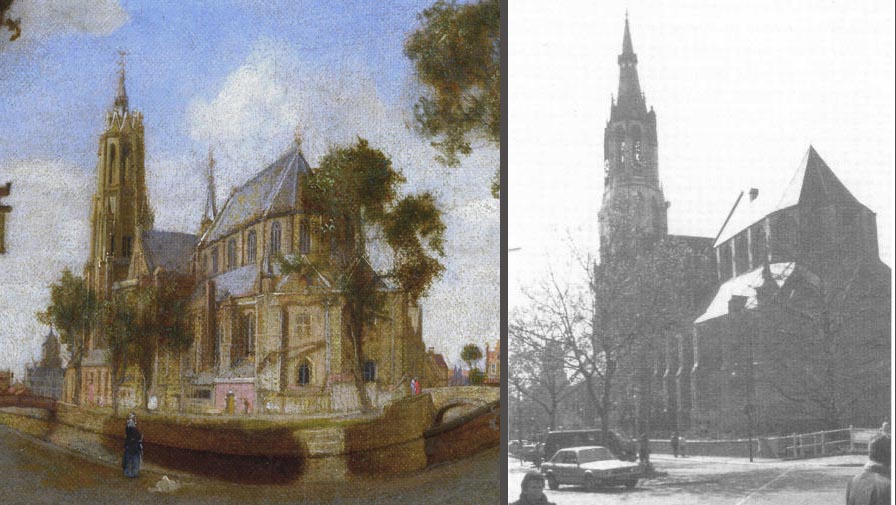
The lute and the viol, the scroll of which has been carved into a little face, are arranged so as to form a tabletop still life. They rest upon a loosely folded blue cloth before a plastered wall that is a miniature masterpiece of “abstract expressionist” brushwork, composed of the same colors that are used in rendering the street, the buildings, and the trees in the right half of the picture. In all likelihood, Fabritius had in mind an analogy between painting and music.
What we see on the right, in contrast to the flattened and compressed arrangement on the left, is an exaggeratedly wide-angle view of the Nieuwe Kerk, the Stadhuis (small in the distance), and a row of gabled houses. (A photograph taken of the Nieuwe Kerk with a 35-mm lens is shown above) Arthur Wheelock has argued that Fabritius looked through a double-concave lens to obtain his wide-angle perspective.
Fabritius has done something that is surprisingly similar to what Brunelleschi did in painting his talvolette: he has taken his stand at an identifiable spot—at the corner of the Vrouwenrecht and the Nieuwelangendijk—from which vantage point he (or his imaginary philosopher) contemplates the architectural symbols of the institutions of which he is a member.
Fabritius’s standpoint attaches significance to the art of music, opposite in every way to architecture in that music is totally an art of process, having no existence apart from the dynamic of performing or experiencing it, while architecture is totally an art of stasis. Surely it is not without significance that the head of Fabritius’s lute rises to just the same height as does the spire of the Nieuwe Kerk, suggesting that a new tension, the personal against the public, has supplanted the old rivalry between Church and State.
In many ways we find anticipated in Fabritius’s little picture the conviction that Walter Paler expressed two hundred years later: all the arts aspire “towards the principle of music, music being the typical or ideally consummate art.” Moreover, all our experiencing of the world consists of the impressions “of the individual in his isolation, each mind keeping as a solitary prisoner its own dream of the world.” It seems likely that a similar thought led Fabritius to place his philosopher against a pattern of confining bars.
Smith doesn't even care to refute the theory that this small painting was made to fit into a Dutch perspective box - where it would wrap around a curved back and allow a viewer to peep through a hole and feel encircled by a scene.
(It's explained on the National Gallery website )
Given its size - and unusual theme - that would seem to be a more likely explanation for its intended use.
Though such an instance of perspective illusion for its own sake runs completely opposite the argument which Smith is making.
***** Part II ********

Although Piranesi claimed for himself the title Venetian architect,” he actually designed only one small building. Yet he deserved the name, for the role he played in the history of architecture was of the greatest theoretical importance. He is chiefly known, of course, for his hundreds of etchings of city vistas and of ancient ruins. In his polemical writings he extolled the magnificence of ancient Rome. Yet he did not imaginatively reconstruct vistas of the ancient city. Rather, he devoted himself to elegiac meditations over the processes of ruination that had overtaken that grandeur. His concern was similar to that of his younger contemporary Edward Gibbon, who was inspired by the ruins of the Forum to write a history not of the rise to splendor hut of the decline and fall of the Roman Empire.

Piranesi (1720-1778)Carcere XIV
Piranesi’s most famous and most sought-after works are the Prisons, which antedate all but a small handful of the vedute. Needless to say, they have been interpreted in many different ways, ranging from Emil Kaufmann’s assertion that they embody chaos and utter confusion to Maurizio Calvesi’s belief that they glorify Rome, Roman law, and Roman order. Both these interpretations seem to me wide of the mark, although Calvesi, alone among recent writers on Piranesi, has had the good sense to detect a connecion between the artist and Giambattista Vico, whom he thinks Piranesi may actually have met on a trip to Naples in 1743, the year before Vico’ death. However, the relationship Calvesi discerns between the two men has only to do with their common concern for the greatness of Rome and the non-Helenic origins of Roman civilization.
Like Vico, he found it to be in the nature of the human condition that men find themselves free to direct their individual lives (not a single figure in the fourteen plates of the first edition is shackled or enchained), and yet they are located within an all-encompassing cultural context that is man-made but not of their own making. The few small figures that occupy these titanic interiors are like bemused tourists: they climb and descend palatial stairways without knowing for whom they were made or whither they may lead; they traverse wooden bridges that lead nowhere, abutting against solid masonry walls; they are surrounded on all sides by arched openings and passageways that do not join, making communication between and among the little clusters of people who are scattered throughout the edifice impossible. Ropes and scaffoldings abound, but no one is shaping or placing a block of stone. An inconceivable amount of toil must have gone into the creation of the structures, yet they are totally without political implications: one cannot imagine what kind of state or what sort of ruler may have marshaled those efforts or to what kind of society the little human beings may belong. The context is wholly non-institutional: it demands no allegiance or allegiances of its occupants. The etchings exhibit strong chiaroscuro, yet there are few visible sources of light; the structures, for all their apparent substantiality, are curiously dreamlike.

Carceri II
Although Vico professed to remain a loyal member of the Catholic Church, he had in fact invented a new religion, according to which there is an all-governing Providence (later to be called the Zeitgeist) that brings it about that historical process itself can be relied upon to proviie the total “binding up’ of a civilization, no matter how disparate its various facets may seem to be. There was no place in his New Science for a biblical or Christian view of history—no teleology, no eschatology. Though he made a distinction between th false religions of antiquity and the true religion of the Church, he found no need for transcendency or for divine intervention in men’s affairs, no need for accordiig historical significance to the Incarnation, no need for concepts of sin and redemption, no reason for expecting a Last Judgment.
It was the grandeur of this fresh idea, I believe, that inspired Piranesi in his mid-twenties to produce the first edition of the Carceri.
Since Smith does not tell us that Piranesi ever wrote anything about Vico, we can assume that he didn't -- and so a direct connection between the two is rather speculative.
But still, it does seem that the one has illustrated the philosophy of other - which has lived on through Hegel, Marx, and Heidigger into the mainstream of academic thought.
As prints, these images have been much more accessible to me than paintings, and I first saw them in Cincinnati almost 50 years ago.
With their connection to Surrealism (and from there to science fiction films like"The Matrix") , the Carceri seem to be the most admired in our time - but being fascinated by ancient Rome, I prefer the scenes of actual ruins, especially the collosseum.

Carceri VII

School of Athens - Carceri V (details)
Only in Carceri II and VII do we catch a glimpse of the open sky and of a modern Italian city. These glimpses may rewardingly be compared with the ones we see through the Bramantian architecture of Raphael’s School of Athens, where we see a gathering of Greek philosophers inside an unmistakably Roman building that closely resembles the as-yet-hardly-begun Basilica of St. Peter. However, Raphael was not in the least concerned with either Greek or Roman history, Greek or Roman culture, but rather with the power of Christian thought to encompass all that was admirable in Greek philosophy and Roman statecraft.
In what amounts to a proto-Freudian vision of cultural inheritance, that dark substructure contains fragmentary suggestions of violence, barbarism, imperial grandeur, ruination, torture, and conquest. Whereas Raphael invites us to take our stand within a frame of reference that the Church (or perhaps Christian humanism) provides and to contemplate the wisdom arid nobility of that stand, Piranesi asserts the ultimate reality of historical process itself and the impossibility of our gaining a vantage point outside its confines.

Pieter Breugel, 1563
It occurs to me that much of Smith's description of the Carceri would also apply to Breugel's "Tower of Babel", painted nearly two hundred years earlier (long before the birth of Vico)

Tiepolo, Sacrifice of Iphigenia, 1757
It also occurs to me that the architecture in the above painting has much in common with the "School of Athens", even though it was done even later than the Carceri.
Which would suggest that these attitudes toward monumental architecture are not specific to time and place.

Alma-Tadema, 1870
And here's one from a century later.
*************
...and now, by way of digression:
It has been the burden of my argument from the beginning that the quintessential sense of Renaissance perspective is bound up with architecture and with men’s attitudes toward the institutions that commission works of architectural art. At this point I think it worthwhile to digress briefly to consider the question: what if an architect were to adopt Piranesi’s (or Vico’s or Hegel’s) standpoint in regard to the relation of edifices to history, what kind of building could he design as an appropriate expression of this new conviction or doxa? 
H.H. Ricardson, Unity Church, Sringfield
All such architecture differs from that of Brunelleschi and Wren in that it was intended primarily to produce a “modification of the minds” of relatively private persons, within a philosophical frame of reference that accorded a higher order of reality to the experiencing mind than to the institutions that had traditionally been thought to make up the Slate. The churches for which Gothic Revival buildings were erected did not perform the functions of those that had been presided over by thirteenth-century bishops—men who (or churciec which) enforced canon law, suppressed heresy by military force, challenged the authority of kings and princes if need be, and regulated men’s lives in countless ways. Nineteenth-century churches depended upon suasion. They sought to save men’s souls and to promote virtue, but the sinner could take his choice among many denominations, none of which cold send him to the stake, or even to the pillory.
There are two ways that architecture can be based upon process, both of which were clearly set forth during Piranesi’s lifEtime. One possibility is deliberately to build into the architectural fabric of the city a visible embodiment of a collective or ancestral memory, a record and reminder of the history of the community’s existence. ---- This is the option that dominated the architecture of the late nineteenth and early twentieth centuries, though the beginnings of what has misleadingly and disparagingly been called “revivalism” or “eclecticism can be traced back to the middle years of the eighteenth century.
So that's why Gothic revival feels less convincing than the Gothic itself?
It's just a kind of advertising - so doing it less-than-perfect might mean one less customer comes through the door - but at least Heaven is not offended by a world put out of order.

Frank Lloyd Wright, Unity Temple, Oak Park
Even though it could not be accused of being a revival of anything, the above church in my neighborhood has always felt to me less like a sacred place and more like a Hollywood set.
The second possibility was formulated during Piranesi’s lifetime by his fellow Venetian Carlo Lodoli (1690—1761), who left no writings from his own hand, but whose ideas were published by Count Francesco Algatotti at about the time of Lodoli’s death. Rejecting cultural history as the basis of architecture, Lodoli proposed that architecture should be grounded in processes of construction and of use.
Whereas Vico amd Piranesi had internalized the significance of art and artifacts by relating them ultimately to the processes by which minds are modified, Lodoli externalized or objectified the principles of architecture in a way that quite divorced architecture from perspectival "stand-taking” of the sort that had been espoused by Brunelleschi and his heirs. Despite his being a monk, Lodoli rejected entirely the traditional conception of buildings as institutional symbols.
It is one of the ironies of modern history that Lodoli’s doctrine, which had little or no effect upon the architecture of his own day, should have gained a complete triumph over cultural historicism——but only by way of a later development in historicism itself. Vico did not foresee the possibility of dividing a people’s history into a succession of more and more narrowly defined style- periods, each with its own distinctive art and architecture. It was only with that development that people began to ask, ‘What is the nature of own style- period, and which kind of architecture would be appropriate to our Age?”
Following the Positivists of the mid-nineteenth century, they concluded that they were entering the Age of Science, to which the functionalist theories of Lodoli seemed wholly apposite—though in fact their theorizing owed more to the Gothic Revivalists than to Lodoli himself.

Frank Gehry, Pritzker Pavillion
On first read, I find the above explanation for the triumph of international modernism to be utterly fascinating.
Then, I'm wondering, will Smith explain the post-modernism of Gehry as following a new kind of post-Newtonian science -- or as the glorification of the rebellious self.
We are living today, I believe, with just those consequences. They have resulted from the belief, cherished by a small but immensely influential elite within the architectural profession in the early years of the twentieth century, that human beings can step outside history and build cities that will remain perpetually young, impervious to the processes of corruption and decay, even to the processes of stylistic change that the passage of historical time brings about. But though the new buildings, with their vitreous surfaces, may seem timeless, history continues. Circumstances change; architects feel the need to be creative, inventive, up-to-date; fads succeed one another more and more rapidly. But as architects have pursued their Lodolian goals, they have aided and abetted the anti-institutionalist and experientialist aspects of modern liberal thought, for once one enters the indefinable and incomprehensible world of the carceri, perfect symbol of “cultural relativism” and the absence of ethical and political frames of reference, the possibility of “taking one’s stand” with regard to matters of institutional loyalty and civic allegiance simply melts away, as do the traditional meanings of architecture itself.
What Lodoli looked forward to was the emergence of an architecture that would be perpetually young, eterna giovariezza. Count Algarotti, perhaps by virtue of his being a count, had grievous misgivings. Algarotti felt that the realization of such new principles would wreak catastrophe in architecture. He foresaw for his beloved art "the most terrific consequences” from so novel a doctrine.
Yes, the Pritzker Pavillion does seem to resemble the Carceri - with its outsized surfaces that lead nowhere and have no purpose. The visitor is enveloped in a powerful and irrational world in which he is only expected to participate by gawking - or running away.

Helmut Jahn, James. R. Thompson Center
But even more so the Thompson Center, that really does feel like one of the carceri (I walk through it every weekend)
And unlike the Pavillion, it was intended to be a place for public affairs rather than entertainment.

Albert Speer
If only Smith would expand his discussion of "taking ones stand" to the architecture of other periods - Medieval, ancient, and non-European.
And what about the Soviet and Fascist architecture of the 20th Century?

Great Hall of the People, Beijing
Doesn't Speer's domed hall, shown above, invite us to stand up for the Fuhrer?
Doesn't the Great Hall of the People invite us to take our stand on Tiananmen Square?
******** Part III *********

Our study ends as it began, with our considering an artist’s prolonged and intense contemplation of architectural symbols of Church and State. Having come full circle, we conclude with Monet’s paintings of Rouen Cathedral and of the Houses of Parliament, which were made almost exactly five hundred years after Brunelleschi’s tavolelle of the Baptistry and Town Hall of Florence.
We need to look first at the route by which Monet became the perfect exemplar of the private man(in contrast to his older contemporary, Gustave Courbet) .....
So far as we know, his one political act was that of signing a petition that had been drawn up by Zola and Clemenceau in support of the cause of Captain Dreyfus. But when he was invited to join a committee to work for the reversal of Zola’s conviction for libel following the publication of i’Accuse, he declined: “Quant a faire partie d’un comité quelconque, ce n’est pas du tout mon affaire.”

Monet, Boulevard Des Capucines (1873)
Smith goes on to detail how Monet, unlike Renoir who was wounded and Bazille who was killed, got out of Paris to avoid the Franco-Prussian war, fleeing to London, and to Holland -- only returning after the Paris Commune had been crushed -- and began to devise "a new kind of urban imagery"
The new type, which is best represented by his Boulevard des Capucines (1873), minimized or obliterated the grand perspectival vistas that had recently been built into the city by Baron Haussmann and stressed, instead, the casual observer’s enjoyment of random sensations as he looked down upon the traffic of the boulevards from an upstairs window or balcony. The Boulevard des Capucines is the most celebrated example because of the prominent place accorded it in Louis Leroy’s mockingly hostile review of the first Impressionist exhibition of 1874. The composition is a novel one in that the dullest and least interesting area lies at the “dead” center of the canvas, while the shapes and colors that attract the eye are dispersed toward the margins. It is as if the painter had covered the fovea of his retina (that small area that is alone capable of focused vision), leaving exposed only the peripheral field that is sensitive to color and movement. just as the structure of the picture denies the traditional significance of centrality. So, too, does it present us with a city that seems to be without Center, in the sense of that word that we encounter in the writings of Mircea Eliade and of Hans Sedlmayr. It is a city without landmarks, historical and institutional symbols, collective goals, a city of apartment houses and of strolling boulevardiers, whose attitude toward common purpose seems no different from Monet’s own.
And yet, this scene violates no rules of perspective,
and like Uccello did, it uses something like an Albertian grid
(in this case, created from lines of pedestrians)
to measure space along the ground.
This scene makes the city enjoyable
just as Chinese paintings
make mountains and rivers
delightful places to visit.
Although Leroy’s argument against Impressionism presented in the form of an imaginary dialogue, is badly muddled, one can see plainly that what offended him was Monet’s reduction ot the ‘reality of things,” including the reality of the city of Paris, to a scattering of loosely defined “impressions”— a word he uses in the same sense in which Pater had employed it six years earlier, though what had seemed good to Pater was intolerable to Leroy.
The consensus among critics and historians of modern art has been that Leroy was blind to the self-evident excellence of Monet’s cityscape. But if it be admitted that city buildings provide us, collectively, with our most—indeed, our only— cogent visual symbol of the State’s real being, then one may easily understand why Leroy’s artist-companion at the exhibition, one “M. Joseph Vincent, . . recipient of medals and decorations under several governments,” should have been outraged. Even though he expressed himself badly, he (or Leroy) presumably perceived that the Impressionists’ imago civitatis was as destructive to traditional political values, the values that sustain urban civility and the life of the polls, as Walter Pater’s conception of the good life had seemed, to Londoners who first encountered it in 1873, destructive to traditional ethical and religious values. Solipsism and politics cannot possibly be reconciled, any more than can solipsism and Christianity.
Impressionism is so universally accepted as France's gift to Western Civilization, it's good to see it taken to task -- even if the reasons are similar to the "decadency" that the Nazis found in the avant garde art of the early 20th C.
Here's what Leroy and his friend, "Mr. Joseph Vincent", themselves had to say:
"Unfortunately, I was imprudent enough to leave him too long in front of the Boulevard des Capucines, by the same painter (Monet)
" 'Ah-ha!' he sneered in Mephistophelian manner. 'Is that brilliant enough, now! There's impression, or I don't know what it means. Only, be so good as to tell me what those innumerable black tongue-lickings in the lower part of the picture represent ?'
" 'Why, those are people walking along,' I replied.
" 'Then do I look like that when I'm walking along the boulevard des Capucines ? Blood and thunder! So you're making fun of me at last?'
" 'I assure you, M. Vincent. .
" 'But those spots were obtained by the same method as that used to imitate marble: a bit here, a bit there, slap-dash, any old way. It's unheard-of, appalling! I'll get a stroke from it, for sure.'
To M. Vincent, and his demand for "good artistic manners, to devotion to form, and respect for the masters", one might remark that loose, brushy passages can be found in many celebrated paintings that pre-date the mid-19th Century.
To N.K. Smith, one can ask why the private contemplation of urban beauty has to be considered antithetical to the cultivation of public virtues. Didn't he begin by telling us how other Impressionist painters were more patriotic than Monet?
Can't even career politicians have a private space in their lives? and private walls where they can hang things that bring them personal joy?
And, just why does Smith say that Leroy's comments are "badly muddled"? Isn't it clear that Leroy and M. Vincent enjoy seeing more sharply defined, identifiable details, and feel short-changed when that is not being offered. We might feel otherwise, but who can be any more clear about what is wanted from a painting?
In the 1870s Monet continued to paint kinds of scenes and occasions that have characteristically appealed to the modern tourist and vacationist.—peopie who were, if only temporarily, as disengaged from the mundane world of workaday responsibility as was Monet in his upstairs room: scenes that involved sailboats and canoes, beaches and boulevards, poppy fields and parks, quiet ponds and broad rivers, all of which he savored in their pure presentness, without a thought, so far as we can tell, for past or future, memory or expectation. Many of the landscapes of the 1860s and 1870s contain figures— people who, it is implied, take pleasure in the colorful world around them in the same way the artist experiences it and invites us to experience it, as we vicariously stroll along country roads and through poppy-strewn fields or float peacefully in boats on the sunlit Seine.
Just as Chinese mandarins were expected to occasionally, and eventually, throw off their civic responsibilities and retreat to a garden or mountain valley, where they could live in "pure presentness, without a thought for past or future". Can't that attitude be understand as complementary, rather than oppositional, to civic duty?

Monet, Rocks at Port-Goulphar, Belle-Ile,1886
During those years Monet, like his companions at the Café Guerbois, found much in rural nature that was worth celebrating for its own intrinsic goodness. In the 1880's, however, we find a conspicuous increase in the number of works that do not contain figures and that do not bring to mind the pleasures of the vacationist. Such are his many paintings of the cliffs along the Channel coast, of the barren hills and rocky outcroppings of the Creuse valley, and of the jagged rock formatons that so fascinated the painter during the ten weeks he spent on the Belie Ile, off the west coast of France, in the autumn of 1886. These pictures seem remote from any kind of human activity. As Robert Herbert has lately observed, the element of sociability gradually disappears. What we are invited to enjoy has less and less to do with a comprehensible attitude toward “the world,” stretching away toward a horizon (with all its connotations as to extension in time as well as in space), and more and more to do with the artist’s processes of experiencing and of translating those processes into an analogous process of painting.

Monet, Bend of the River Epte, 1888
While realizing that Smith is here presenting Monet as the father of Modern Art (or, more precisely, Modern Art theories), the above painting certainly feels like a place in "the world" to me. That's how I enjoy it - and that's also how this kind of painting has affected my experience of actual rivers in Summer - and probably made me so addicted to them. I really don't care about "the artist’s processes of experiencing and of translating those processes into an analogous process of painting." -- and would challenge those who do to write something about it that is as specific and comprehensible as one might write about the process of brewing a malt beer.

After devoting a few months in 1891 to producing a series of increasingly “abstract” or flattened compositions based upon the rows of poplars on the banks of the Epte near his home at Giverny, Monet turned to the facade of Rouen Cathedral. It was an astonishing choice of subject, sharply different from the characteristic concerns of both Monet and the other members of the Impressionist group. Before 1892, architecture had played a minimal role in Monet’s art: nondescript houses along country roads, a distant church as part of the skyline of a village, anonymous apartment buildings along the boulevards of Paris, one lateral view of St. Germain l’Auxerrois (as background for the little park beside it), hardly anything more. Beginning in the spring of 1892, he chose to give over four years of his life to twenty-eight canvases that were completely filled with the facade of a medieval cathedral. In almost all his previous work nature had predominated; suddenly nature was as totally absent as it is in the Carceri.

And these gray cathedrals, which are shot through with purple of blue touched with gold, and these white cathedrals, with portals of fire, streaming with red, blue, and green flames, and these rainbow-colored cathedrals, which look as if they were seen through a turning prism, and these blue yet roseate cathedrals, would suddenly give you a lasting vision, not of twenty but of a hundred, a thousand, a billion states of the cathedral, always in an endless cycle of suns. This would be life itself, of which sensation would be able to give us the liveliest sense of realiy. Ultimate perfection of art, never attained heretofore.
Smith quotes Clemenceau as follows:
and then Smith quotes Roger Fry who complained that Monet's
"achievement was too rigourous and scientific... Monet cared to reproduce on his canvas the actual visual sensation as far as that was possible....he aimed almost exclusively at a scientific documentation of appearances"
In concurrence, George Heard Hamilton has written
"... we can describe these paintings as the climax of Impressionism, its climax, destruction, and transformation. Upon the basis of a technique painstakingly developed through thirty years of experimentation and directed toward the depiction of separate, isolated, unrelated instants in the outer world of positivist, physical causality, the world of the railroad train, Monet erected a new kind of painting which reveals the nature of perception rather than the nature of the thing perceived" (G. H. Hamilton, Claude Monet's Paintings of Rouen Cathedral
But as Smith then notes:
Hardly anyone has been willing to admit, it would seem, that the colors he used in painting Rouen Cathedral do not at all correspond to what human eyes see. Modern color films are extremely sensitive to variations in color. While it is demonstrable that the light on the facade on a sunny morning is bluish and that of the late afternoon, reddish, every tourist can see perfectly well that the building is made of dull, gray, somewhat smoke-stained limestone and that its color remains essentially unchanged throughout the day. I have stared at it and can vouch for the fact that under no conditions does the church appear iridescent, nor does the building seem, on a cloudy day, to have been made of brown mud, though that is how Monet represented it in one of the versions now in the Musée d’Orsay in Paris.
And this is why I love Smith! (how ever many times I may disagree with him)
He actually looks at the painting -- looks at the cathedral -- and makes up his own mind, regardless of academically approved commentary.
And he further notes that:
While he did work on different canvases at different times of day and under different atmospheric conditions, it must be kept in mind that he spent only two relatively brief periods in Rouen, in the spring of 1892 and again in the spring of 1893, whereafter he worked on the paintings in his studio at Giverny, both between those two campaigns and for two full years thereafter. Not until 1895 did he exhibit any of the paintings. When he displayed twenty of the cathedrals at Durand-Ruel’s in that year he arranged them (to the best of our knowledge) not according to a succession of times of day, from early morning till sunset, but rather so as to achieve a succession of color effects or harmonies on which he had been working for many months. By no means do the images record the “fleeting, momentary experiences” that have so often been said to he what it was that he tried to capture. The cathedrals are deeply meditated upon works of art.
A different response altogether in 1895 was that of André Michel and Camille Mauclair , both of whom were offended by what they took to be the moral implications of the works. As Joachim Pissarro sums up Mauclair’s position, that critic found the paintings to be “insulting, disorderly, sensual, orgiastic, and even blasphemous.” What concerned both these men, it would seem, was the vast disparity between what Monet was affirming and what the cathedral itself had been built to mean, and had continued to mean, to the Christians of Rouen for some six hundred years. Though both George Heard Hamilton and Joachim Pissarro touch upon the matter, neither of them seems willing to concede that for various reasons—social, historical, ethical, philosophical, theological—the Gothic cathedral posed the greatest possible challenge to the solipsistic hedonism that Monet had long ago committed himself to and was resolved to defend.
Did some contemporary critics really find these works to be blasphemous?
I'm shocked.
Smith finds a tribute to solipsistic hedonism in this passage written by Walter Pater in 1868:
At first sight experience seems to bury us under a flood of external objects, pressing upon us with a sharp and importunate reality, calling us out of ourselves in a thousand forms of action. But when reflexion begins to play upon those objects they are dissipated under its influence; the cohesive force seems suspended like
some trick of magic; each object is loosed into a group of impressions—colour, odour, texture—in the mind of the observer. And if we continue to dwell in thought on this world, not of objects in the solidity with which language invests them, but of impressions, unstable, flickering, inconsistent, which burn and are extinguished with our consciousness of them, it contracts still further: the whole scope of observation is dwarfed into the narrow chamber of the individual mind. . Every one of those impressions is the impression of the individual in his isolation, each mind keeping as its solitary prisoner its own dream of the world. Analysis goes a step farther still, and assures us that those impressions of the individual mind to which, for each one of us, experience dwindles down, are in perpetual flight; that each of them is limited by time, and that as time is infinitely divisible, each of them is infinitely divisible also; all that is actual in it being a single moment, gone while we try to apprehend it, of which it may ever more truly be said that it has ceased to be than that it is. .. . Not the fruit of experience, but experience itself is the end. .. . The theory or idea or system which required of us the sacrifice of any part of this experience, in consideration of some interest into which we cannot enter, or some abstract theory we have not identified with ourselves, or what is only conventional, has no real claim upon us.
The Wikipedia article notes that "As a boy Pater had cherished the idea of entering the Anglican Church, but at Oxford his faith in Christianity had been shaken. In spite of his inclination towards the ritual and aesthetic elements of the church, he had little interest in Christian doctrine and did not pursue ordination"
It also notes that charges of hedonism and amorality would haunt him throughout his career - and Smith seems to share this rather Puritanical reaction.
But however much he may have given himself over to the pleasures of the arts, I'm not seeing mention of any bad behavior as either a member of a family, faculty, or nation. While he is commended for the excellence of his prose.
When Georges Clemenceau (a confirmed anticlericalist) acknowledged that only a hedonist could enjoy Monet’s paintings of the cathedral and exuberantly proclaimed that there could be a hundred, a thousand, a a billion states of the cathedral—as many as there were moments of sensation in an artist’s or an observer’s experience—he was no doubt speaking as a sensationalist himself.
And yet -- who could be more of an active public man than the statesman Clemenceau, who missed the Seige of Paris because he had been exiled for prose that attacked the imperial regime of Napoleon III, and who would later be called "Le Père de la Victoire" for his role as wartime prime minister.
Monet was ‘taking his stand' in defense of an idea, but not with reference to something that existed “out there” in the public world that he shared with his fellow citizens. Instead, he sought to dissolve away the ancient stonework of the building into a luminously colorful fabric of paint, affirming once and for all the absolute primacy of sensate experience, in all its ephemerality, over the durability of the building and of what it was the cathedral stood for.
And just what did the cathedral stand for?
As Smith then notes, Rouen and several other famous French cathedrals had become "the greatest of all tourist attractions" in the late 19th Century, where, inspired by writers like Ruskin and Henry Adams, tourists practiced "romantic historicists" who visited cathedrals to immerse themselves in "the whole life and spirit of the medieval world".
Ralph Adams Cram, Fourth Presbyterian Church, Chicago
As Ralph Adams Cram described it (in the introduction to the 1913 edition of Henry Adams' "Mont-Saint-Michael and Chartres", the Middle Ages were a time when:
“Dante, the cathedral builders, the painters, sculptors, and music masters—all were closely knit into the warp and woof of philosophy, statecraft, economics, and religious devotion;— indeed, it may be said that the Middle Ages, more than any other recorded epoch in history, must be considered en bloc, as a period of consistent unity as highly emphasized as was its dynamic force.” 
Milton Horn, Creation of Adam
While I would like to note that the above modern sculpture now hangs upon an outer wall of the church in Chicago that Cram had designed a century earlier. Can it also seem to share in that "consistent unity"?
Smith immediately begins to address that question as follows:
But if the Middle Ages were so admired for their “consistent unity,” their art idealized for having been devoted so completely to the expression of that unity, what might one conceive to be the right relationship of modern art to our present “age”? Baudelaire had wrestled with the problem and had decided that the painter of modern life was Constantin Guys, with whom he specifically associated the stance of the dandy, whose doctrine of “elegance and originality” he regarded as a “kind of religion,” as demanding in its discipline as medieval monasticism. Baudelaire believed that the type would survive longer in England than in France; he would have been quick to recognize the kinship between the dandy and Pater’s elegant esthete, burning with his “hard, gemlike flame.” However, it is easy to see that what the cultivated Englishman or Frenchman admired in the Gothic cathedral—namely, its symbolization of the dynamic cohesiveness of medieval society—was the diametrical opposite of that “suspension of cohesive force,” that dissipation of experience into an infinite number of momentary sensations, which Pater conceived to be the highest goal of the human spirit and the whole “tendency of modern thought.”
These opposites can be considered as complementary roles.
"Cohesive force" is applied to build something (a church, drawing, essay, or symphony, while it is suspended when best experiencing it.
What a bold tour de force it may have seemed to Monet, then, to confront the Gothic cathedral itself, that cornerstone of the edifice of romantic, collectivist, proto-socialist historic ism, and to dissolve it into a shimmering fabric of sensation. What better way could he have found for showing his rejection of the claims that systems, ideas, theories, institutions, and conventions may have made upon him?
He would have better shown rejection by presenting the church as an insignificant background detail within a cityscape -- rather than as front, center, looming, and glowing.
Pissarro, Rue de l'Épicerie, Rouen, 1898
Here, for example, is the same cathedral moved into the background.
It still dominates the scene, just mountains would, but this crowd has not gathered to go to church, and you can imagine other varations where the cathedral would be even less important.
So long as he confined himself to poppy fields and ponds, Monet was able to produce pictorial affirmations that still seem today to be enormously persuasive, thanks to the vibrant immediacy of their esthetic impact. But even as he retreated to such lonely places as the valley of the Creuse, he must have known himself to be surrounded by, and wholly dependent for his security upon, the established and lawful institutions of the French state. Always there existed around him a religio-political order of things that implicitly charged him with self-indulgence and superficiality.
Whoa! Monet is not a junkie or wino -- he's the designer and manufacturer of unusally beautiful and much-cherished things. While his discipline may have been seen as too unconventional in his day, now we can better appreciate the intensity of it.
Perhaps John Calvin would have charged him (as well as all secular musicians) with self-indulgence and superficiality, but I doubt that the gentry-bishops of the 15th Century would have concurred.
Monet contributes to the social order that keeps him safe, just as much as policemen, teachers, lawyers, and all the other professionals and craftsmen do.
Most obviously, of course, it was the Christian Church, so well represented by Rouen Cathedral, that had been devoted for some nineteen hundred years to upholding those ideas, traditions, and ethical standards, those teleological conceptions of ultimate purpose and worth, which constituted the body of conventional understanding that made it possible for people to convene as fellow members, fellow citizens.
I like this argument because it cuts to the quick of the modern world.
What is "the body of conventional understanding" that makes it possible for people to live peacefully and productively with each other, now that the authority of the church has been rejected ?
We've been working on it for the past 500 years. It's still a work in progress, but it seems we have agreed that toleration of diversity trumps authority. (although that struggle is still be played out in the Muslim world)
Monet, like Pater, rejected that traditional faith. Yet it was not possible for him to live his life in the world on the assumption that everyone else was a solipsist of the kind he himself aspired to be. Although his art at no point bears upon anything that might be thought to pertain to any of the virtues, he could not in actual life dismiss from his mind the whole realm of ethical concern.
Ouch!
Perhaps this explains why Smith is more of an historian than an aesthete - and why this book, though interesting in some particulars, badly needs to be edited.
He does not understand how the beautiful, perfect unity of a work exemplifies temperance, wisdom, justice, and courage. (this is, by the way, why Confucius recommends that gentlemen (i.e. those who manage public affairs) practice music - and it has carried over into the practice of a kind of landscape painting that is not too distant from Monet's)
Xia Gue (active 1195-1230)
Twenty-eight times Monet tried to disintegrate the cathedral's stubbornly unchanging facade into a finely textured and intensely colorful fabric of his own creation, to suspend its cohesive force by “some trick of magic”—aIl the while taking some deep-seated satisfaction in the fact that the church did continue to be there, despite all those ever-changing atmospheric effects to which he sought to attribute some comparable measure of significance. One might say that he was engaged in carrying on a dialogue, not between Church and State, in the manner of Brunelleschi, but between the building and his own self-conscious being.
That such ideas were on Monet’s niind seems reasonably certain for at least three reasons. First, he deliberately chose the very old facade of Rouen Cathedral, intimately associated with the idea of zeitgeist, as the subject of his aggressively modern paintings, thereby setting up an opposition that is not to be found in his earlier work. Second, his mode of working depended, not upon his ability to capture an instantaneous impression, as so many have asserted, but upon his being able to count upon the fact that the conditions that prevail this afternoon at 2:30 will be observable tomorrow at 2:30, if the sun is shining. That is to say, he relied upon there being a pattern of predictable recurrences that alone made it possible for him to work on the same canvas over and over again. And third, he chose to frame the facade in such a way that there lay at the center, or near the center, of each of his twenty-eight canvases—a clock!
I have to admit -- until Smith pointed it out --- I never noticed that damn clock!
And I wonder why it's been removed - something seems to be missing.
Here's how it looked in 1912, in an etching by Albany Howarth
This disc may be front center in Monet's painting, but it's not especially recognizable as a clock.
It's features are as blurry as the surrounding architectural detail.
If this kind of painting shows disrespect for the church -- it disrespects time as well.
Jean Colombe, Presentation of the Virgin
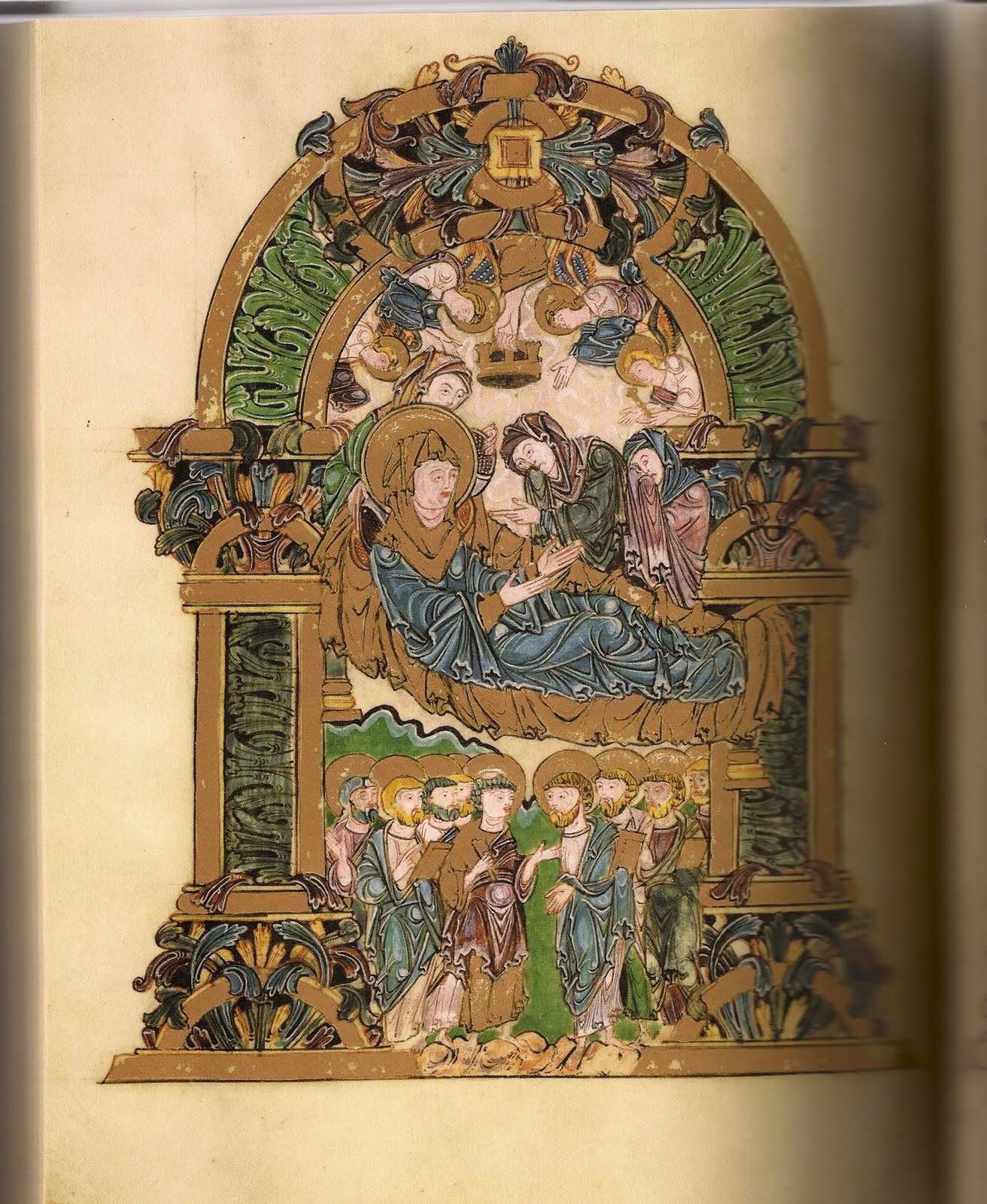
It is especially in connection with Monet’s attitude toward time that it is interesting to compare his cathedral facades with the image that Jean Colombe made as he was completing the Très riches heures in the latter part of the fifteenth century. For his illustration of the Presentation of the Virgin in the Temple he has created a stage, the backdrop of which is a finely detailed representation of the three central sections of the facade of the Cathedral of Bourges. Before these he has placed Joachim and Anna, aligned with the two lateral portals and, in the center, the Virgin Mary as a very young girl. Surely he did not mean for us to see these three people as actors performing a religious play on the parvis of the local cathedral; Ihere is no element of make-believe here. The point he is making is that story-telling lies at the very heart of biblical and Christian thought. The facades at both Bourges and Rouen are decorated with dozens of statues of saints who had lived during the many hundreds of years that had elapsed between the time of Jesus and that of the building of these two churches. Although it would not have been easy for someone on the ground to have identified each of the saints by name, anyone would have known that each of them could have been associated with a story, by virtue of which he or she had been endowed with miracle-working power, with the ability to intervene and intercede on behalf of living Christians so as to give shape and direction to the life-stories of individual citizens of Bourges and Rouen as they made their separate ways from birth to death and toward the Last Judgment that is depicted over the central portal at Bourges.
It's a bit of a stretch to claim that "the point he (Colombe) was making is that storytelling lies at the heart of Biblical and Christian thought" --- any more than millions of other Christian narratives might seem to make --- just because one can more clearly see the statues on his depiction of Bourges cathedral.
They're still so blurry, one has no idea what story they might be telling.
But, Smith is just using this idea to step up to the rant that follows:
And so there was sounded the death-knell for the art of narration that had been of central concern for Western artists for a thousand years. People continue to care about story-telling, of course, in novels, murder mysteries, soap operas, movies, but none of these is endowed with the kind of transcendent significance that is possessed by the stained-glass and sculptural imagery of the medieval cathedrals or by the great fresco cycles of the Renaissance. Our very lives have been “demythologized”—and nowhere more obviously than in twentieth-century painting.
Or ... one might notice that narrative/mythological art (both Christian and Classical) has lived, co-existing with other, more recent traditions, just as Buddhist sculpture has coexisted with landscape painting and calligraphy in China.
Manzu, Monumento al resistenza in Bergamo, 1977
But being immersed in university life for his entire adult life, Smith may not have been aware of that diversity, as every exhibit of contemporary art he would have seen was either abstract or the kind of narrative that is more personal than didactic.
In his academic world, contemporary "transcendence" could only be attributed to canonical abstract painters like Mark Rothko, and the sacred narrative is not the life of Jesus, but the history of Modern Art (regarding which Smith, an annointed professor of art history, might be considered a heretic)
After devoting four years of his life to painting the facade of a church of which he was not a member, in a city of which he was not and never had been a resident, Monet turned, in his next encounter with architecture, to the government buildings of a country of which he was not a citizen. Though he averred that he had always loved London because of its foggy atmosphere, it seems highly probable that his motivations in painting the Houses of Parliament were not merely aesthetic but were bound up, again, with complex emotional attitudes. It was to England that he had fled in the fall of 1870 when he decided to renounce his citizenly obligations to his own nation.
The contemplation of Monet's depictions of church and state is certainly a neat way to end, since Smith began his book by considering how Brunelleschi approached similar subjects.
Nearly thirty years later he returned to London, where his status was that of a foreign visitor, and there he contemplated at length the buildings that lay at the governmental center of the British empire. To that activity he brought a detachment that depended not only upon his being an outsider (with little sympathy, probably, for British imperialism) but also upon the buildings’ being separated from him by a wide body of water and by their being made only dimly visible through the fog. (No doubt there were bright sunny days during his sojourn in London, but he had no interest in the kind of ‘seeing” they provided.)
Taking inspiration, perhaps, from Clemenceau’s assertion that there could be a billion states of the cathedral, Monet undertook in London an even more ambitious project than the one he had carried out in Rouen. He installed in his hotel room some ninety stretched canvases—three times the number he had used for the cathedral—and began making notations thereon of the ever-changing phenomena of light that he observed and that he thought to be the very substance of his existence at its best—for why else should he have attached any importance to those slight changes in the way the light stimulated his retina? Why should he, or anyone else, have thought them to matter?
Nobody has done this ever again, have they? Not just to paint a few variations on the same scene, but to paint so many. Not even neo-Impressionists.
The Rouen series had sold well at high prices - and that would be an incentive to make an even larger edition.
Or maybe he was more fascinated by variations on a theme than anyone else.
Palazzo da Mula, 1908
Having dealt with church architecture and with civic architecture, Monet turned finally to domestic architecture. In the early 1900s he went to Venice and there made a few paintings of palaces along the Grand Canal. We need not linger over them, for the subject did not inspire the painter as earlier themes had done. 
Palazzo Dario, 1908
Painted in cold blues, these are surely the most dispiriting of all Monet’s works. The facades of the palaces lie parallel to the picture plane above a surface of water, so that no element at all of the perspectival costruzione, of which nothing was more important than the ground plane, survives.
There was no ground plane in the Rouen pictures, either. Palazzo Contarini, 1908
Obviously the buildings did not challenge him as Rouen Cathedral and the Houses of Parliament had done. Possibly the apparent gloominess was the result of dismal weather, possibly of his steadily failing eyesight. At any rate, the paintings reveal no discernible attitude on his part toward Venice or Italy or the family, or even toward Impressionism and the art of painting, for the Venetian buildings brought forth no new ideas or new approaches, no new insights into the meaning of architecture or locale. 
Water Lilies, 1916
He spent the remaining years of his life in producing a long series of works devoted to water lilies, watery surfaces, and flower beds, in relation to which the idea of “taking one’s stand” is wholly irrelevant—as it has been in all modern art since that time.
And so our book ends with a rant against "modern art".
What about "taking one's stand" regarding the value of an aesthetic life and a certain kind of beauty?
Or regarding the things in the world that inspired him?
Couldn't these paintings serve well for those who wish to protect these buildings and wetlands?
Isn't the conservation of such things always a public issue of some importance?
Many (if not most) people would agree that some kind of political or religious correctness is more important than the discovery, experience, and cultivation of beauty -- and Norris Kelly Smith is evidently one of them.
I'm not.
And I do notice that none of Smith's books or published papers address political or religious issues. Why does he want modern artists to be more concerned about this stuff than he has been?
But Smith does deserve credit for challenging orthodox art history.
And all orthodoxies need to be challenged, even those established by secular institutions.
************ Artist's House at Argenteuil, 1873
And now for a little tour
of some of the Monet's
at the Art Institute of Chicago.
The above, done earlier than any of the pieces
discussed by Smith,
has been my favorite.
It follows the rules of perspectve,
though a grid has not be laid out
on the ground plane.
But still, the viewer has a pretty good idea
of where he stands in relation to the house,
mother, and child. Bordighera, 1884
Here's another one of my favorites,
done two years before the "Bend of the River Epte"
discussed above,
and six years before Monet began the Rouen series.
I feel that his power was really peaking
in that decade, and slowly waned thereafter.
 Etretat : Beach and Falaise d'Amont, 1885
Here's another one that I like
from that decade.
 Houses of Parliament, 1900

 Palazzo Dario, 1908
And here's one of the Venetian scenes
that Smith disparaged
for introducing no new ideas.
It doesn't crackle with energy
like some his earlier sunny scenes,
but it's still quite enjoyable. Water Lily Pond, 1917-1922
Here's a detail from one of the water lily paintings.
As I recall, this is the kind of thing
that has earned Monet an important place in art history
as a pioneer in abstract painting.
It does feel as if this scene
was paint on cavas before it was
lilies on a pond.
Which is to say, it lacks a sense
of being a particular place
at a particular time. Lily Pond, 1900 (detail)
This earlier piece
feels more like his Giverny pond in the sun.
The A.I.C. has about 30 more Monets on display,
with a large selection from the hay stack series,
and all of them are worth seeing.
But the only reason for making it a permanent exhibit
is that the artist has been annointed
as a "Father of Modernism"
Otherwise, they should be rotated on and off display
with thousands of other good Impressionist paintings,
just as Japanese ceramics are rotated
through the Ando gallery,