.
Above is the expanded version of that same paragraph as written 10 years later - long after the exhibit had closed. Among some biographical details, Steinberg adds “ while modern art was in the making, Rodin seemed irrelevant”. No evidence is even suggested, so we may take that assertion to be Steinberg’s own assumption.
So this panegyric will intentionally ignore most of Rodin’s best known work.
Rodin himself drives no chisel; he kneads and palps the clay, and where a surface has not been shocked by his own fingering nerves, it tends to remain blunt and blind, or else— as in the many enlargements-overblown: rhetoric given off by false substance.
Of course, much of Rodin's own-fingered work is rhetorical too. It seeks to please, to aflict, to persuade-always to stir the heart up into fellow feeling. And it is on these programmatic works, with their charge of heroic agony and defeat, that Rodin's fame largely rests.
Degas has had better luck, His posthumous reputation as sculptor is not founded on what he showed during his life-the "frightful realism" (Huysmans) of the Petite Danseuse of 1880; it rests rather on some eighty unfinished, uncom-pletable wax figurines, formed in profoundest privacy and never exhibited dur. ing his life. Degas even left them uncast, so that a working hive of bathers, dancers and horses swarmed always about him like thoughts
And even for pieces that he will consider, Steinberg is more than ambivalent about their “rhetorical” features. It’s a shame that the public became so familiar with them.
Rodin did not pass the test of a disciplined taste. It failed by those criteria which alone addressed themselves to the essential formal quality of art. And as the emotions Rodin liked to represent were too sentimental and accessible, so their form was too loose to qualify as serious sculpture. Roger Fry, the revered mentor, had passed the final sentence: "His conception is not essentially a sculptural one. Rodin's concern is with the expression of character and situation; it is essentially dramatic and illustrational."
Fry also wrote: His conception of a figure is always so exceptional, so extreme, that every part of the figure is instinct with the central idea, every detail of hand or foot is an epitome of the whole, and the final composition of these parts is often a matter of doubt.
Steinberg mocks Fry as as a “revered mentor”, but at least Fry called it as he saw it, while Steinberg would not have been published if he did not elevate the works in a commercial catalog.
Roger Fry, self portrait, 1930-34
Regarding the first quote: Steinberg has properly scolded Fry for his essentialism. It was the rhetoric Fry used to argue on behalf of Cezanne and the other modern artists he was promoting as a curator - but it cannot withstand much scrutiny. Would Fry have called his own portrait paintings “essentially dramatic and illustrational”?
Regarding the second quote: I’m not sure how to parse the text . If Fry is saying that the parts are more tightly connected with each other than with their surrounding space, I’d agree . Like a tree trunk, his forms grow from within and are blind to what surrounds them.
It seems to me that formalism as a gauge of quality is rarely, if ever, what it claims to be. Rather than a means of isolating the esthetic factor from all styles and manifestations of art, it is, at least in its historic record, a taste preference for certain styles against others. Formalist criticism is nearly always engaged and passionate in its championship of a particular constellation of works. Thus between 1920 and 1950, the sculpture that appealed to formalists had to be unencumbered by expressive or symbolic content, and it tended to be monolithic. It was everything Rodin was not-solid and simple, undemonstrative and imperturbable-like the art of Brancusi, or of the Cyclades.
This passage points to the difference between Rodin and the rest of 20th C. sculpture - as well as the difficulty in “isolating the aesthetic factor” - which is especially difficult when viewing something quite unfamiliar- from an avant garde artist or another culture. Even harder if it represents a worldview found loathsome.(Nazi art). Perhaps every aesthetic judgment should be prefaced with “in my questionable opinion” ….. but if you’re bold enough to carefully articulate one, such self effacement is unlikely. And if some variant of formalism is not the foundation of a judgment, what is?
All that’s left is recognizing the authority of someone else’s judgment - or better yet - the anonymous authority implied by the passive voice. As it turns out, however, Steinberg will indeed express his own strong opinions, and stand behind them.
Growing up you take your place in the world, in the world of taste as in every other. At seventeen, vacationing in Denmark, I discovered the most beautiful of all possible sculptures in Copenhagen's Ny Carlsberg Glyptotek-a male head with a broken nose, Amenemhet III, Egyptian, Middle Kingdom (Fig. 182). The stone, the label said, was quartzite, and its hard crystalline shape was a revelation of infinite density. And that look it had of serious reserve seemed to hold other values implicit: you could tell it had been carved and polished with steadfast determination; and it was all "direct carving," all "honesty" with respect to material.
Quite a head - though note that Steinberg says he loved it in his youth - but no mention of today - and he puts scare quotes around two buzz words of modern sculpture: direct carving and honesty to material. So he’s hip to those ideas, but does not necessarily endorse them.
Could Rodin's nervous, hasty, over-eager output stand comparison with this? When an artist goes into eclipse, the œuvre itself by which he is known undergoes alteration. And it changes in a way that increasingly justifies the aversion of taste. As Rodin's reputation receded, the objects left behind to represent him to our minds were either such proverbial clichés as the Kiss and the Thinker, or else the expensive marbles marketed by Rodin's atelier during his final years. Where, in those days, would you have gone for his best? Much of Rodin's boldest thought remained cellared and closeted at Meudon, where the sculptor in 1897 had acquired a modest estate. Until his death twenty years later he commuted between his Meudon studio,
Rodin's real self had gone underground, and the part of him that was left showing did not seem to deserve reappraisal. In step with my generation, I could assume that my childhood susceptibility to Rodin was well outgrown. The revision of judgment set in during the 1950's. Early in 1953 Andrew Carnduff Ritchie mounted a major show of twentieth-cen-tury sculpture at the Museum of Modern Art, New York. His gateway to the twentieth century was Rodin. In reviewing the catalogue of the exhibition (for Art Digest, August 1953) I posed the question of the legitimacy of Rodin's inclusion and decided in favor:
What is it that sets modern sculptures apart from their predecessors? ... To suggest that modern sculpture shows a greater preoccupation with plastic first principles is not enough. ... Modernsculpture is not merely more concerned with plastic form, but with a different kind of form, one answering to a radically new awareness of reality. The forms of contemporary sculpture are unstable and dynamic things; every transient shape implies a history, a growth, an evolution. ... The question can be stated in another way. On what grounds does Mr. Ritchie claim Rodin for our century? Classifying his works as "conceived in relation to light" only relates Rodin's flickering "lumps and holes" to Monet's fleeting specks of color. It only establishes him as an impressionist. And yet Rodin does belong to us; not by virtue of his light-trap modeling, but because in him, for the first time, we see firm flesh resolve itself into a symbol of perpetual flux. Rodin's anatomy is not the fixed law of each human body but the fugitive configuration of a moment. ... And the strength of the Rodinesque forms does not lie in the suggestion of bone, muscle and sinew. It resides in the more irresistible energy of liquefaction, in the molten pour of matter as every shape relinquishes its claim to permanence. Rodin's form thus becomes symbolic of an energy more intensely material, more indestructible and more universal than human muscle power. And it is here, I believe, that Rodin links up with contemporary vision.
One of the more fascinsting passages of art history ever written. Steinberg offers an articulate characterization of Rodin sculpture - and tells us that it’s exactly what “ sets modern sculptures apart from their predecessors”. But I can’t think of a single well known 20th C. sculptor who fits that bill - from Maillol to Giacometti to Moore. Can you? It does not appear that Steinberg wrote about any other sculptor. I really don’t think it’s history interested him very much.
Barye : detail
The closest I could come up with was Barye - and he was born in 1795
Gustinus Ambrosi (1893-1975)
Here’s a more recent exsmple- but chances are you’ve never heard of him.
(Also a good example of the victimized man)
Within the Western anatomic-figure tradition, Rodin is indeed the last sculptor. Yet he is also the first of a new wave, for his tragic sense of man victimized is expressed through a formal intuition of energies other than anatomical.
the "victimized man" is an occasional subject. Giacometti is the best known example
Small changes in lighting make big changes on such a deeply rumple surface - hard to tell how true these casts are to the original - whatever that looks like.
Here’s the small 5 inch version put into the Gates of Hell.
Looks like a plastic toy melted in the oven.
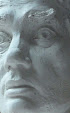
His first masterwork, created when he was twenty-three, was the portrait of a man whose nose had been mashed to pulp-the Man with the Broken Nose . But the sculpture was itself a product of breakage, since the terra-cotta Rodin submitted to the Salon of 1864 was the mask that survived when the full head he had mod eled was accidentally broken. Decades later, Rodin remarked that he had "never succeeded in making a figure as good as the Broken Nose." The image which, he insisted, "determined all my future work," was a visage defaced by a blow. It was a face whose central feature arrests what the young Michelangelo felt when the fist of a fellow art student made his nose "go down like putty" to disfigure him for the rest of his life. An artist of Rodin's susceptibility could not have been unaware that the paragon of sculptors had been himself a man with a broken nose - as are most ancient sculptures-damaged nose first. It is as if the battered prow of the human face were the token and stigma of the sculptor's art. Twenty years later, Rodin repeated the Broken Nose in little for use on the Gates of Hell - and the revision reveals the trend of his thinking: the nose made malleable by an act of ill-chance has become the all-determining pattern. Now the entire face is a medium in fluctuation, a churning sea.
Iris was originally intended for this monument
Rodin, Iris
A fragment, well chosen and mounted - that is carried by a powerful inner dynamic. Many angles and close-ups can be ignored.
Rodin must have seen the fragments chopped out of medieval Indian temples that were beginning to appear in European collections.
Flying Apsara, India, c. 1100
Love these fragments - but shouldn’t we acknowledge that they are evidence of disaster.? Something great and whole has been destroyed, or worse yet, not even sought.
Sacred figures in a world without gods.
A vision of energetic immersion is also the inspiration of Iris -a woman unfurled, headless, lodged in mid-air; of the listing Figure volante , whose home base is not any ground below but some vanishing pole of attraction; of that cantilevered, rock-clinging plaster Figure Study so floated that all the surrounding air turns buoyant to keep it up.
Even Rodin's heads can look tossed and sudden-as Rilke saw when, in his great prose poem on Rodin 1903), he described the head of the Balzac as "living at the summit of the figure like those balls that dance on jets of water." It is in their aerial detachment from body and gravity that Rodin's heads (whether portraits or not) differ from, say, Bernin's great marble busts.
Bernini, Louis XIV
Je suis l’etat— not really the portrait of a man - closer to a pharaoh from ancient Egypt.- but so over glamsoured, hardly divine or even to be trusted. More like a floral display than sculpture.
Bernini's portrait of Louis XIV astonished the French by the commanding posture which its mere head and shoulders conveyed; they felt it showed the King marching at the head of his troops.For Bernini's busts, by their imperious suggestion of stance, imply the whole man, and through the man's implied body, the ground.
Note that Srenberg speculates on how 17th C. Frenchmen felt - not how he sees it himself. For me, there is no man here at all - just a political billboard advertising the monarch.
Rodin, Mrs Russell
Mrs. Russell
Rodin's unbodied heads-the masks mounted off base, tipped and angled the alert Mrs. Russell , and scores of others-they seem not poised but propelled, discharged into space by the abstracted energy of gesture alone. Like Monet, with whom he exhibited in 188g, Rodin evolved within an unquestioned tradition of representation. Both men therefore taught themselves to project some of their most secret intuitions through choice of subject; Monet by looking deep into a lily pond, where the familiar clues of up-and-down and near-and-far watered away ; Rodin by isolating restless fragments of body, such as hands-more familiar in their absolute motion than for their moorings at the nearest anatomical joint.
I can see that —- Rodin had a voracious apatite for gesture.
In the human hand Rodin discovered the only familiar existence which has no inversions, no backviews or atypical angles; which can never be seen upside down. Because hands, weightless and tireless, live in perpetual adaptation and transit, unlike the hard-bottomed space that supports our bodies, the space in which hands exert themselves is as fluid, as musical, as that of Monet's sky-replete water. Rodin made some 150 small plaster hands, two to five inches long, for no purpose but to be picked up and revolved between gingerly fingers (Figs. 199-201). Their modeling is of such tremulous sensibility that, by comparison, Rodin's own hand, preserved in a plaster cast at the Paris Museum, looks stiff and clodden-as would the cast of any real hand keeping still.
Stillness is not the issue in a cast from life. It’s the fact that they were not felt/designed into the space they inhabit. So they feel dead.
But a living hand is in motion, and Rodin's little plasters simulate motion in two ways at least: first, by multiplied surface incident, which makes the light on them leap and plunge faster than light is wont to do; and again by the ceaseless serpentine quiver of bone and sinew, as if the sum of gestures which a whole body can make and all its irritability had condensed in these single hands; and their fingertips so earnestly probing that one credits them with total awareness and a full measure of life. There is in sculpture no surrender of privacy more absolute than when two of these small plaster hands lie together (shown above) Bronze casts of these hands unfortunately have to be mounted. Now they stand flat-footed on platformed wrists, fingers skyward in prophetic pretentiousness. Rodin himself did not usually mount them, but left them lying loose in chests of drawers. "He would pick them up tenderly one by one and then turn them about and lay them back," writes an English sculptress recalling a visit in the year 1901." In other words, Rodin made some 150 sculptures which were not conceived to stand with their weight bearing down.
Same with all small pieces - like netsuke. Viewing them is a different kind of experience. Can’t think of any any modern sculptors who made such small figures. To do so would be to enter the world of shelf top collectibles.
Rodin , Eve
Steinberg addresses Rodin’s responsibility for his marbles. He didn’t carve them himself. Some are truly awful ( like the Eve in the Art Institute of Chicago. Why did Martin Ryerson buy it????)
It would have been nice if the carver were named - just as the performing musicians are credited in recordings of Classical music.
Perhaps we must acknowledge that Rodin was a man of three centuries: the Romantic 19th, the Modern 20th, and the post modern 21st. ( ie his overblown marble kitsch is comparable to Jeff Koons)
Rodin, Hand of God, Carved 1907
Carved 1917
Here’s two variations on the Hand of God.
I do like the clay versions so much more.
Marbles such as the Hand of God, the Cathedral, Idol , Eternal Spring Fall of an Angel, or The Kiss-of which no less than four over-life-size versions exist-they are dulcified replicas made by hired hands. We can bring them back for special studies of Rodin's influence, of his esthetics, his sources of income, his role as entrepreneur. But for his sculpture, look to the plasters, the work in terra-cotta and wax, and the finest bronze casts.
Rodin, The Embrace, Eternal Spring
Clodion, Zepherus and Flora , 1799
Steinberg applies the early Modern direct-carving ideal to dismiss the marbles as sculpture by Rodin. But their narrative character, as well as aesthetic, can still be queried - and is part of his story.
Rodin himself rarely drives his own chisel; he kneads and palps clay, and where a surface has not been roughed and shocked by his own fingering nerves, it tends to remain blind, blunted, or overblown by enlargement; rhetoric given off by false substance. Of course, much of Rodin's own-fingered work is rhetorical too. It seeks to appeal, to afflict, to persuade-always to stir the heart up into fellow feeling. And it is on these programmatic works, with their charge of pride, craving, contrition, defeat, that Rodin's fame largely rests. Degas has had better luck. His posthumous reputation as sculptor is not founded on what he showed during his life-the "frightful realism" (as Huysmans called it ) of the Petite Danseuse of 1880; it rests rather on some eighty unfinished, uncompletable wax figurines, formed in profoundest privacy and never exhibited during his life. Degas even left them uncast, so that a working hive of bathers, dancers, and horses swarmed always about him like thoughts astir. You can, as an artist, try to say something big about life; or be content to make the stuff in your hands come to life. And this humbler task is the greater, for all else merely follows. Or this other distinction: there are objects an artist makes because he wants to be seeing them, and there are themes he invents which, in Rodin's own phrase, "awaken the spectator's imagination." Our own sympathies-I mean those of the post-World War II pres-ent-are flatly anti-rhetorical. They lean towards the object an artist makes simply to make its acquaintance, to find it out. Modern minds are repelled by the kind of advertisement which Rodin's famous works, in their impatience to rouse our feelings, give to emotion.1* It is the diminished status of emotionalism as such which puts the declamatory Rodin at a disadvantage with us (and us with him, which amounts to the same but sounds better; for instead of arrogantly rejecting half his work, we merely confess our incapacity to relate to it). A modern consciousness cannot endure the heroics a contemporary without automatic suspicion. Our commitment to irony is far too serious to enable us to suffer and judge an art of Rodin's demonstrative, humorless pathos.
Degas was not a sculptor- his only concern was contour line - he felt nothing of the mass within them or the surface between them. Hopefully American museums will eventually show more sculpture sculpture from that period. Which will probably happen when “our” commitment to irony finally passes. Personally, I’ve never shared it. It's the bitter cry of the defeated.
IMMERSION IN SPACE
But Rodin too left a private creation, richer and more daring than that of the sculptor Degas. For half a century it has been sequestered, or simply obscured by the renowned exhibition pieces. Move these aside-if only for now-and it is marvelous to see Rodin's art stride into the present.
Much like Luca Cambiaso and so many other 16th C. Italian artists whose sketches are now treasured more than their paintings. Prud’hon is a good example from the early 19th C.
To begin with the space he creates. Rodin's intuition is of sculptural form in suspension. He finds bodies that coast and roll as if on air currents, that stay up like the moon, or bunch and disband under gravitational pressures. He seeks to create, by implication, a space more energetic than the forms it holds in solution. This is the impossible concept behind the Gates of Hell
A wonderful description.
His figure of the Prodigal Son is best known to us kneeling. Thrusting his hands up to the sky, he leans over backwards in the standard large version plunges forward in the reduced model.
Rodin. Fugitive. Amor
Bronze version
Then, in the group called Fugit Amor, the same figure is laid back to back upon a prone, drifting female, and they glide on together trailing his kneeling legs .In the right-hand panel of the Gates of Hell, you may find this group twice, coursing in different orbits. Rodin makes a playful group, representing a seated girl-mother and child. He then breaks it up and, in a new version, a new child with its back to the girl drifts unsupported athwart her closed legs, the title changing to L'Amour qui passe (Figs. 206 and 207). Or The Martyr, originally a small upright female figure in the Gates of Hell. Enlarged to near life-size in 1885, tilted ninety de-grees, and cast in bronze, it becomes a recumbent corpse pressed down on a twisted shoulder, and the legs stifly out.

Ten years later, this same figure, hugely winged, reappears, with no change of sex, as a Fall of Icarus; but now the body descends headlong at thirty degrees to touch ground with the face alone. Finally, fourteen years 341 206. Rodin, Mother and Child 207. Rodin, L'Amour qui passe later, it returns in relief on a tomb slab, upright again and entitled Le Lys brisé, or Resurrection.
The point is not so much that Rodin puts his sculptures through these revolutions, but that they lightly lend themselves to inversions, as most figurative sculpture, conceived to rest on a supporting base, does not.
Shsrp observation!
Rodin, Bastien Lepage
Rodin, Claude Lorraine
Precariously balanced - as a human, yes
But as a tree trunk- it’s quite solid.
And that’s how they feel when placed near trees.
Rodin, Petit Ombre
So that what enlivens Rodin's forms is not only the vibration of surface modeling and the quickened light, but the implication always of some pressure or spatial turbulence to which these forms are exposed. Many of his figures are precariously balanced or hoisted, like the Bastien Lepage and the Claude Lorrain on their respective monuments. Many have to do with falling - La Chute d'un Ange , Icarus in several versions, L'Aiglon, Le Rêve, L'Homme qui tombe , etc. And then La Belle Heaulmière, the Large Shades, and the Petit Ombre, called also The Precipice -figures that gaze into abysmal depths, as if the ground at their feet were a nether sky. This evasive relationship to a supporting ground marks a good half of Rodin's conceptions, his casual doodles, and even his failures,

***********DIGRESSION ALERT************
Auguste Rodin "The Meditation (with arms)", 1881-99

If sculptural form serves an underlying purpose as a recognisable arm or leg or back or foot or breast or buttock, it is simultaneously these things AND a piece of conceived form occupying space and displacing it in a singular fashion, deriving from the force and drive of a sculptural idea. Many old (historical) sculpture traditions were not so tied to recognition as an imperative as not to be able to depart from it when the power of plastic feeling dictated it. Within recent history Rodin, Degas, Matisse, Picasso and one or two others were heavily influenced to some degree by the discovery of these traditions. All four made significant sculpture within the roughly twenty-year period around the turn of the century when this knowledge became available, knowledge of artforms that, at least partially, abandoned the imitative character that Nature's model would normally impose. 'Abstraction' (non-figuration), overturning the spatial expression of bodily gesture to replace it with an attenuated invented version involving the parts of a sculpture being shaped by 'expressive' plastic decisions, rather than mimetic ones, now begin to occupy the direction that sculptors in the early 20th Century were taking - penetrating and animating space in ways undirected, or only partially, by any bodily naturalistic model or norm. Rodin's use of parts to make sculptural conglomerations serves as a pointer to the direction that progressive sculptors were taking.
Scott appears to be locating the “sculptural idea” at the beginning rather than the end of the process of sculpting. I’m guessing that Rodin had no idea he would mangle up that torso until he did it - and then liking what he saw, he called it a keeper.
Awareness of space and expanding into and occupying it, as a 'quantity', enabled a sculptor to turn with relief from the burden of verisimilitude. If we take, for example, Rodin's 'Meditation (with arms)' in the Musée Rodin, the base of the female figure is comparatively conventionally modelled in a contrapposto pose, whereas the top part from the breasts through to the neck and head and arms is wildly distorted to the point of total reinvention of any real structure; occupying and displacing space in an extraordinary fashion, turning the body into a sort of windmill or signal. This process of seizing space in an unconventional way with conventional form can be found throughout most of Rodin's work and is followed by similar characteristics in much of Degas' and Matisse's sculpture.
I think Rodin always labored under a “burden of verisimilitude” … but it was unique to him, so it did not require liberation. And his verisimilitude has usually been convincing for me
To me, this. figure feels more like a human spirit than a human being. Like a poem, it does not live, it does not die. It’s religious sculpture without a religion.
****************** end of digression *****************
Steinberg offers these as examples of interchangeable combinations - facilitated by parts that float instead of root.
And then the opposite: the monumental statues that stand planted and rooted. The Walking Man (L'Homme qui marche) of 1900 and its grand version of 1906, the life-size nude study for the Jean d'Aire (the Burgher of Calais with the key-perhaps Rodin's greatest work,
That is my opinion as well: the Burghers are Rodin's best work.
Here’s four views - with perhaps four different casts, some probably posthumous.
Mankind in all its knobbly readiness.
Rodin’s greatest?
Right up there with the other Burghers and Walking Man.
His later figures not so much
He really nailed the resilience of Everyman,
a recurring theme in European sculpture since the Middle Ages.
And without human resilience, none of us are here.
.
Rodin. Nude studies for Balzac
It’s always problematic to talk about sculpture because of the plurality of views and lighting. With Rodin, it’s more so because so many variations have been cast, many posthumously. Steinberg accompanies this essay with many photos. They’re all black-snd-white, but that’s OK - they do reveal the kind of thing I like - and evidently so does Steinberg.
Obviously these studies are all way different from the final piece - which has more in common with a sheaf of corn than a human body. Why did he bother? I’m guessing that he really liked working from a model and this commission gave him a good excuse.
the Balzac and the striding nude Victor Hugo .
For these figures it is the fierce grip on the earth that becomes the whole enterprise. They stand or take one step as if they were driving piles for foundations.
L'Homme qui marche is not really walking. He is staking his claim on as much ground as his great wheeling stride will encompass. Though his body's axis leans forward, his rearward left heel refuses to lift. In fact, to hold both feet down on the ground, Rodin made the left thigh (méasured from groin to patella) one-fifth as long again as its right counterpart. The resultant stance is profoundly unclassical, especially in the digging-in conveyed by the pigeon-toed stride and the rotation of the upper torso. If the pose looks familiar, it is because we have seen news photos of prizefighters in the delivery of a blow. Unlike the balanced, self-possessed classical posture with both feet turned out, Rodin uses the kind of step that brings all power to bear on the moment's work.
For the Jean d'Aire, standing his ground is an ultimate effort. His huge feet do not rest flat but turn in like a grasping ape's, clutching their clod of earth (Fig. 214). Such actions are hard to see in a photograph, hard to see anywhere if they are not re-experienced internally; one must do it oneself and perform every one of these poses to realize how desperately these statues act out the drama of powerful bodies giving their whole strength to the labor of holding on. As though standing still were the utmost that could be asked of a man. There is only one major work which stands effortlessly on both feet: the early so-called Age of Bronze (1876; Figs. 216-18). It was to become Rodin's point of departure in every sense. For his mature works depart in opposite directions from the common waking experience of equilibrium: they are either disturbed, unsettled, adrift; or else they hold the ground with rapacious tenacity, as if they would lose their limbs one by one, rather than loosen their grip. And both these extremes share in the power of suggesting that the surrounding emptiness is energetic.
Rodin's implied space equips sculpture in three distinct ways for the modern experience. Psychologically, it supplies a threat of imbalance which serves like a passport to the age of anxiety. Physically, it suggests a world in which voids and solids interact as modes of energy. And semantically, by never ceasing to ask where and how his sculptures can possibly stand, where in space they shall loom or balance, refusing to take for granted even the solid ground, Rodin unsettles the obvious and brings to sculpture that anxious questioning for survival without which no spiritual activity enters this century. And there are assumptions more fundamental even than the ground underfoot which Rodin puts to the question.
MULTIPLICATION
Three Shades
Three Faunesses
To all men one body each. Artists who represent figures in action tend to respect the natural rule of one to one. But not Rodin. In his work, the singleness of man's body allotment succumbs to three kinds of action-to multiplication, fragmentation, and random graft.
The silhouette of one standing Faunesse alone suffers like all free-standing sculpture; the exterior shapes made or implied by its contours are surrendered to air.
I do feel a surrender to air in this upward bound figure —- but certainly not in many other standing figures.- especially when their energy is pulling more inward or downward.
By assembling three casts of the figure, Rodin prevents dissipation. The exterior shapes become engaged intervals, and the repeat of this one irregular body yields infinite rhythmic amplification.
Once the figure is untethered to a known narrative, anything goes. For whatever reason, it turns out that putting three multiples in a circle can look pretty good - though it would be more interesting if each figure were different - as with the following examples:
Francesco Messina , 20th c.
Carpeaux, 1872
In comparison, the Rodin triplets are gimmicks.
Rodin is unsurpassed in modeling a single human figure.
But his enormous ability does not extend to anything outside it, including multi figures arrangements.
Canova, Three Graces
….no nuance of M. Ney’s body surface was to lack in his bronze double, and every turn of the bronze must follow the young man's physique. The result is a frustration, almost aggressively boring. But it took the earnestness of a genius to pursue the reigning cant about objectivity to this end. The Age of Bronze was a paradigm of the esthetics of analogues, and the scandalous charge that the sculptor had merely taken a cast from the live - model, though unjust in fact, was esthetically justified.
Rodin, Age of Bronze next to photo of model
conflating these two is aesthetically justified?
Only for those who don’t look at much sculpture.
The details of flesh have been taken into form,
while Rodin’s piece as a whole has an upward, emotive movemen
that is entirely sculptural.
The contrast is even greater with life casts
because flesh is gently compressed by plaster slurry,
so the surface loses its vibrancy.
In Rodin's maturity the constant multiplication of identical forms again helps to remove his art in two directions from the position of the Bronze Age: towards the work of art as an industrial object, made and makable again and again; and towards art as the inside-out of a private obsession. Only by such departures could the art of sculpture be reconstructed into a potentially modern art form.
Industrial objects and private obsessions don’t interest me — so perhaps I have no use for “modern art forms.”
But as we have seen in the discussion of the Age of Bronze, Steinberg’s feeling for form is more conceptual than visual . Another modern approach to art, however, is the very opposite - where it’s not specific kinds of forms that are modern, but the importance of all forms, ancient to modern, as independent of whatever narrative had been or could be attached. This is the theory behind the selection of artifacts for the encyclopedic art museums of the 20th Century. Otherwise such things would go into museums of history. (as some indeed do))
Sometimes the duplications reflect Rodin's avowed interest in expressing a succession of moments; for the repetition of identical or similar poses may suggest-as the carvers of the Parthenon Frieze must have known-uninterrupted duration, or a single form evolving in time. What the sculpture gains is the potency of prolonged states. Elsewhere, the repeats hint at subtler mystification. The famous Cathedral is not formed by a pair of pious hands joined in prayer, but by two right hands that lend each other their tips to explore? The Secret is a complicity of doppelgängers whose encounter expresses the privacy of complete self-absorption.
Hadn’t realized these were two right hands. They could express the privacy of self absorption - but they could also suggest the spirituality of a cathedral- the name they received when Rodin was publishing a book about cathedrals.
And when Rodin lays together two casts of one tiny hand, the suggestion arises of narcissism, of the sculptures forever caught in marveling reciprocal self-contemplation. These strange replications, which can be read either as one figure proliferated in two or three bodies, or as one body in several roles or places at once, compel an instinctive reconsideration of what actually is represented. If it occurs more than once, the sculptural form cannot be a direct representation of nature. It must be either an artifact in mechanical multiplication, or a thought obsessively thought again. It can be both. Only one thing it cannot be: the simple analogue of a natural body whose character it is to be unrepeatable. Rodin's double-takes thus serve to check the ostensible naturalism of his art. The official nineteenth-century notion of the sculptural image as an analogue representation-analogous to some actual or imaginable body in nature-breaks down. And the breakdown is not achieved by simplification of form or depletion of content, but by visual enrichment and amplification.
Points well taken - even if the results may or may not be worth seeing more than once.
Rodin, La Terre
FRAGMENTATION
And yet, beyond all precedent, his fragmentations trace an original path. La Terre, for example- a mountainous skyline formed by the spine of a prone human body . Its undulant contour climbs up to the nape, then drops sharply to let the head fall. The omission of arms and feet is clearly justified by the theme: we understand at once that extremities entail potentials of action and locomotion, whereas what is here conveyed is an activity wholly identified with keeping still. It is not enough to observe that no feet are present, for, as the base indicates, no feet were ever intended; nor arms from the deltoid down. And this betrays the novelty of the approach. Unlike the arms of the Venus de Milo, the limbs here are not conceivable as missing keeping or as replaceable in imagination. The hulk of La Terre allows no fringe forms; it is finished without them because what Rodin represents is not really a human body, but a body's specific gesture, and he retains just so much of the anatomical core as that gesture needs to evolve.
Again, Steinberg’s discussion is spot on - though he does not address the modernity of the theme - which is something like Man pushing himself up from the mud - rather than being modeled by the hand of God - as the earlier Theocratic world would have it.
Rodin, Figure Volante, 1890-91
The drift of it becomes wonderfully explicit in the streamlining of the Figure volante
. Touching down only at the stump of a thigh, the other leg (calf-length) trailed like a streamer, the figure's headless trunk ascends at forty-five degrees, while its single arm heaves close to reduce wind resistance. Not the body's shape but its transit determines its stringent economy.
The airborne figure is the exact opposite of the earthbound piece shown above it. Fragmented sculpture can look quite good - and that’s much of what we see in museums of antiquities.
Capistrano Chancel, St.Stephens, Vienna, artist unknown
Brancusi, Bird in Space
There is a powerful shift here away from traditional ground.
Rodin has not so much modeled a body in motion, as clothed a motion in body, and in no more body than it wants to fulfill itself.
Whence it is no paradox to nominate Rodin's figure the precursor of Brancusi's Bird in Space-where the sculpture gives form to a trajectory. Rodin takes the enormous step that precedes the abstrac-tion. Compare any flying figure from Baroque sculpture, say, a Virgin of the Assumption: a massy body of preformed anatomy is uplifted and put in motion. Brancusi's Bird is at the opposite pole: no body at all, but a movement projected in sculptural form. Between these two, Rodin's Figure volante occupies an exact middle position: the sculpture represents an energy-like an electric discharge in a lightning rod-which has found a conductor body.
It’s surprising that Google did not find me a Baroque Assumptions of the Virgin. Plenty of paintings - but no sculptures. But that Friar from Capistrano does indeed exemplify Baroque levitation - and I agree that Rodin is right in the middle, between Baroque and Brancusi.
Calling Volante an “electric discharge in a lightning rod” is the best metaphor I can ever remember in art prose. Wow.
It is because of the comparative primacy given to movement, gesture or act, that any unmoved part of the body becomes dispensable. Rodin himself said as much when he explained to Degas why his Walking Man had no arms-"because a man walks on his legs."
Just as Walking Man was halfway to abstraction, it halfway departed from figurative art. A man does indeed walk on his legs, but when his arms and head are missing, he’s no longer a man. That bothers me as much as it apparently did Degas.
This principle of dispensability determines the limits of fragmentation. An anatomy can be stripped down so long as it yields a clear gesture. But the dispensability rule also hands us a criterion of judg-ment. Rodin tends to spoil a work when, in obedience to the anatomical norm, he makes a partial figure "complete." This occurred especially during the 1880's, which produced some of his prettiest idyls, and before the sum of his attitudes had caught up with the courage of his imagination.


In 1878 he had made a small female torso, one of his most moving works, named Torse d'Adèle after his favorite model .
The overlapping thighs break off at the knees, the head is lost in the crook of a lifted elbow, the right arm abandoned just below shoulder.
Rodin loved this figure and attached it like a coralline structure to the uppermost corner of his Gates of Hell (Fig. 244, top left). Soon after, in 1884, the figure entered a lover's embrace known as Eternal Spring-one of Rodin's best-selling works of those years and among his outstanding esthetic failures
Based on photos of the earliest casts I could find, they both look pretty good to me
Rodin, Fall of an Angel
In both these reappearances-in the Gates lintel and in the Eternal Spring-the Torse d'Adèle has been "finished" by the addition of a right arm (in two variant forms) and lower legs. Both additions are unconvincing, and so they remain in 1895 when the "completed"" Torse d'Adèle is used once again in a maudlin group known as Fall of an Angel or Illusions Reclaimed by the Earth
A depressing piece fit for a depressing, and quite modern, theme. This is Rodin, the Symbolist. I can’t stand it.
A modern Rodin admirer finds it painful to see one of Rodin's finest sculptures compelled to serve in such mawkish tableaus. These works are failures not only because the translation of scale and material has botched Rodin's surface; not only because much of this mollified marble looks like damp soap; or because the extended appendages sadly outscale the back-bending torso; but because in all these variants, whether bronze, plaster or marble, the consummate rightness of the original abbreviation has been sacrificed to an extraneous appeal. For the addition of these anatomical members negates one of Rodin's profoundest convictions about sculptural form-about what he called le modelé.
On the one hand, these serial adaptations make Rodin a Modernist -- but on the other, they are often so mawkish, they do not serve the Modern taste
"Le modelé ... I know what that means," wrote Rilke to his sculptress wife in 1902, after first meeting Rodin: "It is the science of planes as distinct from contour, that which fills out contours. It is a law governing the relationships between these planes. You see, for him there is only the modelé."
And Rodin himself to Paul Gsell:
I am going to tell you a great secret. The impression of real life ... do you know what it is that gives this impression? It is la science du modelé. These words will strike you as commonplace but you will soon judge their full import. This science du modelé was taught to me by a certain Constant who worked in the decorative sculpture shop where I first started out as a sculptor.
One day, seeing me model a Corinthian capital in clay, he said,
"Rodin, you are going about it badly. All your leaves appear flat.
That's why they don't look real. Make them so that they shoot their points towards you."
I followed his advice and was amazed at the result I obtained.
"Remember well what I am telling you," Constant continued.
"From now on when you model, never look at your forms in exten-sion, but always in depth. Never regard a surface as anything but the outermost point of a volume, as the broader or narrower summit which it directs towards you. That's how you will acquire la science du modelé."
.... but then there is also this famous Rodin quote that I first read many years ago::
“In a human body, the contour is given by the place where the body ends; thus it is the body which makes the shape. I place the model so that light, outlining it against a background, illuminates the contour. I execute it, I change my position and that of my model, and thus I see another contour, and so on successively all around the body.”...as quoted in "Rodin’s Reflections on Art"
They need not be contradictory - they could be synergistic - working back and forth between what's erupting from within and what’s constrained by arranging the contours.
Torse d'Adele, image as shown by Steinberg
In no work by Rodin is this founding principle of his art embodied with greater power and subtlety than in the Torse d'Adèle-its every surface a summit point, the peak of an elevation more or less rounded. And it is the absolute want of exactly this quality which makes the parallel limbs added to the Torse d'Adèle look so soulless.
Even in the Gates lintel, the addition of arms and legs converts the figure, unlike every other figure within this field, into a flat silhou-ette. And in the marble groups, the surrender of the original Torso to honeyed sentiment is matched by the compromise of its sculptural integrity, Rodin's modelé
It is hard to know whether the vulgarity of such finishings is due to a failure of taste, some residual immaturity of feeling, or to a falling back on his early commercial manner prompted either by a genuine need of money or by a more or less cynical exploitation of public taste. At any rate, Rodin's insipid marble groups are the expression of Rodin in his audience-oriented aspect.
Sadly, I agree.
Rodin usually plays to an audience of which I am not a member.
Rodin, Nymph Pleurant
In his vast privacies he makes no compromise. There is a small bronze of 1888 which Rodin first called Danaide accablée, then Nymphe pleurant-another of the hundreds of little figures with which he peopled the Gates. This one represents a nude crouched, knees up and face cupped in both hands, yielding a fairly explicit demonstration of grief or shame. But the sculptor's questioning fingers keep asking how much body a weeping nymph needs for contrition. And he cuts away at the arms and legs until he finds a sufficiency-an accident of breakage, of apparent negligence or knotted and to modern eyes so abstract that it takes a reluctant effort to spell out the pose
I do not claim that abstraction in the modern sense was intended And yet, in some late private moments, Rodin may have recognized in his work a potentiality to which his fragments bore the most eloquent witness. Brancusi, passing through Rodin's influence in 1906-7, and beginning then to lop off anatomical portions, discovered himself in the process and continued thence to the formulation of abstract twentieth-century form.
Brancusi 1910
The Rilke letter of 1902 quoted above had already spoken of Rodin detaching from all things and bodies the modelé, "the law governing the relationship between planes," then "making of it an independent entity, that is, a work of sculpture." And proceeding at once to relate this "secret" of Rodin's art to the esthetics of fragments, the poet continued: "For this reason a piece of arm and leg and body is for him a whole, a unity, because he no longer thinks of arm, leg and body (that would seem to him too thematic, you see, too literary, as it were), but only of the modele which is self-contained and which in a certain sense is ready and rounded."