Art practice is now understood primarily as a vehicle for the reflection of modes of reception and theory rather than as a mode of making…Paul Crowther
It is improbable that more nonsense has been written about aesthetics than about anything else: the literature of the subject is not large enough for that (Clive Bell)

Index

*********************
*********************
The Index is found here
*********************
*********************

Thursday, November 14, 2013

Gombrich: Ascendency of the Sublime

Gombrich: - Ascendency of the Sublime


This is Chapter two of E.H. Gombrich's "Preference for the Primitive"

Quoted text is in YELLOW. Text quoted from other authors is in GREEN *************************************************************************** ****************************************************************************


Carle Van Loo, "Resting from the Hunt", 1737


Chapter two takes us to the aesthetic controversies of the 18th C.-- florid opulence vs classical austerity, climaxing with the rather humorous story of one Maurice Quays (1779-1804), a painter who is only remembered in Wikipedia for having coined the derogatory term 'Rococo', and whose existence is only known through the journal of a student of Jacques Louis-David, Etienne-Jean Delécluze. (though Webster's online tells us that the word  'Rococo' was used 40 years before Quays was born)

Dressing up like an ancient Greek, not cutting his hair, and spouting radical theories, Quays seems like a caricature of an art school bohemian. Delecluze tells us that "the young man's eccentricities, becoming increasingly exaggerated and confused, had carried him ultimately into madness"

By making this clown the mouthpiece for the 'primitifs' of that period, it's rather clear what Gombrich thinks about them - without having to say it directly.

Gombrich is sneering.


Jacques-Louis David, "Rape of the Sabine Women", 1799


Quays and his fellow Primatifs are quoted by Delecluze as expressing disappointment with the above painting by the hero of austere Classicism  for having "no grandeur, no simplicity, in short nothing primatif" -- and so it deserved all of the contempt they felt towards the "Van Loo, Pompadour, Rococo" painting shown at the top of this post.


Carle Van Loo, detail


Gombrich leaves us to speculate on what they thought the two paintings had in common.

One difference is, of course, the costumes.  Van Loo dresses his figures to the hilt - befitting their noble status.


Jacques Louis David, detail


While David dresses his heroine in the simple white gown that had become fashionable in Revolutionary Paris


- while the soldiers don't have any clothes at all, apparently to the dismay of moralists who eventually prevailed upon the artist to cover up the genitals of the standing male on the left.


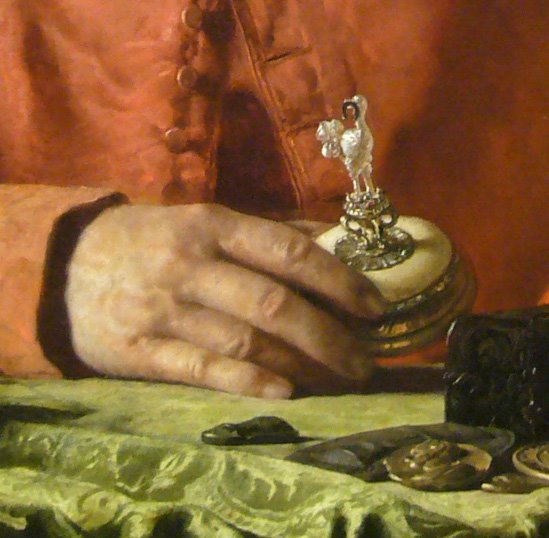
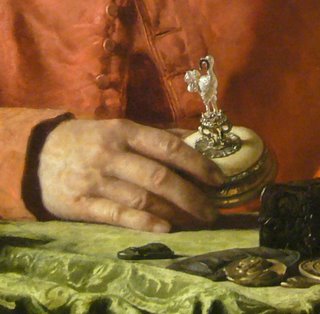
Here are some details from another Van Loo painting - showing his careful attention to fine fabrics.


 Poussin, "Rape of the Sabine Women" , 1634-35


Poussin, "Rape of the Sabine Women" , 1636-37


Or perhaps the young Primatifs were objecting to the less martial treatment of the subject matter, compared with the earlier versions by Poussin where the women were being carried off instead of trying to make peace, suggesting, perhaps, that it was time for the new French Republic to stop waging war.  (the other title used for David's version is "The Intervention of the Sabine Women")


But I'm afraid that the only reason Gombrich presented this comparison is that it was accompanied by the word 'primatif', though Gombrich concludes the chapter by declaring "we can appreciate the relevance of this episode in which so many of the tendencies of the 18th C. came to fruition."

BTW - the more stark contrast between the paintings of the early and late 18th C. France is found in the portraiture.


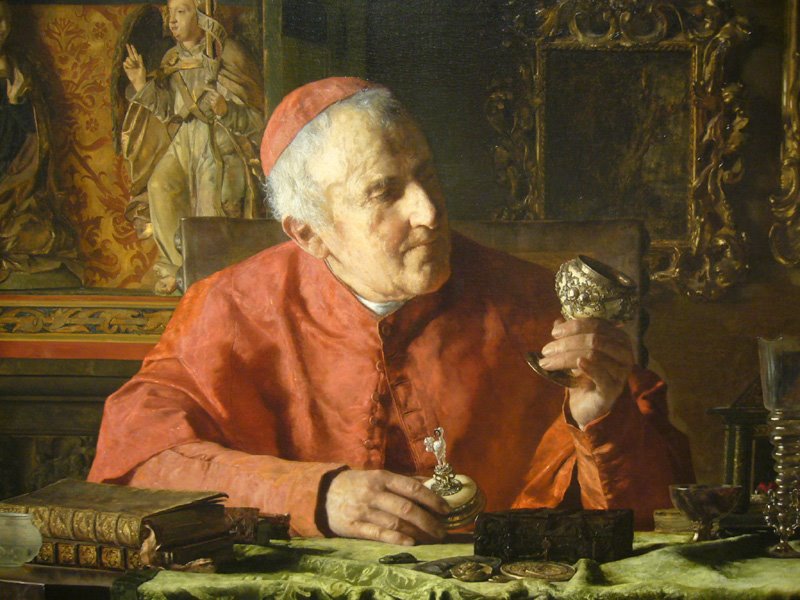
Here's the rest of that Van Loo portrait shown earlier


Here's a David portrait from 1804,
plain background, no jewelry,
and dressed in all black and white
with only a hint of colored finery.

She looks like a girl 
who might volunteer
at an army field hospital.

But the word 'primitive'
would not apply, would it ?


while Van Loo's aristocrat would be more likely to 
utter a clever bon mot.


Saturday, November 9, 2013

Gombrich : Plato's Preferences

Gombrich: - Plato's Preferences


This is Chapter One of E.H. Gombrich's "Preference for the Primitive"

Quoted text is in YELLOW. Text quoted from other authors is in GREEN *************************************************************************** ****************************************************************************


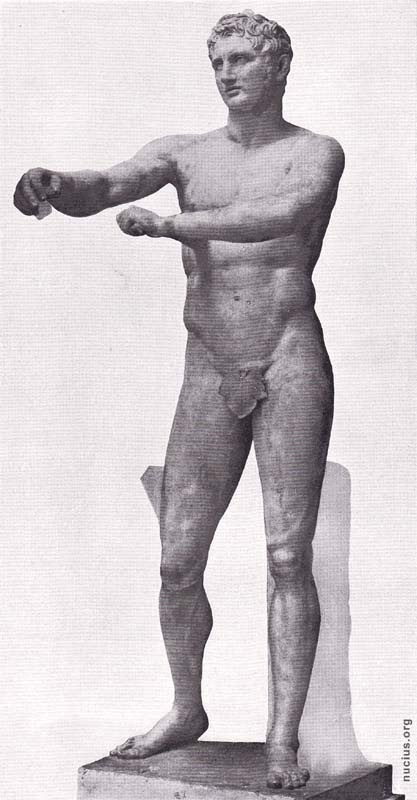
Lysippus "Apoxyomenos"
Roman copy of Greek original from 330 BC


Praxiteles "Apollo Sauroktonos"
Roman copy of Greek original from 350 BC


Polyclitus "Doryphoros"
Roman copy of Greek original from 440 BC


Polymedes of Argos "The Youth Biton"
615-590 BC


What critic who devotes his attention to the lesser arts does not recognize that the statues of Canachus are too rigid to reproduce the truth of nature? The statues of Calamis again are still hard, and yet more lifelike than those of Canachus. Even Myron has not yet fully attained naturalness, though one would not hesitate to call his works beautiful.  .. Cicero


We cannot identify the artists mentioned by Cicero with any degree of assurance, knowing only copies of some works, but we have no difficulty in exemplifying the type of progress he had in mind from extant works of Greek sculpture. In fact there is no history of art in which some such sequence is not demonstrated. We know the type of sixth—century statue that is, in Cicero’s words, ‘too rigid to reproduce the truth of nature’.We can imagine the next phase, ‘still hard but yet softer’ as represented by one of the kouroi of around 500 BC. We have also a sufficient idea of the art of Myron, through copies and accounts of it, to appreciate what Cicero meant when he said, ‘one would not hesitate to call his works beautiful’, though they are not yet quite sufficiently close to the truth. We can see finally why he called Polycleitus more beautiful still and attaining perfection — an academic verdict which was no doubt also connected with the fame of Polycleitus as the sculptor who had established the canon of proportions. Praxiteles in the fourth century added grace; and Lysippus at the time of Alexander the Great brought the imitation of nature to its highest pitch 


Cicero looked at art in the light of its technical powers to achieve certain ends, those ends being truth and beauty. It is important to distinguish this instrumental view of progress from those interpretations with which we are familiar in our own day.


I have two queries:

*To what extent can we see a progression towards "truth to nature" in the four examples shown above ?

*Are there any counter-examples to "there is  no history of art in which some such sequence is not demonstrated"


The oldest piece, the one by Polymedes, stands quite apart from the others - the only one, I'm guessing, that actually had a cultic rather than civic or private application.

It seems to be more about the inner life of the figure than  flesh and bone.  The sculptor seems to have been cutting back from an outline on the front of the block. He seems less concerned with three dimensionality or looking at the piece from any view other than directly frontal.

But none of the other three pieces seem more natural than the others -- though some feel more masculine and some more feminine.

So even in this group of statues, from 600 to 330 BC,  I don't see a progressive development of naturalism.

 I'm wondering where else in world art history Gombrich has found it.


Here's an example of not-stiff,  naturalistic painting from about 17,000 years ago.

Were there less naturalistic examples that preceded them in that culture ?

That's difficult to determine -- but it does seem  that "truth to nature" is available at all times in all places to anyone who wants to pursue it.


Here's an example of naturalism as a brief episode (the Amarna period) 
in the 2,000 year history of Egyptian art.


Like Cicero, most  Greco-Roman philosophers are mostly concerned with the aesthetics of oratory rather than the visual arts - and I won't address Gombrich's discussion of them.

But here's another  exceptional passage - this one from  from Quintilian (35-100 AD):


 Calon is rather hard, Calamis less rigid, Myron softer. Polycleitus surpassed all others for industry and beauty, but it is said that he is lacking in weight. For while he is said to have added more beauty to the human form, even beyond the truth, he does not seem to have endowed the gods with enough authority. It is true that Phidias had what Polycleitus lacked, but he in his turn was more successful with gods than with men. They say that Lysippus and Praxiteles came closest to the truth, while Dernetrius is accused of having gone too far in this direction and having been more enamoured of truth than of beauty. (XII.x.9)


Here, we might note that "truth to nature" is one of several criteria, and is opposed to 'beauty'.

But as with the text from Cicero, the above comments have been excerpted from  a discussion of rhetoric -- and I wonder how seriously either orator was about  the visual arts.

Tuesday, November 5, 2013

Gombrich: The Preference for the Primitive - Introduction

Gombrich: The Preference for the Primitive - Introduction


Quoted text is in YELLOW. Text quoted from other authors is in GREEN *************************************************************************** ****************************************************************************


Cicero, 1st C. AD (Capitoline Museum)


It is difficult to say for what reason the very things that move our senses most to pleasures and appeal to them most speedily at first are the ones from which we are most quickly estranged by a kind of disgust and surfeit. How much more brilliant, as a rule, in beauty and variety of colouring are new pictures compared to the old ones. But though they captivate us at first sight the pleasure does not last, while the very roughness and crudity of old paintings maintains their hold on us. (Cicero, Dc Oratore III. xxv. 98,)


What book that begins with the words of Cicero could end badly ?


He was the scourge of wicked old  Cataline - as well as every  slow-witted school boy  in Latin class. Which is why both Gombrich and I love him. We were good with books -- other kids were good with baseball.

And yet --  gifted orator and noble statesman  that he was -- we just have to wonder how deeply he got involved with the visual arts.

What kinds of visual choices did he make?

Unlike the traditional  Chinese scholar/statesman,  noble Romans were not expected to master the impractical arts of calligraphy and painting.  The above quote is lifted from a tract whose subject is oratory, not visual art.

Gombrich will discuss this passage more extensively in Chapter One.


This book is about a movement of taste that came to its climax during my lifetime and appears to have lost strength during the last few years. I am speaking of the kind of aversion Cicero expressed in the motto I have chosen. Every preference, one might argue, implies an aversion. Hence what I call the ‘preference for the primitive’ may be often tantamount to a rejection — a rejection of what? There is a word in my native German which has only been partly assimilated in English: it is the term ‘Kitsch’. During the days of my youth, critics and art-lovers resorted freely to this term of abuse. What ‘schmalz’ was to music — or perhaps a ‘tear-jerker’ to literature — was dismissed as nauseating ‘kitsch’ in the visual arts. Here it was most of all the works of official art chosen for display in the Salon which were condemned in these terms. But even some of the most renowned Old Masters were also pilloried as having manufactured insipid and sugary paintings that were offensive to good taste. I shall argue that many of the movements of twentieth—century primitivism are best understood as avoidance reactions. I hope to show that the opinions of the great orator continued to reverberate in the history of taste. What he observed is that the pleasure of the senses can lead to displeasure. If we indulge our inborn drives and appetites initial satisfaction will not only end in satiety but in downright disgust. We seem to have acquired an inbuilt warning signal that tells us ‘enough is enough’.


I find a "history of taste" far less interesting, and less knowable,  than the taste of the individuals who made, commissioned,  selected, or wrote about  things that can still be seen.

I categorically reject  the use of "we" or "us" in all statements of preference, including the above  by Cicero and Gombrich.  And I am wary of distinguishing "inborn drives and appetites" from those that have been acquired or developed - because they so inter-meshed.

And yet --- leafing through the pages of this book, it does appear that Gombrich will be using comparative examples, so I am game to read on..


 Apparently this acquisition is part of growing up — that painful process of education that imposes those disciplines of self—control civilization demands. Cicero mentions all the senses as being subject to this passage from gratification to disgust. He includes all the arts, but though he specifically mentions painting (where garish colours soon repel), and later singing (when trills and slides inevitably lose their charm), his real concern — as we shall discover — is the art of oratory, because the purpose of his digression is to warn his reader against trying to seduce the audience by means of verbal display. What is relevant to the argument of this book is the fact that the development of all, or at least most, of the arts ran parallel — in other words, that it took time till they achieved that easy appeal to the senses which Cicero warned against.


I am doubting this "fact"  that Gombrich so glibly asserts.

Though it may well be that Hellenistic sculpture "appeals to the senses" of Gombrich or of its original patrons more than the 'archaic' styles of earlier centuries appeal to them.

At this point Gombrich reminds us of that "most influential" history of European visual art, Vasari's "Lives of the Most Excellent Painters, Sculptors, and Architects" -- and how he introduced the notion of progress from the clumsy/ugly to the hard/angular to the polish/sophistication culminating in an artist like  Correggio.


Correggio, 1532


Is Gombrich proposing that  hard/soft is  the difference between primitive and sophisticated ?


Titian, 1523-24


Titian' s "Bacchanal" seems to be at least as sophisticated, or maybe even more so, than Correggio's "Leda and the Swan", but it does not feel quite as soft.

Gombrich adds that the 'hard' is associated with "nobility, strength, innocence and sincerity" while the soft is associated with "vulgarity, effeminacy, corruption, and meretriciousness"

But who makes those associations and to which specific pieces to they refer ?

He refers us to Lovejoy and Boas' "Primivitism and Related Ideas in Antiquity", but there we find a distinction between primitives who were considered 'hard' and those who were considered 'soft'.


Finally we have the notion of perfection:  "the psychological principle -- the revulsion from that very perfection  that art has been said to aim at"


To the right, we have an example of perfection (12th C. Ju Ware);   to the left, the intentional imperfection sought in a Japanese Wabi Sabi tradition (contemporary).  (though actually -- they might be considered examples of different kinds of perfection.  It's harder to make, and to find, examples that are obviously imperfect yet completely satisfying)

It would seem that here perfection/imperfection is unrelated to either hard/soft or primitive/sophisticated.


************


So what exactly does Gombrich mean by 'primitive' ?


If I am asked to define any further what I mean by 'the primitive, ' I must refer the reader to the pages of this book, which will show that the term was associated in its time with early Greek vases, with quattrocento painting and with tribal art.


Above,  Gombrich tells us that he will let writers from the past define 'primitive' for themselves.

But  he used his own definition when he  applied his phrase  "the preference for the primitive" to Cicero's discussion of the preference for the "roughness and crudity of old paintings"

And doesn't he suggest that these definitions have some principle in common, as he writes about "the movement in taste that came to its climax during my lifetime" by  beginning with Cicero and other ancient writers ?

In this brief introduction, he offers the criteria of perfect/imperfect, soft/hard, sophisticated/unsophisticated as if these were relevant to that principle. But as I've suggested, the application of such criteria might often result in different choices.

Here's one of my favorite poems that happens to address some of the same issues:


A sweet disorder in the dress
Kindles in clothes a wantonness.
A lawn about the shoulders thrown
Into a fine distraction;
An erring lace, which here and there
Enthralls the crimson stomacher;
A cuff neglectful, and thereby
Ribbons to flow confusedly;
A winning wave, deserving note,
In the tempestuous petticoat;
A careless shoestring, in whose tie
I see a wild civility;
Do more bewitch me than when art
Is too precise in every part.

... Robert Herrick


Except  Herrick's poem does not  lead into a critical discussion of civilization, which is lurking behind a preference for the Primitive, and engaged philosophers like  Lovejoy.

Gombrich tells us that such a preference "to a certain extent, I even shared"

Unfortunately, as a professional art historian, he cannot speak directly of his own preferences.

He can only hide them,  though, according to one reviewer, they are not far beneath the surface.


Friday, October 11, 2013

Kandel : Conclusion

My recurring problem with Kandel’s seven chapters about art is that he always seems to be clumsily  forcing a science-relevant interpretation onto the  paintings that he examines.

He gives very little evidence of  “the ongoing dialogue between art and science that had its origins in fin-de-siècle Vienna” – beyond noting that Klimt once put some microscopic-cell-like forms into Adele’s magnificent dress.

Usually his reasoning runs something like this:

Artist-X expressed feelings
Scientist-Y studied feelings or how they are communicated
Therefore there is a dialogue between the artists like X  and the scientists like Y.

His three artists, Klimt,  Kokoschka, and Schiele were progressively more interested in themselves than anything else

He asserted that “each brought to his work a scientific curiosity about mind and emotion that was characteristic of Vienna 1900” --- but that’s only if a scientific kind of curiosity is not distinguishable from any other.  Can’t one be very curious about how various kinds of things might look and feel without any interest in making or proving scientific hypotheses ?   I certainly am.

His chapters on each of his three artists were fascinating to me – but that’s because I knew so little about them. None of them are on display in  The Art Institute of Chicago. (I'm going to the Neue Gallerie in New York next week end to check them out)

Rather than grafting them onto a history of psychology and neuro-biology, I wish he had developed a discussion that encompassed the other European modernists of the first 15 years of the 20th Century – especially those working in Paris.  But that’s really the job of an art historian, and Kandel's  expertise lies elsewhere.

So why did this distinguished neuro-biologist write so much about Viennese modernist painters, anyway?

As he explains in his preface, he feels personally connected to that city.

But also I think it’s because his soul has not been satisfied with the tedious attention to details that is required for serious scientific inquiry.

He wants to contemplate the important issues of  human experience as presented by  artist/prophets, not just  the guys with  white lab coats and  big microscopes.

Maybe  life is too short to be very good at doing both – or maybe, he just hasn't been able to devote much of his time to looking and thinking about art.  His knowledge of art seems to be painfully dependent on the Art History 101 kind of text books.


-------------------------------------------------------------------------------------


And now for a report on my trip to the Neue Galerie


Strangely enough, the above piece felt far less gorgeous in person than would be suggested by the above photograph - probably  because of the lighting applied by the photographer.

And a life size painting has a very different effect when it's seen life size:  poor Adele Bloch-Bauer's distant pale face seems overwhelmed by the massive eruption  beneath it.

A screen size reproduction makes her feel more glamorous.


While the original of this Kokoshka portrait  has such a commanding presence -- far more engaging than the reproduction might suggest.

All  three (or was it four?) of the Kokoshka paintings in the Neue jumped off the wall with the personality of the sitter -- though, like the sitters themselves, I'm not sure I'd want to live with them.


But actually, the highlight of my trip to the Neue Galerie were the four Kandinsky panels borrowed from M.O.M.A. for a special exhibit. Painted in 1914 for the apartment of Edwin R. Campbell, they were contemporary with some of the best work by Klimt, Schiele, and Kokoshka, and seem, to me, to share a scientist's wonder at the kaleidescopic diversity of the natural world.


Friday, October 4, 2013

Kandel: The Beholder's Share

Kandel : The The Beholder's Share - Entering the Private Theater of Another's Mind
This is Chapter 24 of Eric Kandel's "The Age of Insight : The Quest to Understand the Unconscious in Art, Mind, and Brain".

Quoted text is in YELLOW. Text quoted from other authors is in GREEN *************************************************************************** ****************************************************************************


THE CENTRAL IDEA IN THE BIOLOGY OF AESTHETICS IS that the artist creates a virtual reality of the world in much the same way the beholder’s brain does. To do this, as Ernst Kris and Ernst Gombrich point out, the artist manipulates the brain’s innate ability to make models of perceptual and emotional reality and thus to re-create the external world. To understand what cues our brains use in creating depictions of the physical and human world around us, the artist has to master intuitively the cognitive psychology of perception, color, and emotion.


What if one does not accept the premise that images  are created "in much the same way" as they are processed in the brains of whoever is looking at them?

Can a biology of aesthetics be pursued without that central idea ?

That notion seems as far-fetched to me -- as to suggest that airplanes are designed in the much the same way that passengers ride them or pilots fly them.

It's a premise that neglects the importance of skill, planning, and knowledge.


It was only in the decades after the 1850's and the introduction of  photography that artists began to search for new kinds of pictorial representation. As Henri Matisse described it much later, “The invention of photography released painting from any need to copy nature, allowing the artist to “present emotion as directly as possible and  by the simplest means.”  Rather than aiming to portray the outside world, the new painters strove to portray emotions, to enter the private theater of the sitter’s mind.


August Johann Holmberg (1851-1921) 


On the contrary, one might  argue that the invention of photography encouraged painters to render even more  tightly rendered details than Vermeer, who was, by the way, snatched from obscurity in the mid nineteenth century.


Delacroix,"Death of Sardanapalus", 1844 (detail)


By contrast, consider the French painting that preceded the photographic era.

Would anyone characterize this as a copy of nature ?

Doesn't it  “present emotion as directly as possible and  by the simplest means.” ?


Gustav Klimt, Oskar Kokoshka, and  Egon Schiele not only entered the private theater of a sitter's mind, they also revealed a great deal about their own emotional response to the sitter and encouraged the beholder to respond emotionally as well...... Indeed the power of expressionist art, or any great art, seems in large part from its ability to recruit the viewer's empathy.


I'm guessing that Kandel added the phrase "or any great art" after the first draft.  It makes his assertion more reasonable, but it also undermines his focus on what is so special about the Viennese modernists.

He then associates empathy with mirroring -- and draws our attention to two 17th C. paintings that actually portray images on mirrors - to engage the viewer in the private theater of both the subject's mind and the artists.


In Vermeer’s The Music Lesson: A Lady at the Virginals with a Gentleman, painted in 1662, the artist depicts the back of a young woman playing a virginal (a simplified harpsichord) with a young man standing attentively to her right. It appears from the angle of the woman’s head that her eyes are focused on her hands as they move over the keyboard. However, Vermeer has inserted a mirror above the harpsichord that allows him to present the viewer with another, quite different reality. In the mirror, the woman’s head is not bent downward, but is turned to the right so that her gaze is directed toward the man. The human brain, as we have seen, is exquisitely sensitive to the direction of a person’s gaze, using people’s eyes as a means of inferring their interests and emotional state. The angle of the woman’s eyes in the mirror shows us that the true object of her attention, and perhaps her instinctual desires, is the man


Wow - I hadn't noticed that anomaly.

Since the viewer is not positioned directly behind the lady, we would not expect to see her face straight-on in the mirror even if she were directly facing it.

But still -- her head is turned more than one might expect.

Is that due her instinctual desire to look at a man?

Or... is she just looking for guidance from her music teacher ?

The turned head also seems to turn the viewer's back into the room, completing a triangle that ends at the white jug on the table in the foreground.

It seems  quite a stretch to conclude that :  Vermeer's mirror-with-the-painting emphasizes the tension between perceived reality and the true events unfolding in the  woman's mind.

Kandel is not entering into the world of the painting as much as he is pulling the painting into his own area of concern.


In addition to giving the viewer an insight into the subject’s mind, painters allowed them an occasional insight into their own mind. In Velazquez’s Las Meninas (The Maids of Honor) of 1656, the artist appears for the first time as the central figure in his own painting—not as the subject of a self-portrait but as the focus of a large  portrait that he is in the act of painting. Velázquez takes the dominant role in the picture, proclaiming that it is he who has made the picture possible. He also uses a mirror, in this case to reveal people who would not otherwise be visible to the viewer and to make the viewer conscious of the artifice involved in pictorial representation.


As I see it (and as Kandel then describes it)  the young princess, Margarita Teresa is the center of attention in this tableaux, surrounded by attendants and presented to her loving parents who, as reflected in the mirror, are standing where the viewer is positioned. 

The artist is off towards the margins on  one side -- a chubby dwarf and a dog complement him on the other.

Isn't this a rather humble estimation of his role at court ?


 This remarkable painting is a prime example of the technique that Alois Riegl so admired in group paintings—the incorporation of the viewer into  the work.

Velázquez uses the mirror to introduce ambiguity into the painting Are we seeing a reflection of the canvas that the artist is painting? Or are we seeing a reflection of the king and queen themselves, standing outside the space of the picture? Velázquez confronts the viewer for the first time with both an artistic and a philosophical question: What is the role of the beholder? Does the beholder take on the role of the king and queen when standing before this painting? What is reality and what is illusion? Irrespective of what it actually reflects, the mirror is one step further removed from reality because it is a depiction of a reflection:
is an image of an image of an image.

How could the mirror possibly  be reflecting Velazaquez' painting without also showing us the back of the artist who is standing between the painting and the mirror ?

That's why it never occurred to  me that it was reflecting anything but someone  who is directly facing it.

We might also consider that this painting  was not made for just any viewer -- it was made for the king and queen.  They are the intended beholders - and there's no ambiguity about that. The painting and everything in that room, including the artist, belongs to them. 


We see emerging in Velazquez’s painting questions that would come to dominate modern thought and that are of special importance to the  Austrian expressionists and their concern with conveying physical and psychic reality. Through the ambiguity of what the mirror represents and his own dominant presence in the painting, Velazquez brings the act of representation to the forefront of the viewer’s mind.


Ouch! Those two interpretations ( the importance of the artist and the ambiguity of what's in the mirror) are precisely  the ones I find least credible.


He makes the viewer conscious of the process through which art conveys an illusion of reality—the illusion that the painting is the real world rather than an artistic representation of it........ This extraordinary painting, with its several levels of ambiguity and its artistically brilliant depiction, is considered one of the most important paintings in the history of Western art. It marks the beginning of self consciousness, an emblem of modern philosophical thought and a turning point between classical and modern art.


This painting has come to carry a mighty burden!

But is there any evidence that these ideas were current in the court of Philip IV ?  Kandel does not offer any -- instead he retreats to the passive voice to proclaim the judgments of Art History.


While examining mirrors in paintings, we might go back another 200 years to the 1434 Arnolfini portrait by Jan Van Eyck.

Above, the image to the right is a magnification of the tiny image in the mirror shown against the back wall to the left.

It appears to be an accurate reflection of the entire scene -- except that the little dog is missing!

Various theories have the dog depicting wealth, loyalty, or lust ---- but whatever it is, the mirror doesn't reflect it - so perhaps Van Eyck introduced ambiguity and artistic self-consciousness into one of the earliest oil paintings ever made.


This theme recurs powerfully in the Austrian expressionists and is particularly notable in Schiele’s 1910 Nude in Front of the Mirror.   The fully clothed Schiele depicts a nude model standing in front of him but facing away from him, looking into a mirror that is not shown in the drawing. Both Schiele and the model are reflected in the mirror, so the viewer sees the model from behind and the reflection of both figures from the front.Like Velázquez, Schiele introduces himself the artist into the painting, but  rather than depicting royalty and power, as Velazquez did, Schiele depicts eroticism and lust. The model is nude except for her stocking, boots, hat, and makeup. These several items emphasize the clothes she is not wearing and enhance her erotic appeal. By covering parts of the body that are not usually considered necessary to cover, Schiele emphasizes those that are uncovered. Moreover, the model's posture is a perfect caricature: it exaggerates one aspect of a woman;s body that is inherently erotic, her hip. As Vilayanur Ramachandran has pointed out, erotic art enhances the features that most distinguish women from men, such as breasts and hips. The hips of Schiele’s model are brilliantly drawn. They are beautifully cocked, her waist is thin, and her buttocks are generous, as are the curve and the length of her torso. Her thighs are invitingly open, and there is enough of a suggestion of her pubic hair that the viewer’s eyes re irresistibly drawn to it. Schiele enhances this suggestion by putting strong vertical line that runs from the model’s face to her pubis.


All of the above seems  accurate


 Schiele appears to be drawing his model from the back, which seems Innocent and not particularly seductive. But by placing her before a mirror, he is also, indirectly, drawing her nude body from the front and depicting himself sketching her. Seen in the mirror, it is unclear whether the woman is unself-consciously posing for the artist or whether she is engaging in a seduction. Her hat is stylish, and she is posing suggestively while Schiele, sitting behind her with his drawing pad, looks at her intently. Schiele’s gaze is voyeuristic, but the model seems oblivious to his intensity and playfully poses while looking at herself in the mirror. Yet both artist and model look erotically charged, and the interaction between Schiele’s intense gaze and the model’s seductive eyes in lie mirror adds to the sense that we are experiencing a lustful relationship.


But here Kandel and I see this image quite differently, possibly because I've spent so much time myself drawing attractive nude models.


The figure of Schiele seems to be completely focused on making the drawing - which is, by the way, wonderfully composed. The figurative design appears to be emerging from his frown, and frowning is what you do when you're drawing/composing as if your life depends on it.


Meanwhile, the model seems to be in dreamland as she looks at herself in the mirror. When a model is posing for a serious artist, she is quite alone, even if she's nude and the artist is only a few feet away.

 It's as if she's posing for herself, not the intense, cranky little guy behind the drawing pad.

I can understand how a non-artist like Kandel might feel that the scene is erotically charged - but isn't this a drawing that Schiele was making to record his own experience for himself?


 Moreover, the model’s seductive pose and her reflection create a lustful reaction in the viewer as well as in the artist. This parallel reaction to the model creates an intimacy between Schiele and the beholder. Like Vermeer, Schiele uses a mirror to express his interest in the direct and indirect image, the outward appearance and the private theater of the mind, the demure and the sensual. But Schiele’s double depiction of the model literally uncovers her: in the mirror she is both a sexual object and a fascinating woman with a rich inner life of her own. Her attitude toward the artist is distinct from that of Arthur Schnitzher’s Fräulein Else, for the nude model is as attracted to the dressed artist as he is to her. Thus, Schiele makes explicit the unconscious desire that Freud argues is present but below the surface in everyone. It is interesting that both Schiele and his model have fixed their gaze on themselves rather than on each other or on the viewer, thus indicating their inward-facing sexuality


Just to note that Kandel notices, above,  that the artist is looking at himself in the mirror - while in the previous paragraph he told us that Schiele's gaze was voyeuristic.


In Austrian Expressionism the physical characteristics of the artist and of the subject no longer result from the artist’s attempt to create an illusion of real life. Instead, they stem from his attempt to convey his inner feelings through his psychological insights into his subject and through artistic techniques he uses to create the image.


Here's an alleged self-portrait drawing by Poussin (1630) which Kandel might say has attempted to "create an illusion of real life"


But doesn't it also "convey his inner feelings through his psychological insights into his subject" ?

And though it is more interested in  illusions of volume and textures-- does it feel any more life like than Schiele's sketch ?

Note that the artist has also shown himself with an intense grimace -- the consequence, I think, of looking at himself while working. (in his oil self portrait, he presents himself as more of a gentleman)


In an analogous but very different way from Velazquez, the Austrian expressionists Kokoschka and Schiele highlight the emotions of their subjects and bring them to the center of the painting, thereby also bringing them to the forefront of our attention. That they could accomplish this, we owe to the exquisite interaction of the brain pathways we have already seen—and to some we shall consider later that are even more finely tuned to our own emotions and those of the people around us.


Giotto, "Lamentation" (detail)


Here's a painting from the early 14th C. that also "highlights the emotions of his subjects and brings them to the center of the painting, thereby also bringing them to the forefront of our attention."

Is there anything that any human (or any vertebrate) does that does not depend on the "exquisite interaction of the brain pathways." ?