Art practice is now understood primarily as a vehicle for the reflection of modes of reception and theory rather than as a mode of making…Paul Crowther
It is improbable that more nonsense has been written about aesthetics than about anything else: the literature of the subject is not large enough for that (Clive Bell)

Index

*********************
*********************
The Index is found here
*********************
*********************

Saturday, August 13, 2011

John White : Maso Di Banco

(this is chapter 5 of John White's "Birth and Rebirth of Pictorial Space. Quoted text is in YELLOW. Text quoted from other authors is in GREEN)


The starting point for all the later evolution of Giottesque perspective lies in the single composition of ‘The Wedding Feast at Cana’ in the Arena Chapel. In that scene the visual experience underlying the oblique disposition of all isolated solid objects seems to be applied for the first time to a centrally viewed interior. In discussing the composition it was seen that the two seemingly frontal surfaces of the wings of the ceiling canopy were actually in soft recession. On formal evidence alone this could be taken either as a deliberate experiment based on observation or as merely the unconscious carrying over of an established pattern into an unusual context.


How many "isolated solid objects" in an "oblique dispostion" can be found here?

The only one I find is that architectural feature that wraps around the upper edge of the three walls.


The rule-of-thumb application to a single complex building of the general rule that any cubic object of which more than one face is visible must be seen obliquely, is well demonstrated by the Master who painted the chapel of St. Nicholas in the Lower Church at Assisi (Palmerino Di Guido)


In the scene in which the Saint prevents an execution, a large, and complicated building fills the background. The central barrel vault above the main doorway shows that the structure represents a building which is rectangular in plan. Nevertheless, each of its numerous projections is obliquely seen. The forward surfaces run sharply downwards to either side in all the upper parts, and recede upwards in the base. As a result, the whole structure is completely bowed, as if it were indeed an expression of the successive visual images recorded by an artist standing in front of a large architectural mass, and turning his head and eyes to left and right so as to scan the detail. It is, however, most unlikely that this is the true meaning of the construction as far as this particular painter is concerned. The jumble of forms borrowed from this place and that, and thrown together with little regard for their relationship or significance, which occurs in the remaining scenes that decorate the chapel, shows him to be a minor and derivative artist. It is, therefore, improbable that this one composition is the outcome of a scrupulous, personal analysis of the realities of vision. The abruptness of the recession in the details, and the unrealistic extremes to which the bowing of the whole façade is consequently taken, seem to indicate a painter who is either applying a rule based on observation without himself referring back to nature, or else copying and exaggerating a pattern established with more truth and subtlety by some more perceptive artist.


White digresses for a moment to explain why this painting is the work of "a minor and derivative artist"

His judgment is based upon "The jumble of forms borrowed from this place and that, and thrown together with little regard for their relationship or significance, which occurs in the remaining scenes that decorate the chapel"

And, one might add, in almost all of the paintings that White has shown us so far, the architecture has enhanced the drama of the figures.


What kind of narrative could that goofy conglomeration of buildings accompany?

A slapstick comedy ? It seems to be stage setting for Plautus.

So I strongly agree with White - though I don't see how this failure would preclude the artist from making "a scrupulous, personal analysis of the realities of vision", which is more the work of a scientist than an artist.

As he so thoroughly undermines a conventional plot, Palmerino Di Guido might even be considered a mannerist, or more recently, an ironic post-modernist.


The small fresco of ‘St. Stanislaus Raising a Youth’, also in the Lower Church, presents a more interesting problem. The artist responsible for this scene and its companion pieces is notably more forceful and more individual, both as a colourist and as a figure painter. The immediate point of interest is the church which forms the background to the scene. The main body of the building, consisting of the nave, is seen frontally, and lies more or less parallel to the upper border of the fresco. The transept end upon the right, however, is softly, but definitely foreshortened. All the architectural horizontals of the transept end itself, and of the cloister which backs onto it, run gently downwards to the right. This time the subtlety of the differentiation of nave and transept brings the artistic expression very close indeed to the soft changes that take place as the eye swings, and the head turns, shifting the point of focus to take in the totality that lies beyond the narrow beam of stationary vision. The probability that the distortions in the structural pattern reflect deliberate purpose is increased by the fact that the building is a church of standard Latin Cross design, and not an architectural fantasy.

Unfortunately the little set of damaged frescoes in the Lower Church are not the acknowledged work of a known master. Various names have been put forward. Various small groups of works have been associated on stylistic grounds. But no certainties have been established. It is therefore impossible to assess the perceptivity, and the artistic powers, of the painter, with any degree of assurance. It is, in any case, unlikely that they are actually by Maso, to whom they have often been attributed. Even so, there is some stylistic connnection with the frescoes of the Bardi di Vernio Chapel in Sta. Croce, which are Maso di Banco’s chief surviving monument.


Why can't we assess "the perceptivity and artistic powers" of an artist of unknown name? The reluctance to judge on the basis of visual impact alone might well exemplify the detachment of modern art historians from the practice of aesthetic judgment, as this assertion reflects not only White, but also the academic discipline in which he is writing.

More recently, this painting has been attributed to Puccio Capanna , so now, perhaps an aesthetic evaluation is possible?

I'd say this artist comes up far shorter than White has suggested.

However realistically the architecture may have been rendered, formally it's awkward.
The magic of Giotto, Duccio, and Martini just isn't there. (and unlike Palmerino, he can't even be credited as a humorist)


It may be significant that it is in these scenes from ‘The Life of St. Sylvester’ that it appears to be possible, for the first time, to find enough evidence to form the basis for a reasonable judgment.


In the ‘St. Sylvester and the Dragon', on the bottom of the right wall of the chapel, all the architectural features lie softly at an angle to the surface. There is a strong, direct recession at the centre, and a soft slipping inwards and away as the eye moves from the centre to the left or right across the composition. This gentle recession to the sides is not confined to the main architectural masses of the two buildings in the background. The broken arch that closes the left foreground, and the capital of the isolated column also fall softly away from the surface. The gentle curve of the composition shows the same sensitivity as Giotto’s handling of the delicate recessions of the canopy in ‘The Wedding Feast at Cana’. There is, in addition, a harmonious, controlled complexity which is Maso di Banco’s personal achievement.


I see "a strong, direct recession in the center", as well as the "gentle recession to the sides".

But mostly I see a great, wonderful painting that I still remember riveting my attention when I visited Florence almost 40 years ago.


The artist’s own distinctive qualities are visible not only in the structure of the composition, but also in its colour. The clear, cream whites, the calm, flat pinks and greys and yellows cannot be found at Padua or Assisi, and are equally distinct from all the peacock brilliance of Siena by which the painter may have been inspired. At the same time there is a realism, both in detail and in the relation of the figures to the architectural desolation which surrounds them, that intensifies, and is itself heightened by the effect of the artist’s powers as a colourist. The archaism of the representation of two separate actions taking place successively within a single scene, and involving the twofold depiction of all the most important figures, is matched by the compositional skill with which the problem has been solved.

The two episodes, although separated in time, are visually interwoven in an interesting way. The earlier action of the two is compositionally dissipated. While St. Sylvester quietens the dragon on the left, the stupefied magicians lie upon their backs before the emperor and his retinue, who close the composition on the right. In the succeeding moment the whole action concentrates. The saint comes to the centre. The magicians rise. The two wings of the scene are drawn together. The divided interest is focused at the nodal point of the entire design and at the apex of the formal triangle created by the principal actors in the drama. The architectural recession at the centre reinforces the concentration at this point in front of which the onlooker is placed; at which he is brought closest to the action, both in time and space; and, finally, from which the soft recession to the wings floats his attention out to left and right, so that the self-perpetuating cycle may begin once more.


A nice description -- I enjoy having my attention "floated".

Though I do wonder whether Maso's stature as a "colourist" is equal to the artist who painted this one at Assisi.


Within this major circulation to and from the centre there is also a supremely skilful handling of incidental detail. An arch casually frames the figure of the saint as he raises the magicians from the dead. The figure just behind stands as an intermediary between the two events, a temporal connection and a formal bridge. Still turning from the first dramatic happening, he is already fully a participant in the second. On the left, the column in the foreground draws the eye firmly, but not too insistently out from the centre, and the broken arch completes a framing for the action which is, nonetheless, not isolated by it. This fresco, which is Maso’s surviving masterpiece, shows that he is an artist of considerable stature. He is no mere follower of Giotto, a minor painter watering down and misunderstanding the legacy of genius. It is in the light of his own major talent that any further analysis of his approach to visual fundamentals must be seen.


Why must an "approach to visual fundamentals" be analyzed in the context of the artist's talent? Isn't a construction oblique or frontal regardless of who made it?


The fresco of ‘St. Sylvester and the Dragon’ is no isolated phenomenon. The compositional principles which underlie the gently bowed disposition of the architecture as a whole are also given expression in the ‘St. Sylvester and the Bull’ immediately above it on the wall. In this case it is a unified interior, not a group of separate buildings, which is represented. In it the orthogonals of the ceiling recede towards a central vanishing axis, as in so many similar fourteenth-century compositions. The unusual feature is that the parapets enclosing the floorspace do not lie with their main faces parallel to the surface of the fresco and its painted marble flame. Instead they recede softly outwards to left and right until, at the outer edges of the scene, there is sufficient room between parapet and frame for figures to appear, closing the composition. The entire base of the hall, but not the unbroken cornice of the roof, is therefore treated in the same way as the isolated architectural features of the scene below.


One might also notice that the vanishing points of the two scenes, above and below, are not on the same vertical axis. The viewer of the scene above is standing to the right of the viewer for the scene beneath it. Why wouldn't White mention this?


In this particular fresco it could be argued that the figures in the foreground do not fill a space already made, but actually create their own space, like the figures in Giotto’s early landscapes in the upper registers at Padua. In that case the oblique setting of the architectural detail has no significance in relation to the observation of nature. It is merely a rather crude device to make room for some extra figures.


Since use of the oblique setting appears to be optional, why assume that it ever had "significance in relation to the observation of nature"?


This argument is, however, nullified by the fresco immediately above. The latter fills the space beneath the arching of the vault, and represents ‘St. Sylvester Showing The Pictures of the Apostles, and the Baptism of the Emperor’
This fresco, which must have been executed first, since it is the highest on the wall, is filled by a single, large, frontally set building. This is subdivided into two rooms, one of them enclosed and one left open. On the extreme right, the lower line of the front wall is only separated from the framing by the very narrowest strip of ground, and recedes very slightly upwards to the right. On the other side of the scene, the main wall of the building runs quite definitely upwards to the left. The building as a whole is therefore constructed in the same way as that in the fresco underneath. But here there are no figures to provide an explanation.
The three scenes on the right wall of the Bardi Chapel show an increasing mastery and complexity of composition. That is certain. They also seem to reveal a consistent, and ever more clearly expressed tendency to make the painted scene conform to the appearance of the real world as both head and eye are turned to focus on its multifarious contents. The application of this system to the interiors implies that the buildings in the scene of ’St. Sylvester and the Dragon’ are only set in an apparent curve, and in reality would lie upon the straight line marked by the castellated wall that links them.


In his previous chapter about Giotto's Bardi Chapel, White never asserted that "The three scenes ... show an increasing mastery and complexity of composition.", so no explanation was ever offered.


The total effect in this small chapel is quite startling, since its narrowness accentuates the great height of the walls. The painted foreshortenings into and across the picture plane are accompanied by sharply apparent vertical fore- shortenings as the visitor cranes his neck to see the upper scenes. The end effect is of completely curvilinear compositions, painted as if on the surface of a hemisphere. The eye supplies the curves the artist has implied, and which in later generations would themselves be painted.


Presumably, one has to be actually standing in the chapel
to feel this curvilinear effect.

I'll have to remember this if I ever get to Firenze again.


The recessions in the frescoes of the Bardi di Vernio Chapel are noticeable for their lack of crudity and for their consistency. In this they reveal a close community of spirit with the work of Giotto himself which increases the probability that they are based on observation and are not just pattern weaving.


What about narrative effect?

Isn't that a third option in addition to "observation and pattern weaving"


This thesis is confirmed by ‘The Dream of Constantine’ upon the opposite wall. Here an apparently foreshortened frontal building has its forward surface actually in the softest possible recession. The lines of the roof run delicately downwards to the right. The forward bases of the side walls show a correspondingly fine upwards movement. This fresco, with its minimal oblique construction, seems to show precisely that concern for realism, and for the flat pictorial surface, which Giotto demonstrates in several compositions.


The above painting is now attributed to Agnolo/Agostino di Gaddi.

White's argument is that the "softest possible recession" is evidence of a concern for realism.

Unfortunately, the image shown above is the largest one that I could find on the internet, and that recession is too soft for me to even notice it.

Could it possibly confirm White's thesis about the painting on the opposite wall, done by a different artist?


The essential qualities of the new perspective scheme developed by Maso are of some significance. The method marks a definite attempt to break down the cleavage in the treatment of interior and exterior space which was observed when dealing with the work of Giotto. The same rules are applied to both, though somewhat tentatively in the case of the interiors. The bases of these rules are in each case the central position and the moving eyes of artist and spectator. This unification of constructional method also betrays a further stage in a fundamental change of attitude that is historically most important. The concentration on the solid object, which previously dominated the growing awareness of the natural world, is giving way to the idea of space itself, of the void within which objects are contained. The new conception does not triumph until the fifteenth century.


Empty space seems, to me, to have an especially dramatic effect in "St. Sylvester and the Dragon" as well as many paintings by Giotto in the Arena chapel.

Whether the painting exhibits a single POV seems to be irrelevant to that effect.


It is, however, symptomatic of the beginning of a shift in emphasis that, for the first time, a construction has been evolved which, without abandoning the oblique view of the individual object, contains the possibility of a vista down a street that runs directly into depth.


This new potential, not yet realized by Maso, is diagrammatically illustrated in Fig. 2, c

The diagram also indicates a third essential point about the new construction. Whilst the compromise with the plane surface, developed by Giotto, is still retained, a large group of objects can now be represented without forcing on the artist the attendant problem of an equal number of emphatically separate viewpoints. True to the empirical nature of fourteenth-century perspective Maso does not achieve a methodically developed single viewpoint in the scene of ‘St. Sylvester and the Dragon’ . Even so, there is a definite move in that direction. The impression, if not the technical reality, of a single viewpoint is almost achieved.
During the first quarter of the fourteenth century the single object, in its realistically oblique setting, gradually regained, as far as possible, the compositional and formal qualities of the foreshortened frontal setting, which was, for the moment, largely superseded. With Maso the reconquest is extended to the group. The oblique setting is incorporated in a system which assimilates some of the most desirable formal qualities of its rival without sacrificing its own identity. The artistic frontiers opened by this evolution are, significantly, exploited only by one great contemporary of Maso. This artist is Ambrogio Lorenzetti, in whom the Sienese and Florentine traditions are united.


This "artistic frontier" has been opened by nothing more than presenting an oblique construction with a very gentle recession.

Monday, July 18, 2011

John White : Early Sienese Masters

(this is chapter 4 of John White's "Birth and Rebirth of Pictorial Space. Quoted text is in RED. Text quoted from other authors is in GREEN)


DUCCIO DI BUONINSEGNA


The panel painting of the Maestà, which Duccio completed in the years between 1308 and 1311, is the masterpiece that marks the first full flowering of the new school of Siena. The flowing line, and the glowing colour unattainable in fresco, form an unforgettable contrast with the works so far discussed. It is an art in which the harmony of the decorative surface is never disturbed, and never has to be restored.
The emphasis on the picture plane is shown in the structure and interconnection of the figures. In architectural terms this characteristic attitude is expressed by the virtually complete absence of the oblique setting. In almost every case a centralized, or a foreshortened frontal setting is used. This does not mean a lack of interest in the development of space. It only shows that the development takes place within a framework which is more strictly regulated by the flatness of the picture surface.


Why aren't the actual three dimensional features of the wooden frame considered as disruptive of the surface as the illusionary oblique setting?


and doesn't this "foreshortened frontal" setting in the Annunciation (lower left corner) disrupt the surface as much as it would if small adjustments were made to make it oblique?


The size of even the largest altarpiece is relatively restricted. It follows that the problem involved in creating a decorative unity out of a large number of narrative scenes is far less acute than in fresco painting, where the area covered by the decoration is so much greater. Apart from the strong central accent of ‘The Betrayal of Christ’, ‘The Agony in the Garden’, and ‘The Crucifixion’ there is no attempt to balance the scenes on the back of the Maestà symmetrically about the middle.’ The framing is, as in most panel paintings, neutral. The often repeated foreshortened frontal, and centralized interiors are freely intermingled without optical relation to each other. Since all the foreshortened frontal interiors are seen from the left, however, there is no extreme conflict of viewpoints. The most important unifying elements may, in fact, be summarized as the colour; the consistent compositional style; the light, which always falls upon the architecture from the left; and, finally, the careful observation of the unity of place, which is not, however, visual in its impact.


‘The Agony in the Garden’ is, however, his supreme in the creation of pure landscape forms. The inclusion of two episodes within a single scene does not detract from the way in which the rocky landscape provides a convincing, and fairly deep, natural platform for a number of figures. It is a more thoroughgoing representation of figures in landscape than any of Giotto’s Paduan compositions, in which it is normally a question rather of landscape enhancing figures.


The only comparable scene is the early 'Sacrifice of Joachim’ which only serves to emphasize the distinction.


Those two scenes do make a nice contrast, don't they?

Duccio feels more lyrical, while Giotto feels more dramatic.

Giotto's world of concrete-like landscape style is much more appropriate to the early 20th Century.


Duccio's descriptive conception is approached more closely in the Assisi Miracle of the Spring’ , which does not equal it despite the spatial advantage of the blue, fresco sky over the gold leaf of the panel painter. The Byzantine rock convention is much more softly and more naturalistically conceived by Duccio, and almost all the space is inhabitable by the figures.


Doesn't the first sentence suggest that a softer, more naturalistic landscape is somehow better than the harder, more stylized kind that Giotto was painting?

I'm sure that opinion is widely shared among those who love 19th C. French landscape.


Duccio is, moreover, alone amongst the painters discussed so far in trying to present a near view of a scene that takes place in a town. He does more than show the figures set against one or two isolated buildings, or uncertainly connected with a town that is presented as a whole and seen from the outside.


In ‘The Healing of the Blind Man’ it is true that all the houses are behind the figures, and only the well upon the right reaches the very foreground of the scene. Nevertheless, the low viewpoint, and the large figures, reasonably in scale with the clearly co-ordinated buildings, bring the idea of town much closer than it has ever been before.


How greatly the achievement of this result is assisted by the foreshortened frontal construction of the buildings can, perhaps, be gauged by glancing at the fresco of ‘St Francis Repudiating his Father’ at Assisi.


It seems to me that the "idea of town" is no more distant in the painting by Giotto than it is in the example by Duccio.

But the Duccio scene does feel flatter -- as if it were seen through a telescope from a great distance, while there is a great, deep space in the center of that St. Francis painting, and the pavement could be beneath my feet as well.


The most ambitious of all Duccio’s designs in terms of space, and naturalism in general, is that of ‘The Entry into Jerusalem’. The low viewpoint of the buildings makes it perfct1y possible to accept the composition climbing the surface of the tall pictorial rectangle as a road winding steeply upwards into the hill city of a Sienese Jerusalem. Only the small, obliquely set gate in the foreground introduces a slight note of conflict. The scale of the city gate, and of the buildings in the distance beyond it; the relation of the trees to the children crowded under them; all these are quite remarkable. The spatial continuity, and the distance traveled into depth as the eye moves steeply upwards, round, and inwards, leveling out as the even rooftops mark the summit of the hill, are astonishing, especially when the date of the Maestà is brought to mind. Only amongst the figures crowded at the city gate is there some difficulty and a slight loss of conviction. Not least remarkable is the lack of any of that sense of strain which might be expected to accompany so daring a pictorial leap. The iconography goes back to the Byzantine prototypes. The composition as a living organism is Duccio’s own.


What's most remarkable about the "naturalism" in this scene is that White finds any.

Jesus and his horse appear to be floating on air.

Only the heavy tree with its giant-sized climber above keeps him down on the ground.

I like that lonely, mysterious little gate in the foreground that introduces more than just a "slight note" of conflict regarding a realistic p.o.v..

That gate is meant for the viewer, isn't it? That's why it's so lonely, and it appears to be in a different world.

Why is White compelled to applaud a naturalism that is so minimal?

Is that the only quality worthy of celebration here ?


White asserts that in Duccio's scene "an attempt is made by means of a change of scale to create diagonal movement into space"

Has this ever been done before?


The Duccio scene is certainly different from
this 6th Century Byzantine version
whose diagonals are not going back into space.


In interiors Duccio’s starting point lies in centralized and foreshortened frontal buildings, such as those in ‘The Last Supper’ and ‘The Flagellation’. In the former the receding lines of the central section of the coffered ceiling vanish approximately to a single point, whilst those on either wing produce a vanishing axis pattern. There is therefore only a tendency to converge to a point in part of a single plane. The side walls run, however, to the very edge of the composition, and only the thinnest line of gold ground intervenes between roof and frame, so that the building is almost a true interior.


I wonder why Norris K. Smith did not include Duccio in his discussion of Last Suppers.

With the figures on the forward bench no larger than those in the rear, the viewer seems to be "taking his stance" in the middle of the table.

As with Giotto, the architecture is not so much a stage for figures as a vehicle for figurative expression. The beams in the ceiling express Christ's majesty more than they create an illusionary space.

But the principal vehicle of expression seems to be facial.

Can you imagine how this scene would look if the faces were blurred out?

And despite the severe symmetry of putting Christ right in the middle, the sharp arrangement of objects on the table and the contours of the figures make this a lively, non-static, scene.

Even more does the architectural detail of the Flagellation express the vulnerability of Christ (with the tall, thin, twisted columns) and the authority of Pilate (with the ornamental band that extends horizontally from his shoulders, parallel to his outstretched arm)


In foreshortened frontal buildings, amongst which the sense of enclosure increases in such compositions as that of ‘Christ at the House of Caiaphas’, the rule is generally for parallel recession in the ceilings, and for slight convergence in the orthogonals of the side walls. The buildings in the three scenes mentioned are each repeated several times, and form the compositional foundation on which Duccio builds.


Look at how the three different styles of doorway reflect the different groups of people who stand before them.

And note the too-sharp angle of the moulding on the right side of the middle doorway as it cranks up the emotional intensity and pushes Christ forward.


The linking of the courtyard scene of ‘The Denial by St. Peter’ with that of ‘Christ in Front of Annas’ immediately above it, by means of a diagonally climbing staircase, creates quite a strong impression of a two storey building with its upper wall laid open for inspection. The courtyard at the bottom lets out through the archway on the left, giving a feeling not only of extension to the side of the main space, as in a number of examples both at Padua and Assisi, but also of moving inwards from the enclosed court into the depths of an extensive building, only a fraction of the wall of which is shown. The spatial relationship of the two levels is, however, rather shifting. There are also minor difficulties, such as the precise relationship between the two uprights of the left-hand arch, and between the serving maid, who stands in the left foreground, and the banister beyond her. Actual contradictions, particularly those involving the relation of the figures to the architecture, are quite frequent amongst the compositions in the main body of the altarpiece. The recurring lack of co-ordination between the viewpoints of architectural details and the buildings as a whole, or in the relation of objects such as thrones to the interiors which contain them, is illustrative of the same approach. All these things reveal a lack of interest in the fundamental realism which was typical of Giotto.


Duccio does not avoid anomalies regarding the world as it might actually be seen.

His figures live in a special world of emotions - and so do Giotto's.

What strikes me in the above scenes is the contrast between the two central figures, Christ above and Peter below.

Peter seems boxed in and unable to ascend the stairs to a higher level, while Christ is surrounded by hostile forces, but has no need escape them.


In spite of this, the nascent qualities of the courtyard are developed further still in two of the subsequently isolated panels.

The first of these exceptional designs is ‘The Presentation in the Temple’ . The scene is centrally arranged, and the action is shown taking place before a sturdily constructed, arched ciborium. This is itself framed by a wide Gothic arch, cut by the upper border, and looking out into the gold- leaf distance. On either side a smaller arch springs forward to enclose the entire scene, and is cut short almost immediately by the verticals of the frame. Through these narrow openings aisles are seen extending outwards to the left and right beyond the confines of the picture space. A thin strip of gold above the spandrels of the main containing arch shows that the central space is not roofed in by vaulting like the aisles or cloisters flanking it. Despite the representation of an encircling courtyard rather than of an interior, properly so called, the attempt at a complete spatial enclosure is far more radical than any that have previously been considered. The bold truncation of the main space both at top and bottom, and on either side, aims at an inclusion of the spectator that is rarely found again before the fifteenth century. No forward surface, no exterior faces of the principal structure can be seen at all. The main space, as well as the subsidiary enclosures beyond, stretches out and round, outside the confines of the frame. Helped by the scale of the arches soaring above the figures, the doll’s house world of the one room building is left far behind.


I wish there were a website for the earlier eras of Byzantine painting so we could confirm that indeed it never deviated from the "doll's house world"

That phrase sounds a bit disparaging, doesn't it?

How is a one-room setting less adequate than the suggestion of many rooms, truncated by the framing?

It certainly is less adequate for a scientific view that is painfully aware of the limitations of our view into an exterior world of endless rooms.

But it might better depict our window of inner awareness, where the scenes might change, but at any one moment, it's only one room.


The same breadth of conception is found in the panel of ‘Christ Teaching in the Temple’. Here the immediate impression of depth is, perhaps, increased by the open foreground that is only partly filled with figures, all of which are ranged into the picture space. Once again a courtyard, rather than a true interior is shown. But the distinction is reduced to a minimum by the nearness of the frame to the upper line of the architecture. The scene is asymmetrically viewed, and despite a number of internal conflicts caused by the recession of different architectural features impartially to left and right, the breadth of the conception remains unaffected. The vaulted arcade is cut short by the lefthand border, whilst on the right the arches springing forward to enclose the central space are similarly cut. Enclosure of the onlooker is once again implied.


The floor tiles in the above scene do not recede to a vanishing point as they would in an Albertian grid, but don't they still encourage the viewer to "take a stand" on the same floor as the other characters ?


These two compositions create for the first time the impression of a slice of life, a view into a small part of a clearly indicated and extensive architectural space through which the mind is free to wander. This partial view of an extensive whole is an idea which Duccio also develops in his treatment of the exterior in at least one of his compositions.

The scene in question is ‘Christ’s Temptation on the Temple’ . The action unfolds on the balcony of a great, centrally planned Gothic structure. Two whole storeys are shown on a convincing scale, views of the interior opening into each. Above, the building soars beyond the boundary of the upper frame. This new scale of representation matches the advance in the conception of enclosure. It completes the picture of the development of pictorial space within the confines of the single work which is the Maestà.


That's a fascinating little peek through the doorway into the temple, isn't it?

The floor tiles inside are running every which way in a kind of confusion.

I'm sure Norris Kelly Smith would have declared that the artist was attacking the institution of the church.

It's also neat how the four supporting struts are all seen from the right even though the building as a whole is seen from the center. This puts the viewer on the same side as Christ.


The estimate of Duccio’s achievement implied by these analyses might seem at first to nullify, at least in part, the arguments establishing a close connection between the observation of nature and the emergence of the oblique setting in the work of Cavallini, of the Assisi painters, and of Giotto. The apparent contradiction disappears, however, on consideration of the fundamental qualities of the different styles.


The extent of Duccio’s achievement is partly due to the very fact of his conservatism; to his willingness to retain conventions questioned by Cavallini and Giotto. To these artists the fundamental reality of the ground is its flatness, its absolute contrast to the vertical of the human figure. Giotto was never prepared to climb the surface of a composition and use the sloping instability of a hill in order to achieve depth. To him depth was valuable only if it could be created at eye level on the flat earth. Duccio, on the other hand, was willing to accept the convention of the surface climbing composition, and, combining it with natural observation, achieved ‘The Entry into Jerusalem’.


If "The Entry into Jerusalem" had been lost, would Duccio's achievement really be recognized as that much less?


This design would still have been impossible without Duccio’s equal willingness to accept the older figure canons to a greater extent than had either Cavallini or Giotto, or even the artists of the St. Francis cycle at Assisi. He did not see plasticity as the fundamental quality of the human body. In his art a more natural articulation and a limited solidity were combined with a dominant, linear, surface pattern strengthened by exquisite colour. Only the more limited realism of his conception of the human figure allows the crowds to gather on the road that leads up to the Holy City.


In the same scene of ‘The Entry into Jerusalem’, it is the acceptance of the foreshortened frontal setting from Duccio’s Byzantine sources which allows the buildings to fit with such harmonious unobtrusiveness in the background of the composition. He does not abandon the convention, as did Cavallini and the painters ofAssisi at least in part, and Giotto almost entirely. Instead, as with his figures, Duccio inflated it a little; blew in enough reality to give it life, and was content to work within the limits it imposed. As a result he was neither controlled, like the artists at Assisi, by the too powerful spatial effects of the oblique setting, nor did he have to concentrate considerable energy upon the restoration of a pictorial balance disturbed by the fundamental realism of an artist such as Giotto. Duccio’s concentration upon the bases of individual phenomena was less intense. Consequently he was free to try for more daring representational effects than the Roman and Florentine artists without setting up uncontrollable internal conflicts in designs not yet sufficiently evolved to contain such intense realism.


The above detail area from the "Entrance to Jerusalem" exhibits both the "foreshortened frontal" and the "oblique".

Did White expect readers to examine his examples?

If he were writing for the art academic community, he would have rightly assumed that they would not.


The foreshortened frontal convention, which Duccio accepted and developed, created little of that tension between the representation of interior and exterior which was experienced by the artists who espoused the oblique construction. There is no inherent dualism in Duccio’s art. The rapidity of his expansion of the interior, and the magnitude of the final achievement, reflect the greatness of his genius.


Or perhaps that just reflects a different set of concerns from those who came before.

White has stepped away from his scientific role as an archeologist of illusionary buildings to play the role of an Art historian whose primary job is to confirm the genius of famous artists.


They also reflect the fact that the very limitations of his figure style and the inherent qualities of surface harmony in his perspective constructions, together with the brilliance of his colour combinations, the strength of his linear patterns, and the non-naturalistic gold ground of the panel painter, all helped to relieve him of concern for the integrity of his decorative surface, enabling him to develop a more and more complete conception of internal space, and a greater complexity of grouping in architectural landscapes and exteriors. There is never too abrupt a spatial pattern in Duccio’s painting, never any need for the ambivalent architectural features used by Giotto. Orthogonals and transversals are always clearly distinguished. This positive approach to spatial questions was also characteristic of the frescoes at Assisi. But here a more inherently harmonious architectural result is obtained through the accented frontal elements that appear in every construction. The readiness with which the basic organizational qualities of the foreshortened frontal setting lend themselves to the creation of unified compositional groups is underlined by the subsequent career of Simone Martini. At the same time it becomes even clearer how much the rapidity of Duccio’s advance was assisted by the compositional docility of this convention.


One "advance" that White has proposed is the spaciousness of that hill scene for the "Entry into Jerusalem", which does indeed include an oblique as well as a foreshortened frontal construction.

The other "advance" was using the picture frame to crop architectural features, which it would do regardless of how those features were constructed.

So his above conclusion is rather far fetched.

**********************************************


SIMONE MARTINI


The first surviving example of the perspective grouping of several scenes about a clearly defined central axis occurs in the predella of the altarpiece of ‘St. Louis of Toulouse Crowning Robert of Anjou’, which Simone Martini painted in 1317. The idea was adumbrated in the Paduan frescoes, and developed in the single, vertical ranges of the Bardi and Peruzzi chapels. It is in the work of Simone Martini, however, that the new relationship between the spectator and the narrative composition is defined most clearly.


The central scene of the predella shows ‘St. Louis Serving at the Table of the Poor’. The perspective pattern is now hardened into a rigid vanishing axis system (. Uniform parallel recession replaces Duccio’s tentative advance towards the focusing of receding lines upon a single point. The vanishing axis system is standardized by Simone to such an extent that, in the later ‘The Death of St. Martin’ in the Lower Church at Assisi, part of the axis itself is visible in the ceiling pattern. The orthogonals run together in an even herringbone within the boundaries of the architecture, instead of only meeting invisibly when extended in the mind. In the predella scene, however, the art of Duccio is still reflected in the composition as a whole, as well as in the contradictory foreshortened frontal setting of the table which fills the centrally composed room.


The four flanking scenes of the predella are all foreshortened frontal in construction. Their orthogonals recede in parallel towards its centre. In contrast to the table in the central composition, the various cubic objects shown conform completely to the architectural setting of the interiors which contain them. The steep recession of the parallel orthogonals of the floors and ceilings precludes the possibility of any mathematical construction based upon a single axis valid for the entire group of five compositions. The continuity of the recession towards the middle of the predella, and the way in which the scenes run into one another, nonetheless create a powerful pull towards the centre about which they balance.


Why would this set of scenes be constructed around a single viewpoint?

Perhaps because its patron, Robert of Anjou who is kneeling down to receive the crown from his older brother, the boy saint, wants you to know that these episodes really happened. They occurred in the natural, as opposed to the spiritual, world.
And they show why he is a king worthy for the preeminence in Italy that the Pope recognized in the year, 1317, this painting was made.

It's a neat story.

Obviously, his older brother, Louis, was not suitable to run the family empire, but unlike Freddo , he renounces worldly things and joins the Franciscans. Perhaps his untimely death followed a change of heart?

Whatever, Robert of Anjou certainly found the best artist to paint this memorial with the same dreamy sweetness of the Annunciation that would follow 15 years later.


This is only predella scene that's been enlarged for the internet.

As with many of the other paintings shown earlier, the figures express themselves through the architecture rather than just inhabit it -- and that expression is kind of spooky.

A similar, spooky feeling re-emerged locally, here in Chicago, with the paintings of Gertrude Abercrombie, in the 1940's.


The same ideas are carried out with even more assurance in the Chapel of St. Martin at Assisi. Here the ten narrative scenes are ranged above each other on the side walls immediately to left and right of the chapel entrance. The two lowest registers on either wall contain a pair of frescoes each, whilst on either side a single fresco, which adjoins the entrance wall, carries the scheme into the vault. The three interiors in the frescoes nearest to the entrance wall are all centrally seen, establishing the onlooker’s position immediately in front of them. This position is confirmed by the foreshortened frontal setting of the four buildings in the frescoes nearer to the altar. Their orthogonals, and those of all the cubic objects they contain, recede towards the chapel entrance. The problem of co-ordination is more complex at Assisi than it is in the Bardi and Peruzzi chapels, but the solution is essentially an extension of the same idea.


Unfortunately, views of entire walls are scarce, so it's hard to confirm White's conclusions.

But as you can see above, the walls are packed with images of buildings.


The different treatment accorded to panel and fresco, in recognition of the different problems that are posed, seems to show that the new organization is not simply a device for compositional co-ordination. Its implications as regards the position to be taken up by the spectator are intentional. This is confirmed at Assisi by the perspective structure of the niches in the embrasures of the windows, which are all presented as if seen from the body of the chapel.


Further evidence is supplied by the increasingly complex realism with which the pattern is developed in such panels as that of ‘Beato Agostino Novello’ in the church of S. Agostino in Siena. In this work the centralization of the flanking panels covers a far more complicated range of architectural designs. At the same time the sense of depth is increased by the extension of the ground plane, and by the representation of a street scene in one composition, whilst in another the eye runs on into the golden distance through an archway set between two houses.
It is interesting to notice that, in their consistent use of centralized and foreshortened frontal settings, both Duccio and Simone Martini come closer than either Giotto or his immediate followers to that unity of construction which is one of the fundamental characteristics of fifteenth century artificial perspective. The contrast between the early stages of development in these two artistic streams throws further light upon the interaction between the observation of nature and the organization of the flat surface. Each feeds, and is dependent on the other. Each creates, and is created by, the form the other takes.


As a whole, "Beato Agostino Novello" feels claustrophobic to me. Since the side panels present scenes that are seen from the center of the painting, they feel like compartments that built into the panel instead of windows on the world.

And even though they are seen from the same position horizontally, each has its own height.

But when each is seen from the front of itself, they are wonderful (and wacky) views.


I love this falling bambino.


The imaginative sweep of the Sienese approach to the natural world, and its conservative base, are epitomized in the bold spatial and decorative contrasts of the fresco of Guidoriccio da Fogliano which Simone painted in the Palazzo Pubblico in Siena in 1328. Horse and rider, blended into one by the flowing curves of the compelling diamond pattern, parade, caparisoned in gold, across the foreground. The splendid golden silhouette swells and gleams against the blue backcloth of the sky. A characteristic medieval ground strip fills the lower third of the wide proscenium rectangle. There is the usual uncertainty in the relation of the figures to the ground plane, the usual abruptness in the change of scale between flgures and surroundings. It is impossible to say if the charger walks across the landscape or upon the picture frame. There is no knowing its relation to the foreground palisade, under, behind, or in front of the highstepping hooves. Yet the result is no mere archaism, but a new, and vivid evocation of reality. Each of the inherent contrasts is intensified. The landscape detail is more widely scattered, smaller, and more distant, the figure more boldly in the foreground than in the miniatures and panel paintings the characteristics of which are here seen exploited on a monumental scale and with dramatic consequences. In the Palazzo Pubblico, as in the Peruzzi Chapel, space, no matter by what widely disparate means, is taking on new meaning both for artist and for onlooker alike.


Once again, the evidence does not justify the broad, sweeping conclusions.

Someone needs to do a website called "European painting 800-1300" to give us a better idea of what came before.

If this is the first large equestrian mural, then yes, that is an innovation. But its sense of space feels neglected, perhaps because most of the original painting has been damaged and/or replaced.


One page on the internet even asserts that:

"No, this Guidoriccio is not a masterpiece: it is hard to think that a genius as Simone Martini realized a fresco which is on a quality level very inferior to his Majesty."
(shown above)


I'm also wondering about the "conservative base" that White attributes to Duccio and Martini. Is that just because they mostly don't use oblique constructions?

Or does it relate to a political conservatism -- i.e. serving the ideals of the landed gentry instead of the urban businessmen ?

Giotto has more hustle and bustle, while Martini has more dreamy elegance - and weirdness.

But White has continued to frame his discussion within the discourse of modernism that separates technique from content and priveleges an objective, scientific view above all others.

Wednesday, July 13, 2011

John White : Giotto - Bardi and Peruzzi Chapels

(this is chapter 3 of John White's "Birth and Rebirth of Pictorial Space.
Quoted text is in RED. Text quoted from other authors is in GREEN)


The paintings in the Bardi and Peruzzi chapels in Santa Croce are all that remains of the rich catalogue of frescoes completed by Giotto after his triumph in the Arena Chapel. It is most exciting that these two fresco series, preserved by chance, and separated by well over a decade from the work of Padua, should, despite their highly individual qualities, reveal in full the striding steadiness of development and intensity of purpose which are characteristic of the greatest artists.


The lighting within the scenes falls on figures and on architecture as if from the windows which, in both chapels, create a unified source of outside light. Furthermore, the internal architectural perspective is co-ordinated with the viewpoint of the observer as he enters. The tentative experiments of Padua are perfected and complete coherence finally attained.


Or maybe these two features are more appropriate in the these smaller chapels that have only one window and will mostly be seen while walking past them through the church.


In ‘The Apparition at Aries’ the strictly limited depth is enclosed by the unbroken back wall, characteristic of all four of the scenes below the lunettes. The effect of this is reinforced by the low socle and slim columns which mark the forward boundary of the building and strengthen the already powerful network of forms maintaining the surface tension of the wall. Furthermore the smoothly sloping roof is so designed that the eye runs up its outer surface, instead of being forced downwards into depth by the orthogonals of an enc1osed ceiling.


There's a few anomalies in this architectural view that White doesn't mention.

The doorway on the left makes the POV seem to be as high as the head of Francis, but then we should see the upper edge of the two horizontal window sills, unless that partition is paper thin.

And, if the forward columns echo the arches that are behind them, then our POV would be left of center. But the tiles on the roof give us a POV that is dead center.

Though, of course, it's quite appropriate to have mysterious architecture framing a supernatural event (i.e. the ghost of St. Francis floating in the air)


The figure disposition completes the picture of Giotto’s efforts to create a convincing space which itself stresses the flat reality of the wall. It is the p1anar distribution of the figures that prevents the one obliquely set exterior from bursting through the composition of ‘St. Francis Repudiating his Father’ in which it occurs. The knife edge of the solid block simultaneously centres all attention on the figure of the Saint and is blunted, and held back by it. On either side the line of figures holds the plane against the spatial pull of the receding cornices. These same cornices fit ideally into the curved frame of the lunette, allowing the decorative surface to be filled completely. This probably provides a partial explanation of this isolated use of the extreme oblique construction.


In his chapters on Giotto, White has focused his discussion on the disposition of the architectural box. Is it frontal, or some degree of oblique?

But there are several other interesting anomalies - in this case, the tiny size of doorways that makes the people in front of them seem to be giants, and the enjoyable suggestion of the empty volume within that upper courtyard.

And it's fun to compare this design with the one at Assisi on the same theme:


The figures of Francis and his father and the supporting cast are basically the same, but the architecture behind them is quite different. At Assisi, the opposing blocks of houses echo the opposing groups of people, while at Florence, the massive palace in the background brings them together.


There are, apart from the constant use of the Paduan softened oblique setting, two other interesting features in the architecture of the scenes in the Peruzzi Chapel. The first is the strong cutting of the buildings by the upper border of the frame in both the ‘Zacharias in the Temple’ and in the ‘Birth and Naming of the Baptist’.


White does not elaborate upon this movement away from complete enclosure.
(and BTW - the frame does NOT appear to be cutting the building in the Birth of the Baptist)


In ‘The Resurrection of Drusiana’,Giotto tries, for the first time, to emancipate the idea of space from the tyranny of the solid.

In this fresco a varied, but unbroken wall stretches continuously, in soft recession to the left, from one side of the composition to the other. At neither side is there any indication that the wall comes to a stop, or that its ends lie just outside the frame. Space is no longer extended beyond the limits of the composition only by the movement or the cutting of the figures, or by the amputation of a few protuberances from a central architectural mass. Space no longer comes to an abrupt end with the block-like building to which it clings. No one can tell how far the wall runs on.

It is also significant that its softly receding continuity allows the domed basilica and the twin gate-towers to resume the spatially strong extreme oblique construction with complete success. Their interconnection is established, and their potentially aggressive quality calmed by the continuity of the wall.


A similar maturity is present in the crowds which flank the miracle. They are, for the first time, composed of individuals. Like the architecture they have been coordinated, not congealed into a block.


Giotto does seem to have picked up on that more urbane, neo-classical Florentine vibe.

This is his one painting that most resembles the work of Masaccio.


Before leaving this brief chapter, I do have to point out the above, my favorite Giotto painting at Sta Croce. (and I still remember it, even though it's been 40 years since I was in Firenze )

(Though, there's nothing remarkable about the architectural rendering, I suppose)

Tuesday, June 14, 2011

John White : Giotto - The Arena Chapel

(this is chapter 2 of John White's "Birth and Rebirth of Pictorial Space.
Quoted text is in YELLOW. Text quoted from other authors is in GREEN)


The frescoes painted by Giotto in the Arena Chapel at Padua, about the year 1305, mark an entirely new stage in the development of empirical perspective, as in that of every other aspect of pictorial art. In his depiction of the human figure the emphasis on weight and volume is as striking as his concentration, as a storyteller, upon the dramatic essentials. The discursive interest in the haphazard detail of the visible world, characteristic of Assisi, is noticeably lacking here.


White has chosen to ignore
paintings like this one
at Assisi.

What's missing at Padua
is the more Byzantine style
of Cimabue and the Isaac Master
as well as the weaker collaborators.


It is therefore no surprise that the treatment of space betrays the same severe concentration. Out of this penetrating interest in the essentials both of nature and of art, a new relationship between pictorial space and the flat surface of the wall rapidly emerges. Giotto’s conception of what this relationship should be is vividly shown at Padua by the framework which surrounds the history scenes, uniting them to the architectural reality of the chapel.


Within this modest, barrel-vaulted rectangle, complicated only by the addition of the simplest of Gothic choirs, everything is planned for painting . There are no cornices, no raised mouldings. Six plain, untrimmed window openings are the only interruption in one otherwise unbroken side wall. Nothing interrupts the other. There are no columns, no pilasters,no ribs running in the vault. Without the painter there is nothing but the inarticulate, bare wall. This total bareness has the effect of giving the ambitious artist the maximum area of ideal painting surface whilst removing the element of competition. There is no need, and no temptation, to try to equate painted architecture with the natural volume and solidity of structural stone and marble. The lack of any wish to create a binding, over-all illusion is categorically stated by means of the plain red band which separates the marbled decoration of the walls at all four corners. The painted framework on each wall is a floating, decorative unit on the existing surface, and not a counterfeit wall in itself.


More than any other church,
the Arena Chapel does seem
to have been designed
strictly as a picture gallery.

Hats off to old man Scrovegni!

I can imagine Giotto
whining to him
about the goofy friars
and dim witted
collaborators he had at Assisi,
so Scrovegni put him in charge
of the entire project.

South wall


North Wall


The most exciting development of all in the conception of the chapel as a single whole is the emergence of a tendency to adapt the viewpoints in the scenes themselves to that of a spectator standing at the centre of the building. This new conception is not reflected at all in the frescoes of ‘The Life of the Virgin’. These are seen haphazardly from left and right, regardless of their place upon the wall. In the scenes from the ‘Life of Christ’, however, the compositions themselves belie the neutrality of their frames. Apart from the ‘Noli Me Tangere’ and the ‘Pentecost’, they are all constructed so as to emphasize the centre of their respective walls. Even in the interiors the axis is displaced to left or right in harmony with the position of the middle of the wall to one side or the other. At Assisi the scenes were united by balancing their surface patterns one against the other. Here, although innumerable correspondences can be found between one row of frescoes and another, as well as between individual scenes, there seems to be no attempt at direct formal balance. The simplicity of the problem at Assisi, where only a single row of scenes needs organization, lends itself to such a solution, whereas the more complicated situation at Padua does not. Instead, the unification is achieved by perspective means.

Regarding whether the rectangular shapes
are oriented as to be seen
from the center of the chapel,
here's my count for the north and south walls:

Top row (life of the Virgin) : 5 (correct) , 4 (wrong), 1 (N/A)
middle row (early life of Christ) : 5 (correct) , 3 (wrong), 2 (N/A)
bottom row (passion of Christ) : 5 (correct) , 2 (wrong), 3 (N/A)

Assuming that these walls were painted
from the top to the bottom,
there is a gradual tendency
to orient the rectangles
towards the center of the chapel,
but is this really
"the most exciting development
in the conception of the chapel"?

And, as you can see,
there is an equally increasing tendency
not to include a rectangular shape at all,

(these are the scenes that I marked as "N/A")

The "wrong" ones on bottom row include:
"Noli Tangere" and "Pentacost" (as noted by White)
and the three "wrong" ones on the middle row include:
"Adoration", "Presentation", and "Massacre of Innocents"


north wall


Now lets look at photos
of the entire wall.

(note: in 2011 they're still hard to find on the internet!
Why hasn't the Arena Chapel been given the same
thorough presentation as the Sistine?)


north wall


south wall


south wall


Several sets of scenes do seem
to be composed with each other,
either vertically or horizontally,
and they also seem to work with the
windows beneath or between them.


... the first point of interest is that nearly all the buildings are obliquely set within the picture space. In the St. Francis cycle, and in Cavallini’s work in the ‘nineties, the foreshortened frontal setting was used in fully half the scenes. At Padua it only appears four times in all. And this includes one special case and the relatively minor example of the sarcophagus in the ‘Noli Me Tangere’.
The special case is that of the ‘Annunciation’, which takes place across the top of the triumphal arch.


Damn those counter-examples!

It's like continuing to use a sled
after the invention of the wheel.

White accounts for this backwardness as follows:


The great fourteenth-century painters were always ready to sacrifice the demands of external logic to the particular compositional problem with which they were faced. There was no fixed theory of perspective construction. There were no set rules to be obeyed or broken. Methods were empirical, based upon inherited skills, on personal observation, and upon the craftsman’s sense of what would give the best results in practice. In Giotto’s case, there is no doubt that the divergence seen in ‘The Annunciation’ is a matter of deliberate choice, and not of ignorance, or of indifference to a distinction which seemed unimportant to him.


The above would seem to apply to the artist of every painting worth looking at.

But what about the Christian visionary's sense of spiritual truth? As a secular scholar, White ignores that.

(Further discussion of Giotto's neglect of mathematically correct constructions can be found here , thanks to Philosophy Professor John H. Brown, University of Maryland.)


Lower down on the same wall are painted the upper parts of two small Gothic chapels, perfect in every detail of their vaulting . These are seen as if from the centre of the arch, in contrast to the buildings immediately above. Here there is no story to be told. No figures dominate the scene and influence the architectural construction through their paramount demands. What is desired is the illusion of two chapels flanking the existing choir, and everything is ordered for the benefit of an observer standing in the centre of the church. Here, where realism is supreme, the result is quite astounding, and the extreme importance of weighting the artist’s own intentions in attempting to assess the significance of his constructions gains due emphasis.


As we might remember, Norris Kelly Smith addressed the same detail (the corretti) as follows:


"The "secret chapels" are not relevant to the nature of the building, for it contains no galleries or other kinds of wall articulation; they prompt us rather to think about the meaning of the building as a symbol of the Church, wose nature is exemplified not in hierarchical offices and dogmatic formulations but in the lives and deeds of people like ourselves -- only the coreti remind us that we too must imaginatively and personally participate in that larger order of things that constitutes the vital reality of the Christian Church, a reality for which the Church-as-institution serves only as an articulating enframement"

While it seems to me that the arched ceilings of those illusionary chapels provide an upward thrust that energizes the scenes above them, while the emptiness of their space emphasizes the heaviness and volume of the figures.


Apart from the ‘Annunciation’, the only scenes with large buildings shown in a foreshortened frontal setting are ‘The Annunciation to St. Anne’ and ‘The Birth of the Virgin’ in the uppermost row of frescoes running round the two main walls. It is exactly the same building which appears in both these frescoes, since throughout his work in the Arena Chapel Giotto carefully maintains the unity of place. It is, therefore, no exaggeration to say that the foreshortened frontal scheme is very rare indeed. The extreme oblique construction is also far less common than it was before. It likewise only appears at all amongst the scenes in the topmost row on either wall, so that it is once more seen side by side with the foreshortened frontal setting.


‘The Refusal of Joachim’s Offering’, the opening fresco of the cycle, shows the extreme oblique construction at its most aggressive. The architectural mass is solidly constructed, although the receding lines in several places tend to diverge, instead of running parallel to each other or converging. Seen from a normal viewpoint, emphasizing its solidity, the building is as full of jutting angles as possible. Everything advances and recedes, and nothing is in harmony with the plane. Yet at the potential point of greatest conflict the thrusting knife-edge of the figure platform is suddenly blunted, as if sheared off by the flat surface of the wall just as it was about to burst beyond the confines of the marble frame. This shows, perhaps, that Giotto was himself aware of the element of conflict in this type of composition.


Speaking of conflict, does the architecture enhance the psychological conflict in this event, or not?

Why isn't White asking that kind question?

Wasn't that issue more important, both to Giotto and Scrovegno,
as well as to the subsequent centuries that preserved it?

It seems that each straight line, as it converges or diverges from others, is responding to a dramatic rather than technical situation.

And it is neat how the corner of the platform feels like its been sheared off by the picture plane.


‘The Presentation of the Virgin’ seems to confirm the supposition. Its architecture is again set at forty-five degrees to the plane, and this time figures intervene to subdue the conflict. On the right, where the architecture juts most fiercely forwards, half the receding lines are covered by two onlookers, who face inwards, holding back the forward thrust and softening the hard edge of the block. On the left, the figures, climbing the steps and standing on the ground behind them, stop the plunge on into depth along the main lines of recession. The oblique construction of the architecture shows no sign of compromise. Yet the resulting wedge shaped mass is not allowed to burst the wall asunder.


Do the "figures intervene to subdue the conflict" (resulting from the architecture set at 45 degrees) ?

Or -- do the angles and planes of the architecture help establish the drama of the situation. (the young Virgin entering the world of adulthood) ?


The next three frescoes are equally valuable in helping to chart the direction in which the artist’s mind is moving. These scenes of ‘The Wooers Bringing the Rods to the Temple’, ‘The Wooers’ Praying’, and finally ‘The Marriage of the Virgin’ each contain a repetition of a building which is peculiarly interesting in construction.
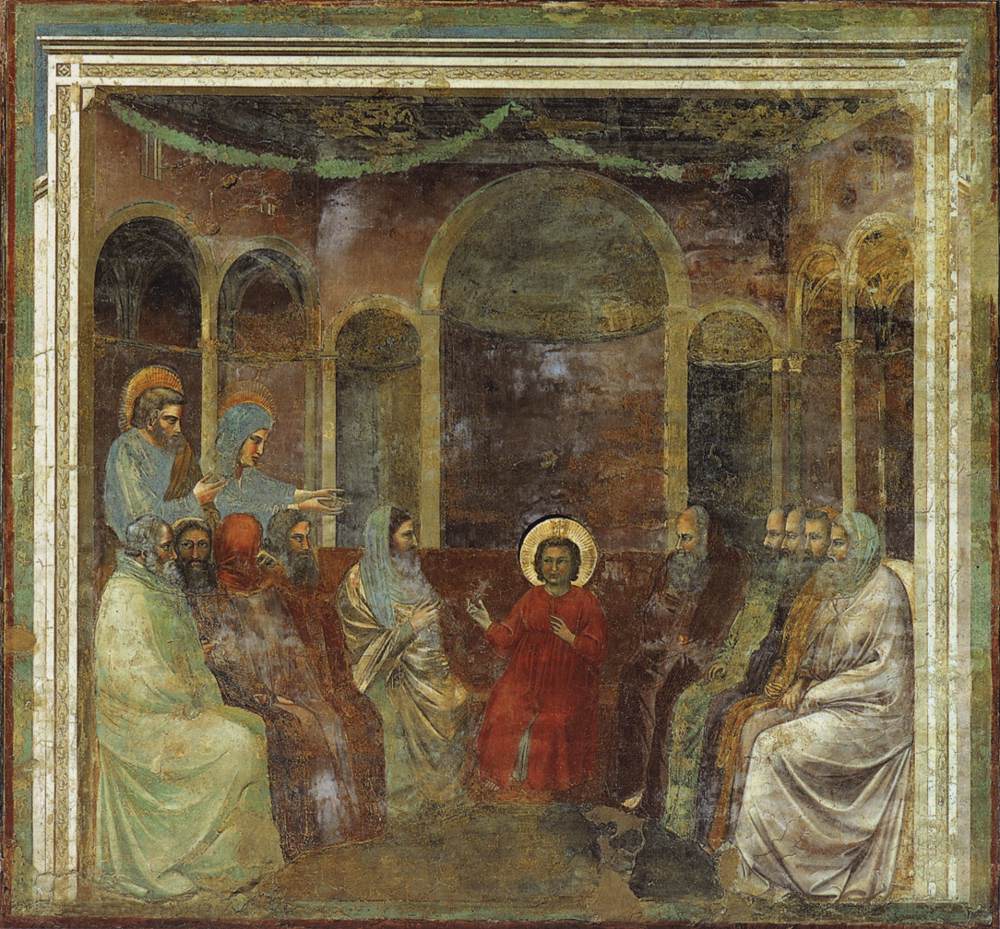
At first glance the temple in ‘The Wooers Praying’ seems to be a normally constructed ‘interior’ seen from straight ahead. A closer look shows that the roof, and in particular its forward edge, slopes very slightly downwards to the left, whilst the altar-front runs softly, but quite definitely upwards in the same direction. Moreover, the receding lines of the coffered ceiling run with a considerable bias to the right, instead of evenly towards the centre, whilst the two inner walls clearly reveal a similar distinction. The left-hand wall is demonstrably less foreshortened than that on the right. Its forward edge all but encloses the small subsidiary semi-dome, the counterpart of which upon the other side is almost evenly cut in two. All these small distinctions lead to one conclusion. The seemingly frontal surfaces of the building are, in fact, softly, but quite consistently receding to the left, as if away from an observer standing a little to the right of its centre line. The construction is coherent in itself. Its repetition in the scenes on either side precludes the possibility that these slight variations are due to accident and not intention. The buildings are, all three of them, not frontal, but oblique.


I remember being thrilled by this series 40 years ago when I saw it in Padua, and the mystery of it still excites me. That little chapel is some kind of holy place and the priest is some kind of magician.

Looking at the reproductions before reading White's text, I was looking for differences between the chapels in the three paintings. The coffering in the ceiling is a bit more pronounced in the middle scene, but that's about all I could find.

And I certainly didn't notice that the top and bottom edges are not parallel, the frontal plane recedes softly to the left, and the viewer is sited a little to the right of center.

So I appreciate the subtlety of White's observation on that feature.

But did Giotto arrange it this way because he considered the oblique to be more progressive than the frontal?

Or was that off-kilter arrangement done to enhance that sense of mystery which I have felt so strongly?


The same minimal recession of surfaces which seem to lie completely in the wall plane also appears in the balcony seen in ‘The Wedding Procession of the Virgin’. This time it is an apparently foreshortened frontal building which turns out to be obliquely set.


Since we can clearly see that receding right wall, how could that ever be "an apparently foreshortened frontal building"?

And doesn't the anomaly of that enormous leaf overwhelm whatever sense of space is created by the building behind it?


Between the two poles of the very sharp and of the very soft oblique constructions lies the middle way adopted by Giotto in the fresco of ‘The Golden Gate’. In this scene an architectural composition of the first importance is experimented with, only to be developed in a very different manner in the subsequent fresco of ‘The Presentation of the Virgin’ , which has. already been considered in some aspects.


The composition of both scenes is similar in essence to that of ‘The Mourning of the Clares’ in S. Francesco at Assisi. There, however, both the faces of the church recede quite steeply, and its disposition as a whole stands in contrast to the firm horizontal of the bier, which lies parallel to the fresco surface. This slight weakness of connection in the parts is gone. At Padua the two elements of the composition are finely co-ordinated in both scenes. In both, the figures move convincingly over the bridge, or up the steps, at right angles to the main architectural mass. There is nothing to confuse the clarity of space or motion. Beyond these basic similarities of composition the two Paduan frescoes differ fairly widely. The recession of the main face of the architecture in ‘The Meeting at the Golden Gate’ is softer than in either of the other scenes. The continuous vertical of the right-hand tower, which forms the principal spatial accent, is so close to the border that long lines running downwards to the right, like those in the upper part of the Assisi fresco, are avoided. No devices are required, as in ‘The Presentation of the Virgin’, to soften a too strongly thrusting spatial block. The association with the surface accent of the frame is close enough to render them unnecessary. At the same time the fact that ‘The Meeting at the Golden Gate’ lacks the complexity of jutting shapes, which characterize both ‘The Presentation of the Virgin’ and the opening fresco of ‘The Refusal of Joachim’s Offering’ , gives it a correspondingly calmer spatial quality.


Comparing the the disposition of the buildings represented in those two paintings from Assisi and Padua, yes, they may be essentially similar.

But their roles in the composition are quite different.

In the "Mourning of the Clares", the facade is like a weeping face, with the mourning Clares flowing out, like tears, from the doorways. In the "Meeting at the Golden Gate", the twin towers buttress the two figures who are meeting between them to kiss.

And what does White mean by "slight weakness of connection in the parts" of the Assisi painting? Does this refer to whether the architecture appears to be solid -- or is White introducing a discussion of aesthetic quality (i.e., whether the design seems strong or weak)?


It is worthwhile to pause at this point, and take stock. So far only those frescoes, containing the prologue to the life of Christ, which occupy the upper row on the side walls and on the linking choir arch, have been considered. Within these limits Giotto’s architectural compositions can be divided into four main groups.

The first is made up of foreshortened frontal compositions. In these the earliest method of creating space whilst stressing the flat surface is still used.

The second is composed of the extreme oblique constructions. These also appeared alongside the earlier foreshortened frontal type at Rome and at Assisi, marking a new departure, a new emphasis on realism. At Padua, however, there are indications that the inherent compositional conflict, which grows step by step with the increasingly successful counterfeiting of solidity, has become something of a problem to the artist.

The third group is that in which it seems as if the artist wishes to retain the surface-stressing harmony of a frontal setting without entirely sacrificing the realistic connotations of the oblique construction. The outcome is a make-believe foreshortened frontal, a minimal oblique setting, which has the formal qualities of the first group, yet recognizes the conception of the realities of vision which is the basis of the second. The extreme delicacy of the four times repeated construction, noticed only by a minute fraction of the thousands who pass through the chapel, is alone strong confirmation that Giotto was himself actually conscious of both the formal and the realistic qualities of the new perspective patterns.


I was certainly one of those many thousands who didn't recognize the minimal oblique setting -- but I bet that I wasn't the only one who was thrilled by the sense of mystery that it created.

And what is the "inherent compositional conflict"?. Harmony need not be "surface stressing".

White has taken the leap from categorizing architectural presentations to making assertions about the compositional intentions of the artist without including any discussion of the narrative being presented.

That is the fundamental weakness of his argument.


Finally, in the single fresco of ‘The Meeting at the Golden Gate’ the artist makes use of a moderate oblique construction. This becomes the basis of the system used throughout the remaining frescoes of the chapel for all buildings seen from the outside.

The new compromise, which represents a genuine middle ground in the tug of war between the demands of realism and of surface pattern, is well represented by ‘The Last Supper’. This not only becomes a standard pattern in the scenes from ‘The Life of Christ’ in the lower registers at Padua, but is still used for the later work in the Peruzzi Chapel of Sta. Croce which marks the peak of Giotto’s achievement in those frescoes that survive.


The essential features of ‘The Last Supper’ , which are so often repeated both by Giotto and his followers, are twofold. In the first place there is no ambiguity; no doubt that the whole building is obliquely set. The downslope of the roof-ridge and the gutterboard, and the upwards recession of the bench on which the figures sit, backs turned to the beholder, are as clear as they are gentle. In the second, the building is now brought into the closest possible association with the surface of the wall, to which it is so nearly parallel, that is compatible with clarity.
The same desire for spatial realism in harmony with the flat surface, which seems to underlie the growth of a clear preference for architecture set obliquely in the picture space just at the moment when the formally aggressive tendencies of such a setting were being smoothed away, leads Giotto, at the same time, to important modifications in the structure of interiors.


Norris Kelly Smith noted that:

"..for even Giotto had not been able to infuse that quasi-liturgical subject with the kind of narrational intensity that distinguishes most of his Paduan frescoes. It is the most inert of all his compositions"

While I've noted that curious, but realistic, phenomenon of the disappearing foremost pillar, and that the P.O.V. is outside the chamber.


In the fresco of ‘Christ Teaching in the Temple’ the internal spaciousness is greater than in any of its precursors. There is abundant head room for the figures, and the outer limits of the sides and ceiling of the main space only just remain within the borders of the fresco frame. The latter actually cuts short the vaulted side aisles that appear to left and right beyond the arches closing in the central room.


The scene is an exceptional achievement even for Giotto. It is seen from a position slightly to the right of its mathematical centre, in conformity with the placing of the most important figure, that of the young Christ. The firm arc of seated priests and elders curving back into the space, carves out the reality of enclosure and defines it in a single movement. Nothing more is needed. Overhead, across the whole top of the scene, are hung two green festoons. They lie in the most forward plane, caught at the ends and centre of the foremost edge of the ceiling. The swinging curves, living completely in the plane, are echoed by the hanging top line of the arches running into depth. The very architecture of the room’s space mediates between these green catenaries upon the surface and the spatial figure curve which it encloses. This interplay of pattern on the surface and in space grows more exciting still when it is seen that the festoon upon the left hangs right across the principal three-dimensional join, where ceiling, back, and side walls meet. It is completely hidden. The same thing happens on the other side, and although the crucial point is lost beneath an area of damage,a continuation of the lines of wall and ceiling shows that the small, lost part of the festoon would have completely masked the spatial accent. The rectilinear coffered ceiling has its purpose in the definition of the architectural structure, but it is not allowed to add a harsh, unwanted emphasis to the sufficiently emphatic space created by the figures and by the softer double curve of arches. Instead a purely surface accent softens the spatial pattern of the ceiling, and ties the whole design together. The interplay, and actual visual equation, of curves lying on the surface and curves set in space lead to a full appreciation of their dual function as essential elements both in the three-dimensional realism, which gives immediacy to the story, and in the creation of the decorative pattern which transmutes the dead face of the wall into a living thing of beauty
.


Those green festoons also echo the arms of young Jesus, and both the arms, festoons,
and the child savior's arguments all share a certain light, almost playful quality, and the festoons, like the arguments, have gone right over the heads of the audience.

BTW, when White declares that Giotto's reconciliation of spatial illusion with surface pattern is an "exceptional achievement", he sounds more like a critic of his contemporary 20th C. abstract painting, than an historian of the early Renaissance.


The scene of ‘Christ Before the High Priests’ shows the achievement of essentially the same result by opposite means. The space enclosed is principally defined by the repeated, unbroken orthogonals of the ceiling beams. As compensation, the figures are aligned much more across the surface than in the previous scene. A different device is this time used to stress the unity of space and plane. The central moulding, which runs across the back wall just below the windows, then turns round both corners and runs forwards on the side walls to enclose the entire spatial content of the room. This cornice, stressed by a colour change, is almost a single, mathematically straight line. Potentially a major spatial accent, it is used to emphasize the surface qualities of the design. In addition, it gives formal being to the dramatic unity and tension of the scene. It becomes a bar linking the heads to, gether in its grip, vibrating under strain.

These ambivalent elements in Giotto’s designs are distinguished from the occasional, chance occurrences of similar features in the work of other artists by their consistent use, their compositional prominence, and their close association with emphatic space. It is the strongly three-dimensional quality of the compositions in which they play an important part that gives them their particular significance.


Is the enclosed space "principally defined by the repeated, unbroken orthogonals of the ceiling beams" ?

Above, I've removed those beams, and the space of the room beneath them doesn't feel any different to me.

As an area of great interest that stops the eye, doesn't facial expression also affect how we read space?

And the interaction of facial expressions seems to be the main event in this scene.

The space of this room seems to be defined by two vertical, triangular wedges.
On left, the forward edge is the figure of Christ; while the forward corner of the priest's knee and platform is the forward edge on the right.


Another fine variant of this newly evolved compositional method is ‘The Wedding Feast at Cana’ . The depth is very calmly indicated by the L-shaped table, since its angle is filled in, masked by the figures, whilst a line of wine jars lies across the surface on the right. The canopy that crowns the walls reiterates the spatial content of the scene, although here again the effect is modified. The finials and the ornamental vase, which decorate the upper edge, are made to form a constant link between the architectural design in depth and the flat band that frames the scene. Between these areas of controlled spatial definition above and below, the fresco is divided horizontally at the top of the striped wallhanging. The sharpness of the colour contrast makes this demarcation line a striking feature of the composition. Once again it is a case of emphasized ambivalence. The line, which as before encloses the whole room space, turning through a right angle at each corner of the wall, s shown as being practically straight, repeating the near horizontal disposition of the heads below. The slight depression in the wings, almost invisible in reproduction, is, however, balanced by the soft, but noticeable upturn of the diaper moulding higher on the wall. This forms a visual transition to the firmly space defining angles which distinguish the orthogonals and transversals of the ceiling canopy.


One might also notice that the POV is right of center, closer to the Virgin, while the bride is in the center of the scene -- making for a nice contrast between who's important and who's really important.

There's a gentle humor about this scene, as the big round shapes of the wine jars are echoed by the groom's belly, and Christ is explaining something to an attentive young woman on the left.


The mention of the transversals of the ceiling canopy leads to an interesting and historically important point. The banqueting hail definitely appears to be rectangular in plan. The two sections of the L’shaped table are parallel to the walls, and it seems reasonable to suppose that these arms are set at right angles in the normal way. The canopy above is so disposed, however, that the forward edges of the wings are shown receding softly downwards to the left and right. In the ‘Christ Before the High Priests’ it is noticeable that the throne is set obliquely, whilst its back shows that it is conceived as running parallel to the side wall, if not actually attached to it. The same phenomenon is visible in the ‘The Approval of the Rule’ at Assisi and occurs quite frequently both there and elsewhere. The ceiling canopy of ‘The Feast at Cana’ is, however, the first clear-cut example of this tendency to apply to architectural details the rules of natural vision based upon the turning of eye and head to look directly at the various separate objects in the field of vision. There is no other case of it in Giotto’s extant work. But when the story is continued in the paintings of Giotto’s followers, this detail will emerge as the first signal of a long, significant, and historically important development. It is a tentative beginning, and in itself may, or may not be a deliberate experiment. About the subsequent growth of the idea there can be no doubt.


I can feel this head turning to see the architecture in this painting, but it also seems to be the case with the two canopies on either side of the Joachim expelled from the Temple.


The foregoing analyses of Giotto’s Paduan frescoes fall into a definite pattern. If they are individually correct, and are, which is even more important, truly representative of the forty or so required for complete coverage, the pattern will help to build up the larger picture both of Giotto’s own life’s work and of the history of art in Italy as a whole. In doing this it will confirm the validity of its own line of growth.

The general configuration in Giotto’s case is that of a steadily increasing harmony between. the flat wall and an ever more ambitious spatial realism. This pattern is supported by the presence of a similar concern in the arrangement of the figure design. It has often been remarked that the position of the figures on the surface in relation to each other and to the compositional diagonals and other lines and subdivisions, which express the inherent geometrical properties of the pictorial rectangle, is as important as their individual solidity and their interaction across convincingly described pic tonal space. The trend of Giotto’s ideas is equally stressed by the flat marbling and low relief of the architectural framework, which combines with the reality of the wall in a way that is entirely new. Realism is intensified, and at the same time an attempt is made to avoid the destruction of those qualities which the less realistic decorative art of earlier centuries possessed in such abundance.


This pattern of development reflects the fact, confirmed by recent technical investigations, that work in the Arena Chapel was started at the top and steadily continued downwards. This was the usual course, for purely practical reasons, and the non-existence of cartoons in the fourteenth century makes it unlikely that the order of conception was reversed in execution. Finally there is the fact that the perspective constructions grow increasingly consistent as the lower registers are reached.


Here's a painting from Assisi.

Is there any painting in the Arena Chapel that shows greater "harmony between the flat wall and an ever more ambitious spatial realism."?


‘When all these observations are considered in relation to the later frescoes of the Bardi and Peruzzi Chapels it becomes clear that the direction of development at Padua cannot be reversed.

The history of the emergence of the oblique construction in the final quarter of the thirteenth century, and the characteristics of the artists using it, led to the conclusion that its basis lay in natural observation. The fact that it later comes to be the standard pattern used by Giotto seems to increase the validity of this conclusion. The oblique construction is, indeed, used by him in fully seventy-five per cent of the architectural compositions at Padua. That is to say, three times as often as all other settings put together. In his approach to narrative and to the human figure Giotto concentrates all his attention upon fundamentals. The probability is, therefore, very strong that this predominance of one particular spatial pattern is not a mere coincidence. It is rather a reflection of his passionate interest in reality as a foundation for the ideally ordered world that is his art.


The close connection of the two phenomena is witnessed by the singular lack of pattern prototypes available to the artists who espoused the new construction. It is not a question of the increasing use of an already common pattern. Amongst the hundred or so Italian panels painted before 1300 in which architecture appears, there are no examples of a normally seen oblique construction.


Here's an architectural detail from Cavallini in 1291.
(to which White recently referred)


Isn't this a "normally seen oblique construction."

And how would White distinguish between the "normally seen"
from any other way of seeing?

This is the first time that the notion of "normal" seeing
has entered his discussion.

And how did "The history of the emergence of the oblique construction in the final quarter of the thirteenth century, and the characteristics of the artists using it" lead us to "the conclusion that its basis lay in natural observation." ?

Might there be any other reason for the use of the oblique construction ?

One might also notice that Giotto's figures have a greater sense of weight and volume than can be found in the work of his predecessors. This gives them a different, more earthy dramatic quality. Wasn't the oblique construction of the architecture a more consistent setting for the figures he would place within them?

And is it only a coincidence that his more earthy figures make their first appearance in the home church of the down-to-earth Franciscans?


In discussing the work of the great late thirteenth and early fourteenth century artists the conflict with the plane surface, which emerges as the component parts of the pictorial world take on increased solidity, has been treated as a problem not merely in retrospect, but as one which existed for the artists themselves. At Assisi the balance was restored by an extension of traditional ways of building up a decorative surface pattern. At Padua the manipulation of perspective itself was the means by which the troubles which resulted from its use were remedied. It is always difficult, however, to make the jump from the visible records of achievement to the sometimes conscious, and often unconscious mental processes behind them. There is always the danger that the mental process belongs to the modern analyst, and not to the long dead artist. It may, consequently, prove revealing to move for a moment right outside the stream of Western art.


White's concluding remarks about the different solutions at Assisi and Padua to the "problem" are not supported by the previous text.

But nobody can dispute that "It is always difficult to make the jump from the visible records of achievement to the sometimes conscious, and often unconscious mental processes behind them".--- especially since White is prone use the language of mid-20th century art criticism to discuss paintings made 700 years earlier.


It is generally agreed that in Islamic, and in Chinese art the decorative surface is of paramount importance throughout all the periods of highest and most characteristic achievement. That is, until the imitation of western models finally changed the direction of the traditional currents. In both arts the representation of certain aspects of the natural world is nevertheless carried to dazzling perfection. The formal problem, if it is not simply a contemporary one, should therefore be reflected in these arts, and the solutions found may throw some light upon the history of art in Italy from the late thirteenth century onwards.


Unfortunately, White begins his discussion of Islamic and Chinese painting with two problematic assumptions and he is not going to offer us any examples.


Fan K'uan ,Sung Dynasty


Jacob Isaackszon van RUISDAEL

Is the "decorative surface" really more prominent in the Sung painting than in the Dutch Baroque? If so, I have no idea what that phrase might mean.


Tale of Genji, Early 17th C., Japan


In Islamic miniatures the surface stress is positive. Flat areas of brilliant colour are left sometimes unadorned, and sometimes sprinkled evenly with delicate designs of flowers or with the carpet-makers’ geometric patterns. The gorgeous butterfly designs of text and illustrations are the formal outlet for that same burning directness which is characteristic of the Mohammedan religion and of so many of its middle eastern variants and forerunners.

In Chinese art, on the other hand, the surface emphasis is negative rather than positive. It is in close accordance with the calm acceptance, the contemplative natural mysticism, which reached its highest flowering in Taoism. The surface is left undisturbed. Colours are few, and soft. Ink, and delicate monotone washes are the characteristic media. Spiritual and decorative qualities are valued high above imitative naturalism, the evocative above the representational. Art stops short long before the plane can be disrupted by geometric space or obtrusive solids. The unmarked silk, or paper, is at once the atmosphere, the space, and the inviolate decorative surface. Only in certain Buddhist works such as the great series of paintings in the distant caves of Tun Huang, which depend, with Indian mediation, upon patterns which originated in the Hellenistic world; only in these relatively few examples is there any radical departure from the general rule.


Poles apart as Chinese and Islamic art may be in many ways, they are alike in carefully eschewing just those patterns which, it has been suggested, are spatially the most aggressive of those used in western art. The box interior, with its too insistent recession of floor, ceiling, and side walls, is avoided equally by both.


I've offered an example of a Japanese screen as a "positive" surface that is much closer to Chinese than Islamic culture.

Also, it offers something of a box, although it's one that is seen from above rather than from within.

But I won't respond to White's brief discussion of Asian art any further.

He introduced it so that he might claim that his "problem" of spatial realism versus surface design was universal -- but I still have no idea what that problem might be.

Every mark that is placed upon a surface needs to be incorporated within a design if the finished piece is going look good -- and nothing, other perhaps than a square of flat, even color, is without some illusion of space.