Art practice is now understood primarily as a vehicle for the reflection of modes of reception and theory rather than as a mode of making…Paul Crowther
It is improbable that more nonsense has been written about aesthetics than about anything else: the literature of the subject is not large enough for that (Clive Bell)

Index

*********************
*********************
The Index is found here
*********************
*********************

Friday, June 17, 2022

Rise of Landscape Painting in France - the catalog: Bazille to Corot


This is an itemization of the paintings shown in the 1991-1992 exhibit:

"The Rise of Landscape Painting in France"

The commentary was written by students of Kermit Champa

…………………………


 as installed in the Dallas Museum


Frederic Bazille


 Frederic Bazille (1841-1870), Beach at Sainte Adresse, 1865, 23" X 55"

The text notes that "Monet literally conscripted Bazille into landscape painting" - and took him to the Normandy coast where he offered advice and possibly re-touching on the above piece.

"It shows in its large areas of comparatively unmixed color and the apparent energy of its brushing a great deal of familiarity with Monet’s example and and Monet’s current enthusiasms for Manet’s seascapes"


In a way totally unlike the treatments of light and movement developed by landscape painters of earlier generations, Bazille strives in the Beach at Sainte Adresse  for a quick and forceful communication of his effect. Even though he composes with boats and figures, he concentrates his effort on a clear yellow/orange, blue/green color chord (initiated from red ochre) which is delivered powerfully and without much distracting detail.


Bazille, Self Portrait , 1865-66

One of my favorites at the Art Institute of Chicago.

Portrait of a sharp young man.


Edouard Manet, The Kearsarge at Boulogne,  1864


Claude Monet, Seascape, Storm, 1866-1867


It's difficult to imagine how Bazille's seascape (shown at the top of the post)  might appear on a wall instead of a computer screen.

On the screen, the  left and right sides feel like two separate paintings. And it feels more like a myth or fantasy than a  view of a particular shore and boat. There's a strange light on the sea and an ominous darkness in the sky.


It doesn't have much in common with Monet or Manet.

It’s closer to the late 16th C. piece shown below:


Tintoretto (?), Christ at Sea of Galilee


Bazille: Western ramparts of  Aigues-Mortes, 1867


This fine piece, however, seems to have Monet written all over it - even if Monet wasn’t there.

It was not included in this show - but it can be seen at the National Gallery in D.C..

********************


JEAN-ACHILLE BENOUVILLE (1815-1891)
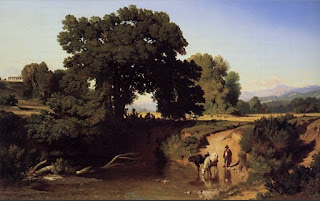


Roman Countryside, 1843


This piece was discussed in the previous post.  For Fronia Wissman,  its late date exemplifies the tenacity of the French landscape tradition.  The catalog text notes that it  strays from those conventions by presenting ordinary rural folks.


It feels to me like a well made stage set. A spotlight has been pointed at the cattle and cowherd standing by the stream.  


Catalog text also suggests that the large tree was borrowed from Rousseau and the patches of shadow from the English school.


Jay Moore, The First of Many, 2020’s ?


Denise Antalya, Puddles, 2019


Joseoh McGurl, Evening comes to the Tuscan Hills, 2010’s ?


The "commitment to a degree of precision and detailed craftsmanship" that later painters "would forego in favor of greater immediacy" did not vanish with the advent of Impressionism.


Above are some similar examples of contemporary landscape painting. Regretfully,  their work has less chance of entering a museum of contemporary art than the rubbish bins or cigarette butts that occasionally win the Turner prize.


*******************

EUGENE BOUDIN (1815-1891)


Boudin, Beach at Trouville, 1865


the drawing is so electric and the figures so theatrical.

The strange girl on the left could have been done by Gertrude Abercrombie.

Boudin paints the wind ... as well as the light.


 Here's another variation.

The sky is quite similar; the figures have been rearranged.

 Loneliness or isolation also feels like a theme.

The theatrical set-up is quite academic. (Which is not a bad thing)
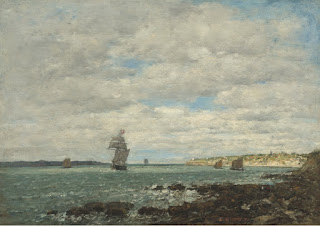


Boudin, Coast of Brittany, 1870


It is a beach life still sufficiently unsorted socially to have remained a comfortable ambience for serious painters, including (besides Boudin) Courbet, Jongkind, Monet, and Whistler. Advanced artists and the touristically adventurous urban bourgeoisie stood together for a moment on the tidal beaches of Trouville, Deauville, and elsewhere- their feet plant~d semifirmly in the sand and their eyes trained either on each other or on the continuous horizon of the open sea. It is this horizon line, with a sandy floor and a cloud-filled ceiling, that seems most consistently to initiate Boudin's particular means of imaging. He hangs (in the most characteristic of his early beach works) his figures, their tentcabins, their horses and wagons, on the horizon line. Everything seems more attached to it than to the softly changeable sand. In an almost Japanese way, the shapes of figures and of things seem to stand or move without weight or substance of any sort. They are small colored patterns, alone or in groups, stretched from one side of the picture to another. Boudin seems extremely fascinated by the often caustic interaction between nature and the man-made, chemically dyed fabrics of Second Empire beach dress. Here he indicates a taste for the chromatically unpredictable that is quite likely informed by the art of the schematically colored Japanese woodblock print. This is a taste he will pass on directly to Monet. But what is ultimately most remarkable about the Boudin beach scenes is the manner in which they overturn anticipated conventions of landscape imaging- conventions still respected by Corot, Daubigny, and Courbet. No longer is the "ground" (where things stand) dark and the sky light; both are light in tone, and this lightness above and underneath increases the tempo of the seeming dance of variously tinted shapes across the horizon. Boudin's palette is uniquely fresh in the landscape practice of the early 186os, and its freshness resides not just (as Daubigny's does) in high values, but in the combination of those high values with a wide range of intense, pure hues. It is the palette from which Monet will begin.


 Boudin, Fishmarket at Honfleur, 1865

 Murky, claustrophobic, sentimental  ... an isolated self amidst the maelstrom


Boudin gradually substitutes a nervous sketchiness of touch for the flatter and more optically focused animation of earlier work. A more oldmaster form of painterly touch appears in works like this exhibition's Fishmarket, Honfleur, to make the excitement of Boudin's way of seeing somewhat easier for the spectator to comprehend and accept.

\


Constable, Brighton Beach, 1824


Most of what is quoted above would also apply to Constable’s beach scene.

It also has the bright colors of beachwear and a strong horizon.

Though  the Constable is more about the scenic view, while  Boudin is more interested in the people.


**********


JOHN CONSTABLE (1776~1837)
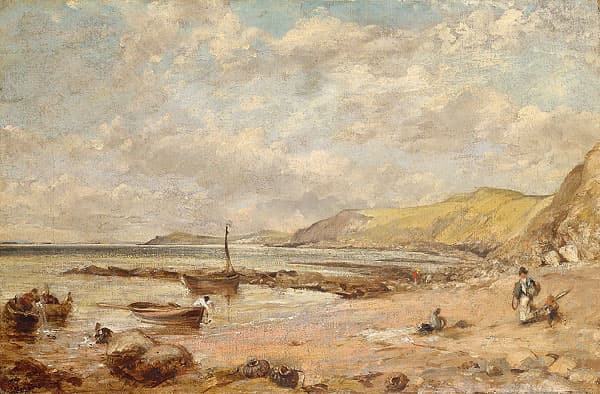


Constable, Ossington Bay,  c. 1824


Constable, Dedham Lock and Mill, 1820


Constable, Dell at Helmington Park, 1826-1833


 Constable, Hampstead Fields Looking  West, 1821


Thomas Gainsborough, who had in the 1780s developed a monumentally personalized form of landscape painting that was almost totally improvisatory in character. It evoked landscape sensation without attending very closely to any actual topographical particulars. Gainsborough's landscapes were highly processed memory images, leaving nature, as a sum of specific sensations, virtually out of the picture. Constable undertook to bring nature back in, and to bring it in with an emphatic form of descriptive clarity. This did not mean that he was ever to be a painter of details, but rather that he would manage in a wholly unprecedented way to construct paintings that seemed to match painted color with natural light. In order to do this, he sketched (in oil) out-of-doors as a matter of routine, and his sketches served to guide the order and number of color steps that appeared in "finished" large-scale works intended for Royal Academy showing.


Gainsborough, Connard Wood near Sudbury, 1748
(this may not have been the best piece to compare with Constable.  It was made at the beginning of Gainsborough's career -- and Constable's uncle once owned it)


Gainsborough; Connard Wood above; Constable- Dedham Lock below 
(Palettes as sampled from internet images)


Gainsborough, Returning from Market, 1771-2

 Here's a later piece that feels less attached to a specific place - and has more green in the palette.
It being in Cincinnati, I've seen it many times - and always felt it was soporific - even if grand.


When two of Constable's "finished" large landscapes appeared in the Salon of 1824, they caused a considerable stir, largely because their rendering of light was so convincingly complex. Recognizably natural landscape coloration was set forth by painted greens, reds, blues, and yellows that were clear in hue and often highly saturated in value. No colors were simply a single value, but a series of carefully adjusted values leading to the most forceful statement of the hue. More about the appearance of landscape emerged than had ever been seen in painting before. This was viewed as an exciting accomplishment by the entire group of French landscape painters who would come to the fore in the 183os and 184os. Yet their excitement was mitigated by the suspicion that too much of "feeling" had been left out of Constable's imaging practice and that too much of "science" had been allowed to replace it. The somewhat ad hoc character of Constable's highly innovative paint construction showed no obvious style, and for eyes still sensitive to and appreciative of the poetry of style in French classical landscape- particularly Claude Lorrain's, or in later seventeenth-century Dutch examples - the shock of Constable was ultimately too great to produce a continuously positive effect in France.


Constable.  Weymouth Bay,1816-7


Looking at Constable's work today, it is difficult to reconstruct the sense of shock his paintings initially produced. Images like Dedham Lock and Mill or Branch Hill Pond remain crisp in the coloristic and topographical effect they deliver, but they seem to have a strongly picturesque side as well. Although he adjusts his motifs relatively little in terms of spectator directing schemes of alternating light and dark, Constable nevertheless uses just enough contrast to guide the viewer comfortably into the picture and through the variety of landscape attractions. Perhaps more of the original sensation which Constable's work produced remains visible in oil sketches like Hampstead Fields Looking West or in a pre-1820 oil like Weymouth Bay. In images like these, the poetically less-processed side of Constable still stands distinct. The color harmonies are unexpected, emphatic, yet ultimately natural in feeling. Even though they have never appeared before in painting, they begin after a time to look right and to feel almost inevitable. The effort is somewhat analogous to the roughest and most excitingly unexpected ·of Beethoven's progressions of musical harmony.


Those Constables do feel less processed than Gainsborough. They also feel less aristocratic.

More like a portrait of the land than some kind of daydream fantasy.


***********


COROT


Art Institute of Chicago, Oct. 6 - Nov 13,  1960

142 paintings, 27 drawings, 55 prints


This was the last time Corot got a retrospective in Chicago. I was 12 years old - and we did not drive up to see it.  A few years later, I began viewing Corot at the Taft and Cincinnati Art Museums.


“ COROT is both intentionally and appropriately the star of the present exhibition".

That’s odd, isn’t it ?  With his preference for light and color over subject matter, Monet is a great hero of Modernism. The uncredited author(s) of this essay go on to explain their preference for Corot - and I agree with their arguments and probably share their feelings.  I have never loved Monet as much as  Corot.  Perhaps I share his predilection for  wistful melancholy.

As a landscape painter, he stands alone in this period in the breadth of his achievement.  Yet to modern eyes, Corot's range can seem narrow.  His has in the consistency of its general asproach perhaps too few of those surprises which might merit the highest forms of modernist compliment. There are no "breakthroughs"; Corot appears always to have known (more or less) what he wanted to image and to have possessed the means to manage it. The nervousness, the theatrical personalisms, the frontal ego that we so admire and seek in the most honored of nineteenth- and twentieth century work is hard to find in Corot. In this sense, he seems not of his time or, by extension, of ours. More than any other modern artist of note, Corot managed, or at least seems to have managed, what the great German philosopher Friedrich Nietzsche so prized among philosophers: the ability to stand apart from and above contemporary life, so as not to be dominated or limited by its prevailing habits of feeling (and of knowing) . The landscape world that Corot imaged is only partly "real" in terms of actual time and place. But that is not to say that its "non-real" aspects are precisely modeled on nostalgia for a lost Arcadia any more than they are simplistically longing for an impossibly innocent future . At base, "nature" for Corot is what he wants it to be; he makes it behave according to his wishes. His is a radical art only in its peculiar aesthetic refinement and in its refusal to let that refinement be guided by anything but private feeling of a highly confident and consistent sort. The making public of this privateness through exhibited works and the refusal to develop any but carefully cultivated personal sensations are Corot's radical act. He makes himself public without becoming public. Political feelings exist in his art only by virtue of their absence.


 On the contrary, "Lost Arcadia" would seem to fit some of my favorite  Corots  - though they did not make it to  this exhibition:


Corot: Festival of Pan, 1855-60  (Taft Museum) (not in this exhibition)


Corot: Bathing Nymphs and Child , 1855-60 (Art Institute of Chicago)  (not in this exhibition)


Corot's relation to nature, time, and the spectator is a collectively complex phenomenon. He requires that the spectator approach his work without demanding anything specific of it besides "beauty" (that word so unacceptable to modern ears) in a virtually limitless yet always related series of manifestations. In his offering up of beauty in what is, in essence, a value free fashion- no ethics, no politics, no religion - Corot demonstrates in the very roots of his aesthetic behavior the preeminent characteristics of a romantic melomane. He is a sublime entertainer of the sensations and he never questions the worthiness of his entertainment. since it is  in its essence identical to that most valued of civilized treasures - namely live culture. Corot's spectator can be anyone who treasures culture.  His audience is, therefore, at once elite and democratic.

"Beauty" is never value free — because  beautiful forms drive us to associate them with that something - anything - that can be elevated by them.

(I put the above in large type because it's a rare declaration of my own catechism of art)
 
In the case of Corot, that would  mostly likely be the French countryside.  When he also depicts French country people, he is also elevating a meme that had been running through French painting for over 300 years. And when he throws in some nymphs, he goes back to the Roman Empire.
 
The above paintings celebrate the naturalness of  Western and French civilization - which would encompass its natural born social order. (aristocrats at the top, peasants at the bottom)

Therefore - they are political (though I cannot determine whether Corot ever said anything about the tumultuous politics of his day.

The appropriate spectator for most art is anyone who enjoys looking at it.  The importance of culture need not be an issue.


 As with the music he loved most, Beethoven's and Mozart's, the sense of time and place in Corot's painting is intensely familiar and intensely special at the same time. His landscapes suggest actual experience, but no more or less than they signal memories and dreams. At their best, the synthesis of experience with memories and dreams is perfect, and the perfection resides in the alternation of the accented and the unaccented stresses of pictorial technique - in tone and in touch, and in the softly elaborate, precisely choreographed dance of topographical and figural specifics within a given picture to the particularly rhythmical character of the stresses. Corot requires, as few other painters before him, extended spectating time. Viewers have to find their way into and through the veils of the stated and the suggested in order to grasp the sensible character of the imaged whole. The required spectating time gives nothing in terms of the quantity of what is pictured, but everything in terms of the quality, character, and feeling of the picturing. The demand for extended spectating time is perhaps the most quintessentially musical characteristic of Corot's paintings. One must look at them for a considerable time, just as one must listen through the entirety of an inspired piece of concert music. Otherwise one sees (or hears) very little of real substance.


Jacob Van Ruisdael, Cornfield with Zuiderzee in background, 1660


Thomas Cole, The Mountain Ford, 1846


I've selected two other landscapes, one by a contemporary of Corot, for purposes of comparison.

For me, Champa's analogy to music could be applied no less to them:
"The alternation of the accented and the unaccented stresses of pictorial technique - in tone and in touch, and in the softly elaborate, precisely choreographed dance of topographical and figural specifics within a given picture to the particularly rhythmical character of the stresses."

What feels especially different is the movement between the center and the edges. In Corot, energy pulls towards the center - enveloping the viewer and sheltering a private, intimate moment of delight. In Ruisdael , the energy expands dramatically outward toward the edges. In Cole, it feels static - frozen in time - like the surface planes of a crystal.


Quite remarkably, Corot's art displays its distinctive (and musical) character from an early point in his career. In a sense his art cannot really be said to develop (in a conventional way) substantially from 1830 to his death in 1875. True, there is much sorting, adjusting, and refining to be noted, but there is little alteration of basic aesthetic premises. Technique just becomes more flexible and secure as the years pass. From the time of the small, carefully constructed, Constable-inspired oil sketches of French (and Italian) sites in the years around 1830, Corot asserts his preference for working with close values and close hues (and without much contrast). Depending on his location (Jumieges, Dunkerque, or the Forest of Fontainebleau, for example), Corot would decide to work rather high or low on the scale of light values, but his combinations of high and low are cautious in order to avoid having the spectator's eye led too coarsely (or abruptly) from the painted surface into pictorial relations of space. Even in larger, more studio-finished Salon-type pictures derived from oil studies made out-of-doors and from rather schematic drawings, there is a substantially limited availability of spectator access to pictorial space evident in Corot's work -limited by comparison to prior landscape practice, including Constable's. Corot seems always to want the spectator's eye to read all relationships of tone, substance, and position with reference to the singularly forward presence of the picture surface. While motifs can often seem to convey softness in substance or atmospheric ambience, the sensations that originate in that ambience, as well as more clearly defined accents, always begin 'from the picture surface and the differentials of paint deposit left visible there.


COROT: Inn at Montaigne, 1825-30


This early piece gives no hint of the dreamy, silvery forest views of his later years.


COROT : Fishing boats at Dunquerque,  1830


Corot : Jumieges, 1830


Corot: Paver on the Chailly  Road, 1930-35


Corot:   Trinitie de Monts, 1925-28  (not in this catalog)

I've pulled in this painting from the Louvre because I like it much more than the ones in the catalog - and it also exemplifies the rest of Corot's Italian work in its aggressive horizontality.

It confronts viewers rather than inviting them into a space that tunnels into the center.

And it emphasizes the geometric sharpness of architecture rather than the blurry softness of trees and hills.


COROT : Evening, Lake and Boatman,  1839


Corot: View Near Naples, 1841


Corot: Girl beside a stream, Lormes,  1842


Corot:  Forest of  Fontainebleau, 1846


Corot: Bridge at Grez-Sur-Loing, 1850-60
 
 
Corot: Canal near Rotterdam, 1854

( the Virginia Museum of  Fine Arts, which owns this piece, has  boldly watermarked its online image. How rude!)


Corot:  Chateau Thierry, 1855


Corot: Path in the Woods, Semur, 1855-60

This piece appeared only in the Dallas exhibition.  It was lent by a local  girls school. and apparently a color photo was not available.  It. still cannot be found online.


Corot, Cabassud House at Ville d'Avray, 1855-60


I would especially like to see these Ville d'Avray pieces in person


Corot : In Monsieur Wollen's Park, 1860-65

Not much old growth timber here, but plenty of the flickering, wispy, airy excitement of the moment.


Corot: Peasants stopping at edge of a wooded road, 1860's

Corot:  Moored Boatman, 1862


Corot : Sevres-Brimborion, Road to Paris, 1864


Corot: Farm Scene, 1865 - 1868


Corot: Souvenir of  Mortefontane, 1864 (Louvre)


Corot: Island of Happiness, 1865-68


 Corot: Idyllic Spot at Ville D'Avray., 1865 - 1870


Corot : Old Bridge at Limay, 1872


Corot : The Brook, 1865-1870  (Taft Museum)


Corot : Outside Paris: The Heights Above Ville-d'Avray , 1865-1870 (Taft Museum)


Corot : Banks of the Seine at Conflans, 1865-70
(Wheelwright's Yard)

Corot : Canal in Picardy , 1865-71


Corot - Ville D'Avray (Salon of 1870)


“Remarkably Corot’s art displays its distinctive and musical character from an early point in his career. In a sense his art cannot really be said to develop in a conventional way substantially from 1830 to his death in 1875"

This would contradict those, like myself, who set the early Italian period apart from the decades that followed.  It’s a change of purpose - not just a refinement of technique.


Depending on his location (Jumieges, Dunkerque, or the Forest of Fontainebleau, for example), Corot would decide to work rather high or low on the scale of light values, but his combinations of high and low are cautious in order to avoid having the spectator's eye led too coarsely (or abruptly) from the painted surface into pictorial relations of space. Even in larger, more studio-finished Salon-type pictures derived from oil studies made out-of-doors and from rather schematic drawings, there is a substantially limited availability of spectator access to pictorial space evident in Corot's work -limited by comparison to prior landscape practice, including Constable's. Corot seems always to want the spectator's eye to read all relationships of tone, substance, and position with reference to the singularly forward presence of the picture surface. While motifs can often seem to convey softness in substance or atmospheric ambience, the sensations that originate in that ambience, as well as more clearly defined accents, always begin 'from the picture surface and the differentials of paint deposit left visible there.

"The forward presence of the picture surface" is Modernist talk -- while I would say that these paintings work to pull inward and envelop the viewer into a refreshing if not enchanted space.


The refinements that Corot's work undergoes, in the decade of the 185os in particular, appear tied to his productive decision to focus his motific reference in more geographically limited terms. Increasingly he restricted himself to studying "northern" (north or west of Paris), atmospherically rather heavy motifs in semi-river, semiforest settings. similar to those he lived with on a day-to-day basis at Ville d'Avray. In the process of developing a deep familiarity with predominantly veiled conditions of light - rarely full sunlight - Corot managed to sensitize his eye and his touch to increasingly subtle coloristic variations. Alternating between horizontal and vertical medium-sized picture formats, portraying a variety of landscape prospects, he created a series of masterpieces that combine aspects of intense looking and intense feelings experienced by looking that are both brilliant in themselves and basic to the often more improvised compositions of the 186os. In this exhibition there is an excellent representative sampling of Corot's mid-185os achievement in the paintings from Omaha, Des Moines, Dallas, and Richmond.


Wednesday, February 16, 2022

Photography and the Japanese Print in 1850--- Deborah J. Johnson


William Henry Fox Talbot, The Open Door, 1844


OF THE THREADS THAT TIE the nineteenth century into a coherent whole, none, perhaps, is more compelling than that century's obsession with issues of "objective" reality and perception. In the area of painting, particularly in France, landscape became the primary testing ground for this obsession. Landscape painting was less bound than other types by academic rules and regulations and could easily be checked against reality; and the land itself, in the face of nineteenth-century urbanization, had taken on the additional romantic appeal of a place of escape and the potential victim of extinction. While the artist might choose to work from nature or not, a certain level of verisimilitude was a growing expectation in nineteenth-century France, and artists began to search for ways to unite "objective" reality with artful perception. Many "new" arts were uncovered as part of this search, including British watercolors and seventeenth-century Dutch painting. None, however, was more significant than the tandem discoveries of photography and East Asian art, especially the Japanese print. Together, they provided artists with both the motivation and the structure to generate the profoundly new aesthetic premises of the modern age.


I'm stunned by the boldness of speculating that an entire century of human history had an specific  obsession - and I'm surprised by the  notion that landscape painting was its primary testing ground in the 19th Century.

We  may indeed note that those who now call themselves "objectivists" (the Ayn Rand enthusiasts) look to the nineteenth century French  Academy of Bouguereau and Meissonier  as the standard of truth in painting. But isn't their taste in art exceptionally narrow, insensitive, prosaic, and, thankfully, marginalized ?  And what kind of objectivism could possibly encompass a Ukiyo-e print?


Johnson will go on to make several compelling connections between photography, Japanese prints, and a few French painters of mid 19th century Paris -- but the overstatements in this introduction are not very promising.


The photograph was immediately accepted as the ultimate statement of visual truth in science and art. The "truthfulness" of the Japanese print was also lauded, however- a surprising position given the premises of decorativeness and non-illusionism fundamental to the print. Through the elements shared in common by the print and the photograph, the photograph gave impeccable credibility to the print. This, in turn, allowed access to and understanding of the print's essential abstraction . Without the precedent of photography, it is unlikely that the Japanese print (and East Asian art in general) would have captured western artistic imagination as significantly as it did.

No footnotes accompany the above assertions - and none of them are especially obvious. The use of the passive voice is regrettable.  No evidence has been offered that the emergence of both photography and Asian art in the years following 1834 was less coincidental than whatever else also emerged in those years.


Louis Daguerre, Fossils and Shells, 1839


Daguerre and Talbot are the two pioneers of photography - and they make for an interesting contrast. Daguerre produced spectacles for popular entertainment, Talbot was a gentleman with the time and means to exercise his sharp and curious mind.   "Fossils and Shells" is  packed with wonder and mystery; "The Open Door" is more casual and desultory.  You might walk through that doorway - or you might not.

The first large exhibitions of photography were under the category of "Science and Art"

Baudelaire's response is quoted as follows: "Photography's real task....is in being the servant of science and art, but a very humble servant like typography and stenography, which neither created nor improved  literature"

Johnson assures us that "the kind of photography against which he spoke, however, was that patterned after paintings he disliked equally.... sentimental, moralist, and maudlin .. heavily reliant on the realistic credibility of form for impact"

 Yet Johnson did not share any of Baudelaire's positive critiques of photography.Maybe he would have spoken differently had he seen the art photography of the next century.  Or, maybe not. 


Henri-Jean-Louis Le Secq : North Porch, Chartres , 1852

Baudelaire's quote would certainly apply to the above - one of the photos of treasured monuments commissioned by the French government to promote their restoration. Called the "Missions Héliographiques" project, Johnson offers it as a prime example of the "confrontation between aesthetic convention and empiricism" --- though here they seem more congruent than confrontational.  The camera can be used to capture the formal ideas of architecture and sculpture.  Nature, however, offers us forms, not formal ideas, so the photographer must hunt for his own. And that's  exactly what Charles Marville appears to have done with the sinuous lines of foliage and heavy masses of rocks he framed below:


Charles Marville, Fontainebleau, 1854


It's no surprise that Marville had been trained in painting and then practiced illustration for 17 years before taking up the camera. 


Charle  Marville:  Corot and Diaz on the rocks at Fontainebleu

I'm  guessing that Corot is the one at  the top - as he should be !

 This certainly proves that painters and photographers sometimes collaborated. And it's a fine photograph - presenting eruptive natural forces rather than a scenic view for daydreaming.


Hiroshige, Moon Pine at Ueno, 1857

presented as a fine example of :

"alternative pictorial structures"


It may have been Edmond de Goncourt in his book on Utamaro of 1891 who first noted that photography and the Japanese print offered certain mutually supportive pictorial systems. On the most fundamental level, both the photograph and the print presented a destabilized definition of reality, at least in terms of traditional structure. Paintings in the dominant western Renaissance tradition were typically contained and finite, the proverbial "window onto the world" in which a box of space, clearly defined by non-intrusive framing edges, presented that world as calculable and whole. In contrast, the photograph and the print presented a fragmentary view of the world based upon discontinuous forms and unexpected juxtapositions. The factors generating this fragmentary view differed.


Jacob Van Ruisdael, "View of Egmond-on-the-sea" , 1648

Here's the  most unconventional old-master landscape that I could find after a brief search. There's an unsettling contrast  between its four areas of interest (clouds, stump, tower, travelers). It doesn't really feel much like a " box of space .. that presented that world as calculable and whole". The word "destabilized" might apply.

But still it is "clearly defined by non-intrusive framing edges. It would  benefit from an elaborate picture frame.  The Japanese print would not.


The early photographer, only moderately in charge of the edges of the image, unavoidably truncated incidental objects while focusing on the real point of interest ; it is part of the genius of photography that as its aesthetic matured, "haphazard" cropping was exploited as a positive characteristic, evolving into the genres of the instantaneus and the snapshot, and eventually influencing painting attitudes. Similarly, the absence of finite framing edges in Japanese art was inherent from its beginnings in the scroll form . Within this format, space literally unrolled as narrative continuity without definitive beginning, middle, or end. As ukiyo-e developed, printmakers saw no need to restrict themselves to the small and regularized sizes of the woodblock- although the block itself might end, the image frequently spilled over onto several other blocks, resulting in similarly truncated forms . One need only compare a typically stable and timeless landscape in the Renaissance tradition from early in the century with a more random, destabilized image after mid-century to appreciate the radical shift in reality-definition this represents.


The early photographer - indeed, any photographer - is also only moderately in charge of pictorial space.  Spacial relationships can be accurately  depicted - but they  cannot be intensely felt.  They cannot express an artist's form making spirit. (even if they can  express the spirit of the sculptor or architect whose work has been photographed)

Johnson offers a full page to photography versus painting as understood in mid-century Paris. I can appreciate why "with Baudelaire, photography became the polemic with which to attack the Realist painters"  But since no visual examples  accompany the text, I will not address it. In my own view,  the highest non-mimentic qualities of photography are conceptual rather than formal, and therefore should be on temporary rather than permanent display in art museums. ( Mostly, it is )


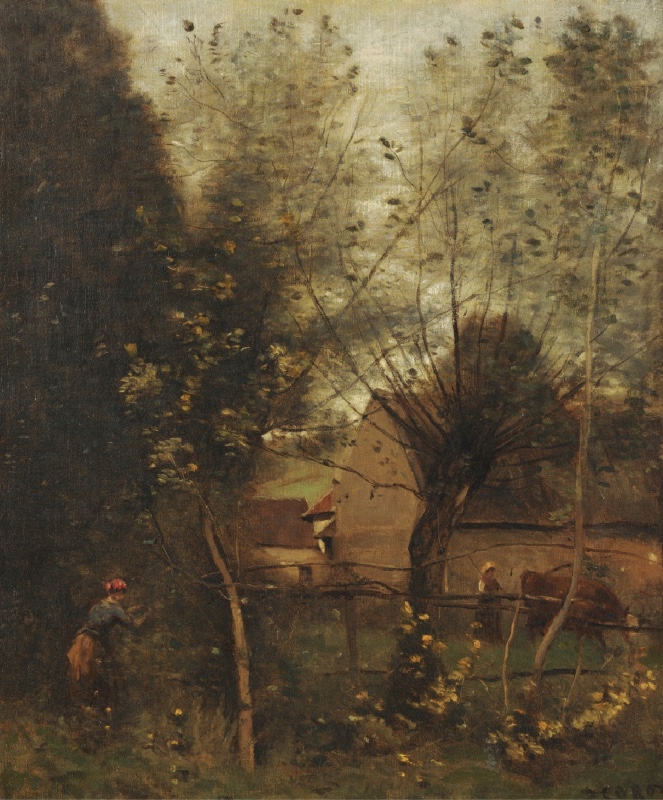
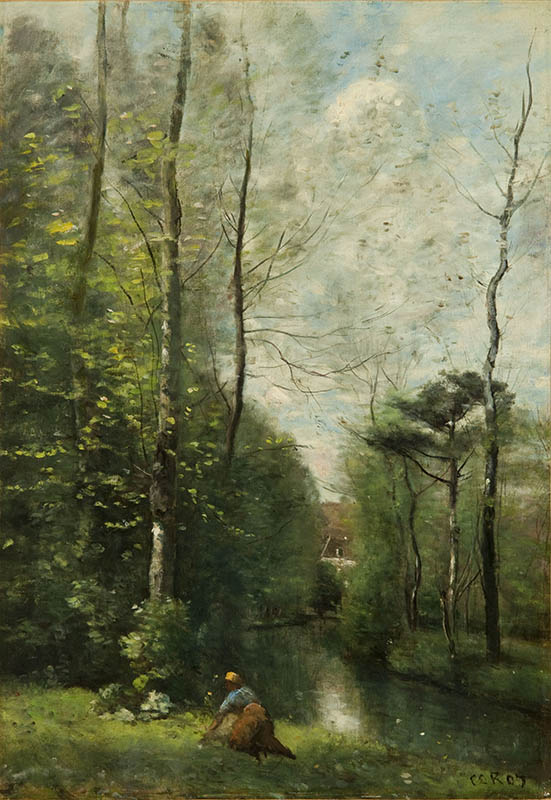
Corot, "Garden of Horace", 1854


No  painter was  more  substantively influenced by  the  principles of  photographic light  and  effet  than  Corot.  It has  frequently been noted  that  around  1848,  Corot's style and apparent  interests shifted dramatically. From an early  style  heavily  dependent   on  architctural structure,  hard-edged   linearity, and geometri­cally  based  formal   relationships,  Corot  broke through to an overwhelming concern with light effects, particularly with  light  as it dematerialized the earlier solidity  of his forms.  The result was a new and sweeping  atmospheric veil that would be impossible  to explain without the precedent  of  the  paper  photograph.  His "sacrifice of  detail"  for  a  "feeling of  extreme softness " is a virtual illustration of Le Gray 's pronouncements; but more specifically, the blurring  of leaves against  the sky and halo of light around  these  forms -the latter  an unavoidable chemical  phenomenon known  as "halation" - specifically point to the paper print with a coated glass  negative  popular  after  1850  as source.


Significantly, this technique also de-emphasized dramatic  tonal contrasts  in favor of a more even gray cast, a kind of "tonalism" that  is predomi­nant throughout Corot's middle period. The interest  in photographic light is no doubt key  to  understanding Corot's  intense  involvement  with  cliche-verre  during  this same period ; the process provided a means to test and check light and relative values as a natural phenomenon literally created by the sun. This experimentation with value and tone is the primary link among most of his cliches-verre, as well as an insistent graphic quality also apparent in his paintings at this time. In the latter, silhouettes of trees rendered stark against the sky are full of the charged and nervousmark-making exploited in the cliches-verre. Not coincidentally, these qualities were also commonly found in early paper prints in which the middle tones had been dropped out, emphasizing silhouette, edge, and linearity . In all three - Corot's paintings of the period, his cliches-verre, and early paper photographs -this encouraged a wealth of illusionistic surface incident, touch, and a kind of painterly quality that grew increasingly autonomous  In fact, it must be considered that the phenomenon of autonomous brushstroke as it evolved into Impressionism had among its immediate predecessors not only Corot, as is traditionally asserted, but the mid century landscape photograph with its rich and abstract surface activity..


In cliche-verre,  the artist manipulates a negative that will be printed, just like a photograph, onto light sensitive paper.  Typically the negative is a translucent sheet that has been coated with a black film that can be rubbed or  scratched off so that light can pass through.

It allows for a very delicate touch --- as well as an infinity of tone.  You can see above how Corot made one series of marks much lighter than the others. And where he coated one central area with a thick enough coat to totally block the light (so that the area would appear a bright white in the print)


Corot, Environs of Rome, 1866
  
 
Some of the same tonal effects were achieved in the above etching, but you can feel the greater pressure behind the lines.  They are not as light and playful,


The faint, wanton lines in this  detail of a cliche verre almost feels like a drip painting.

The effect is atmospheric - as Corot  liked to do in his paintings.


 Rembrandt created a playful variety of texture in this area of the below etching,
but the touch is uniformly firm.
 

Rembrandt, Landscape with three  gabled cottages, 1650


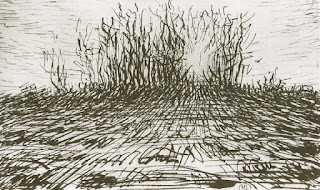
Millet, Sunset, pen and ink


Millet


 Hokusai, detail from the Manga


Nobody could have felt the humble symbiosis of humanity and nature as expressed in the Manga (Hokusai) more than Millet, who, at least by the early 1860's owned a volume from the series.

... both stressed a charged, dynamic, information-laden line.

Hieronymous Bosch, Study of Monsters, 1465-1516


Annibale Carracci, 1593


Watteau


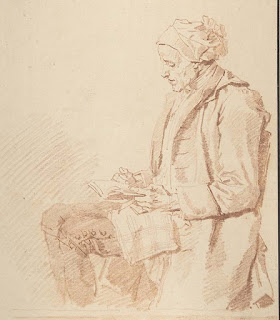
Fragonard


The point is well taken : linking Millet's drawing to the Hokusai Manga in his collection.

The "charged, dynamic, information  laden line" is not typical of  early 19th century academic or Romantic drawing - yet it might be seen in the Louvre.

It was certainly done in earlier centuries.


Utamaro, Bathing in Cold Water (detail), 1799

The "charged, dynamic" line was also not typical of Japanese prints. 

Usually you get the kind of fine, even line shown above.


Millet, Cliffs of Grenville, pastel, 1871


Millet, 1867
 

Regarding the influence of Japanese prints on Millet's paintings and pastels, I can't find examples of 

 "bright primary hues without interceding halftones"

The two pieces shown above do seem to have:   "highly keyed contrasts", "general intensity", and an "aspatial, surface oriented image by precluding modeling in depth"

But can't that be found in pre-1850  European landscape as well?


Andre Giroux (1801-1879)


Edouard Bertin (1797-1871)


Both Giroux and Bertin are about 15 years older than Millet, yet these landscapes have similar, non-academic qualities.  ( I could not find a date for these pieces)

Giroux, Forest Interior with Waterfall, Papigno, 1825-30

And here's a piece that has many of the qualities of photography and Japanese prints, yet it predates their arrival in France by nearly a decade.

(it reminds me of the romanticism of Girodet) 


There is a sense of wonder in the Millet pieces -- but is that especially related to Japanese prints ?


Millet, Meridian,  c. 1865

Millet  also seemed consciously to manipulate perspective and works which after 1865 grew increasingly strange and dramatic. Once again this was most apparent in his drawings. While the looming anatomic components of Meridian of 1865 have been compared to photographic idiosyncrasies, this type of frontal plane distortion would have been actively eliminated in the early photograph, especially in figure compositions. Instead, the unusual worm's-eye vantage point and resultant inversion of spatial recession better suggest the witty effects in certain plates of Hiroshige's 100 Views of Famous Places in Edo , well known by this date. Moreover, the figure in Millet's work has a decisive object quality - as if it could as easily be a haystack as a figure - underscoring a possible source in study of Hiroshige's landscape prints.


Hiroshige, Summer, from 100 Views of Edo


Yes, there is a playfulness of perspective in this series--- as if that was Hiroshige's main concern.


We might also assume that such spatial playfulness was intended in the drawing shown above - though, since I did it myself,  I can assure you that it was only the result of my circumstantial point of view on a reclining model at the art club.


BTW - I really like the figurative volumes in Millet's "Meridian".  It reminds me of Diego Rivera (now better known as the husband of Frida)


Millet, Entrance to Barbizon Forest in Winter, 1966, pastel and conte, 
(commissioned by Gavret).


Similarly, works like Entrance to the Forest of Barbizon in Winter  of 1866-67 rely for much of their effect on Millet's urge to flatten space. The drawing, although a reworking of earlier ideas, is also suggestive of the spirit and aesthetic of Hiroshige's popular landscapes of the 1840s and 1850s: it is resolutely vertical in its push to the surface plane, especially via chalky wisps of snow which spot the surface and in the projection of highest light from the scene's apparent background; it is redolent with atmospheric space - identified as western influence when it appears in Hiroshige - which subtly pulls against the flattening impulse; and it is evocative of the quiet, spirit-laden presence identified


I also feel both the "spirit-laden presence" and the dramatic push and pull of pictorial space.  

As a viewer, I am pulled right up to the gate of the forest - so that the foliage and  wisps of snow in the foreground are actually behind me.  It's a thrilling sensation.


Johnson's connection of Millet to Hiroshige and Hokusai is my principal takeaway from this essay.